"Belief in God doesn't deter a person from cheating on a test, unless that God is seen as a mean, punishing one, researchers say.Fairly interesting. As the saying goes: "We're not perfect, we're forgiven". It must be noted, however, that people who believe in a vengeful god may cause a lot of other problems.
On the flip side, psychology researchers Azim F. Shariff at the University of Oregon and Ara Norenzayan at the University of British Columbia found that undergraduate college students who believe in a caring, forgiving God are more likely to cheat.
[...]
No differences in cheating were found between self-described believers in God and non-believers."
ScienceDaily Apr. 20, 2011

Thursday, October 20, 2011
If you believe in a loving god you're more likely to cheat


Irreligious countries are happier
"Circumstances predict religiousness," he said. "Difficult circumstances lead more strongly to people being religious. And in religious societies and in difficult circumstances, religious people are happier than nonreligious people. But in nonreligious societies or more benign societies where many people's needs are met, religious people aren't happier -- everyone's happier."This should settle the discussion on religiousness and happiness. Irreligious people has a harder time in religious countries, but if irreligious people are the majority, then everyone's better off. The map in this post (which I think is from the Gallup poll this study is based on) is also pretty self-explanatory.
ScienceDaily Aug. 8, 2011
Saturday, October 15, 2011
More divorces in the Bible belt
"A recent U.S. Census report shows the Northeast - and New Jersey in particular - has the lowest divorce rate in America, trailed closely by New York.If you're not married you can't get divorced.
The Bible Belt, meanwhile, home to Southern hospitality, church telethons and country music, has more "shotgun" weddings and the most divorces.
"People assume that people in the Northeast divorce easily because they're less religious, but that's not the case," said Deborah Carr, a professor of sociology at Rutgers University.
In the Northeast, 7.2 per 1,000 men and 7.5 per 1,000 women got divorced. In the South, the rates were 10.2 for men and 11.1 for women.
New Jersey's rates were 6.1 for men and 6 for women, according to the 2009 American Community Survey, which released the data in August.
[...]
The South sees more divorce for several reasons, Carr said:
First, Southerners tend to marry young.
Second, couples don't usually move in together while unwed, a trend tied to religious beliefs. They often frown upon birth control, and are "more likely to have nonmarital pregnancies, which ... then trigger 'shotgun' marriages."
Third, there are simply more marriages in the South. New Jersey had the second-lowest marriage rates, just above Maine. The Census survey reported New Jersey's marriage rate is 14.8 for men and 13.3 for women."
Chron.com, September 29, 2011
A rough decade for American congregations
"A new decade-long survey of American congregations shows religious health and vitality are weaker than they were 10 years ago.
[...]
Congregations are also having hard times financially, the survey found. In 2000, 31% of survey participants reported excellent financial health. In 2010, that number plummeted to just 14%.
[...]
Roozen writes that a variety of factors led to the decline, but overall, there are fewer Americans in the pews, and "... more than 1 in 4 American congregations had fewer than 50 in worship in 2010, and just under half had fewer than 100. Overall, median weekend worship attendance of your typical congregation dropped from 130 to 108 during the decade, according to the FACT surveys."
[...]
The decline hit across religious and denominational lines, sparing no one, Roozen wrote. He said that "no single category or kind of congregation ... was exempt from the decadal downsizing of worship attendance."
The data came from Faith Communities Today surveys and represents 11,077 congregations and 120 denominations of Christian, Jewish, and Muslim traditions, the institute said."
CNN Belief Blog, September 20th, 2011
Religion in retreat in Britain
"A large-scale survey of British attitudes has been carried out by YouGov–Cambridge (a collaboration between pollsters YouGov and the University of Cambridge’s Department of Politics and International Studies) has some revealing statistics on religion. A representative sample of 64,303 adult Britons aged 18 and over responded.Lots more numbers in the article.
78% (82% of the over-55s) agreed and 12% disagreed that religion should be a private matter and had no place in politics
In response to the question “What is your religion?” 40% of adults professed no religion, 55% were Christian and 5% of other faiths – age made a major difference, with only 38% of the 18–34s being Christian and 53% having no religion, whereas for the over-55s the figures were 70% and 26% respectively
35% described themselves as very or fairly religious and 63% as not very or not at all religious – there were no big variations by demographics (even by age), but Londoners (41%) did stand out as being disproportionately religious, doubtless reflecting the concentration of ethnic minorities in the capital
79% agreed and 11% disagreed that religion is a cause of much misery and conflict in the world today
72% agreed and 15% disagreed that religion is used as an excuse for bigotry and intolerance, with a high of 81% inScotlandwhere sectarianism has often been rife
35% agreed and 45% disagreed that religion is a force for good in the world, dissenters being more numerous among men (50%) than women (41%)
[...]
Full tables can be seen here."
National Secular Society, 23 Sep 2011
Hygiene more important than religion to mothers survey shows
I came across this international survey via NSS:
 It shows that religion has the lowest priority among mothers and fathers whereas hygiene has the top priority.
Here's the full report (page 22). (See also Sca.com for more information about who produced the survey).

Here's the full report (page 22). (See also Sca.com for more information about who produced the survey).
Wednesday, October 12, 2011
Doing good is not the preserve of the religious
"This point was demonstrated yet again last week by the latest figures from the government's citizenship survey. In terms of civic engagement and formal volunteering, the figures show no significant difference between those with a religion and those with no religion (57% and 56% respectively). There is scarcely any difference in participation between those with no religion and self-described Christians (56% and 58%). At 44%, the proportion of Hindus and Muslims participating in civic engagement and formal volunteering is actually lower than the proportion of non-religious people doing so, and the lowest of all groups. This is no flash in the pan – it is a continuing feature of the figures over a number of years.Just as I've been thinking but it's really nice to have the statistics now.
The figures supplement other data that makes the same point, not only from previous years' citizenship surveys. In 2007, Faith and Voluntary Action, from the National Council of Voluntary Organisations found that "religious affiliation makes little difference in terms of volunteering", and as a matter of simple numbers, the overwhelming majority of the voluntary, community and charity sector in the UK are secular."
Guardian.co.uk, Andrew Copson, 26 September 2011
The shrinking [Christian] majority
"Britain is still a Christian country but the drift towards secularism continues.
[...]
The headline figures suggest that the United Kingdom remains a predominantly religious and mostly Christian country. Almost seven in ten (68.5 per cent) identify themselves to researchers as Christians -- far more than the 15 per cent who regularly attend church. Less than a quarter (23 per cent) profess no religion at all (although in Wales, the figure is considerable higher, at close to one in three. Of the population as a whole, 4.4% is Muslim -- more than all other minority faiths put together -- but still less than one person in 20. (The full IHS figures can be found here.)
This picture of stability may be something an illusion, however. The last time this survey was conducted, in 2009-2010, the figure for Christian affiliation was 71.4 per cent and for no religion was just 20 per cent. A movement of 3 per cent from a Christian identity to a non-religious one in a single year is potentially a dramatic one. The annual population survey, which has included a religion question since 2004, records what looks like a consistent pattern. In 2004-2005, the figures stood at around 78 per cent Christians and less than 16 per cent having no belief. "
New Statesman, Nelson Jones, 29 September 2011
America's secular revival
"Five signs that, despite the GOP's efforts, religion's impact on U.S. politics will soon decline
1. American religious belief is becoming more fractured
[...]
2. Non-belief — and acceptance of non-belief — on the rise
Last month was the first time atheists were knocked from the top of America’s most hated list, an honor that now belongs to the Tea Party. While this development may have more to do with the fact that the mainstream media’s love affair with the Tea Party is not shared by most Americans, it also dovetails with increased visibility and acceptance of atheism.
[...]
3. Growing numbers of young people who do not identify as religious
As recently as 1990, all but 7 percent of Americans claimed a religious affiliation, a figure that had held constant for decades. Today, 17 percent of Americans say they have no religion, and these new “nones” are very heavily concentrated among Americans who have come of age since 1990. Between 25 percent and 30 percent of twentysomethings today say they have no religious affiliation — roughly four times higher than in any previous generation.
[...]
4. Hate group that exploited religion to bash gays hemorrhaging funds
In 2008, Focus on the Family had to cut its staff by 18 percent. Last week, FOTF had to do another round of cuts, again citing a drop in donations (though it claims the lower funding is a result of tough economic times).
[...]
5. Getting married by friends
A study last year by TheKnot.com and WeddingChannel.com showed that 31 percent of their users who married in 2010 used a family member or friend as the officiant, up from 29 percent in 2009, the first year of the survey."
Salon Mag/Alternet Sep 29, 2011
Sunday, October 9, 2011
Rising atheism in America puts 'religious right on the defensive'
"The exact number of faithless is unclear. One study by the Pew Research Centre puts them at about 12% of the population, but another by the Institute for the Study of Secularism in Society and Culture at Trinity College in Hartford puts that figure at around 20%. Most experts agree that the number of secular Americans has probably doubled in the past three decades – growing especially fast among the young. It is thought to be the fastest-growing major "religious" demographic in the country.
[...]
There are other indications, too. For a long time studies have shown that about 40% of US adults attend a church service weekly. However, other studies that actually counted those at church – rather than just asking people if they went – have shown the true number to be about half to two-thirds of that figure."
Guardian.co.uk, Saturday 1 October 2011
Feelgood article in The Guardian.
Monday, August 8, 2011
Why Atheism Will Replace Religion: New Evidence
"Atheists are heavily concentrated in economically developed countries, particularly the social democracies of Europe. In underdeveloped countries, there are virtually no atheists. Atheism is a peculiarly modern phenomenon. Why do modern conditions produce atheism? In a new study to be published in August, I provide compelling evidence that atheism increases along with the quality of life (1).
[...]
The reasons that churches lose ground in developed countries can be summarized in market terms. First, with better science, and with government safety nets, and smaller families, there is less fear and uncertainty in people's daily lives and hence less of a market for religion. At the same time many alternative products are being offered, such as psychotropic medicines and electronic entertainment that have fewer strings attached and that do not require slavish conformity to unscientific beliefs."
Psychologytoday.com, Nigel Barber, Ph.D, July 14, 2011
Good news!
Tuesday, February 1, 2011

Saturday, November 20, 2010
I Can't Believe It's Not Religion

As every atheist knows, it can often be an exasperating task to explain that atheism is not a religion, and well, I guess this picture won't be of any help.
Saturday, October 30, 2010
Religion and wellbeing paradox
"A new analysis of more than 550,000 Gallup-Healthways Well-Being Index interviews conducted over the last year and a half finds that Americans who are the most religious also have the highest levels of wellbeing. The statistically significant relationship between religiousness and wellbeing holds up after controlling for numerous demographic variables. Higher levels of healthy behaviors, life evaluation, work environment perceptions, and emotional health affect religious Americans' high wellbeing.As you can see below, this may very well be true:
Gallup.com October 28, 2010

Note that non-religious generally fare better than the moderately religious.
But here's from an earlier Gallup survey that I blogged about which shows which countries are most religious:

I am thinking that while religion may have positive effects on health, because there's less partying etc., the effects on society at large are not good. Of course, one can't attribute all problems in the south to religion, but it's a matter of fact that religion has lots of negative side effects ranging from terrorism to witch hunting.
Another paradoxical survey:
"People who see themselves as active participants in their faith are less susceptible to depression. But for those who feel alienated from their religion, it makes them more likely to be clinically depressed.
Jack Jensen, director of UVU’s mental health services, and Cameron John, associate professor of behavioral sciences, decided to survey UVU students after Mental Health America ranked Utah in 2007 as the most depressed state in the nation."
The Salt Lake Tribune, Oct 25, 2010
If religion helps against depression, then surely Utah should have been better off. But if you read the article it seems that the religious in-group, dedicated mormons, has better mental health at the expense of others.
So I'll stick to Atheism for now.
Friday, October 29, 2010
Half of American Christians can't say what Christianity has contributed to Society
"The people who seemed least aware of either the positive or negative contributions of Christians were the largest segment of Christians: Notionals. Along with the unchurched, Notional Christians were the segment most likely to not be able to identify either a positive or negative contribution of American Christians. Notionals currently represent about half of all Christians in the U.S.For a list of complaints and grievances, scroll down to "Negative Contributions". Notably, Evangelicals are hard critics of American Christianity.
Most of the non-Christian segments of the population cited serving the poor and underprivileged as the best thing that Christians have done.
Overall, there was a more extensive and diverse list of complaints about Christians and their churches than there was of examples of the benefits they have provided to society."
Barna.org October 25, 2010
"When asked to identify what they thought were the negative contributions of Christians to American society in recent years, the most frequent response was violence or hatred incited in the name of Jesus Christ. One out of five Americans mentioned such vitriolic attitudes. This was most likely to be mentioned by people associated with non-Christian faiths (35%) and by evangelicals (31%)."
Wednesday, October 27, 2010
Why Young Adults Are Leaving the Faith
"Postmodern leavers reject Christianity because of its exclusive truth claims and moral absolutes. For them, Christian faith is just too narrow. "Recoilers" leave because they were hurt in the church. They suffered some form of abuse at the hands of someone they saw as a spiritual authority. God was guilty by association. "Modernists" completely reject supernatural claims. God is a delusion. Any truth beyond science is dismissed as superstition. "Neo-pagans" refers to those who left for earth-based religions such as Wicca. Not all actually cast spells or participate in pagan rituals, but they deny a transcendent God, and see earth as the locus of true spirituality. "Spiritual Rebels" flee the faith to indulge in behavior that conflicted with their faith. They also value autonomy and don't want anyone -- especially a superintending deity -- telling them what to do. "Drifters" do not suffer intellectual crises or consciously leave the faith; they simply drift away. Over time God becomes less and less important until one day he's no longer part of their lives."Some interesting categories there. Interview with Drew Dyck who has written "Generation Ex-Christian: Why Young Adults Are Leaving the Faith ... and How to Bring Them Back".
Birmingham News, October 23, 2010
Tuesday, October 19, 2010

Sunday, October 10, 2010

Sunday, August 22, 2010
Charitable Atheist
 Pakistan is going through some rough times, and if there is a time to donate money to Pakistan, then it's now.
"Every cent and penny of money donated via Non-Believers Giving Aid will be forwarded to Médecins Sans Frontières/Doctors Without Borders"
Sunday, March 22, 2009
Losing Wealth but not Finding God
"Contrary to recent media reports suggesting that the country's economic troubles have led to higher levels of church attendance, a Pew Forum analysis of polls by the Pew Research Center for the People & the Press finds that while the Dow Jones Industrial Average has shed over half its value since October 2007, there has been no increase in weekly worship service attendance during the same time period."Pew Research, March 13, 2009

I just had to laugh at this graph, because I know all to well the joy some believers have that when finally the economy goes to hell, then perhaps the ungrateful will turn to the Lord. "No Atheists in an economic foxhole" and so on. But it's apparently not happening.
(In fact, if you look closely, the latter half of the church attendance graph is more below the 40 line than the first half.)
Saturday, February 14, 2009
Most and least religious countries in the world
Here's an interesting Gallup survey listing up which countries are most and least religious, and comparison to US states. Always nice to keep around when there are discussions about how important religion is for your well-being. (The poll data is based upon interviews from 2006, 2007 and 2008, the article seems to be brand new: February 9, 2009.)
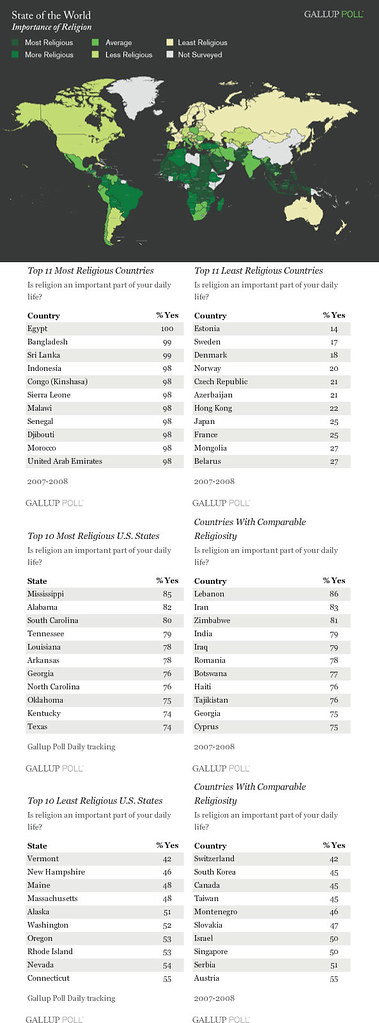
See also this post about religion and social issues.
See also this post about religion and social issues.
Monday, August 25, 2008
Society Without God: What the Least Religious Nations Can Tell Us About Contentment
"Sociologist Zuckerman spent a year in Scandinavia seeking to understand how Denmark and Sweden became “probably the least religious countries in the world, and possibly in the history of the world.” While many people, especially Christian conservatives, argue that godless societies devolve into lawlessness and immorality, Denmark and Sweden enjoy strong economies, low crime rates, high standards of living and social equality. Zuckerman interviewed 150 Danes and Swedes, and extended transcripts from some of those interviews provide the book's most interesting and revealing moments."
Publishers Weekly, 8/11/2008
Considering the sheer amount of American Christians who refer to the Soviet Union as a prime example of what an irreligious society can be like, this should provide some food for thought.
Subscribe to:
Posts (Atom)