Showing posts with label survey. Show all posts

Sunday, January 13, 2013

The spiritual but not religious likely to face mental health issues, drug use, study says

"Can being spiritual but not religious lead to mental health issues? The answer is yes, according to a recent study.
The study, published in the January edition of the British Journal of Psychiatry, says spiritual but not religious people, as opposed to people who are religious, agnostic or atheist, were more likely to develop a "mental disorder," "be dependent on drugs" and "have abnormal eating attitudes,” like bulimia and anorexia."


Religion.blogs.cnn.com, January 9th, 2013 

I think this just shows that the benefit of religion isn't the belief itself, but rather the sense of community. But also note that atheists and agnostics do well in the survey.

Here is the abstract.


Thursday, August 9, 2012

Number of atheists around the world is rising

"According to the latest global poll released by RedC Opinion Poll, part of WIN-Gallup International, a world-wide network of leading opinion pollsters, the number of self-declared atheists in the world has risen by 9% since the measure was last taken in 2005.

The massive poll, conducted in 57 countries (not, apparently, including Britain) among 51,000 people asked a single question "Irrespective of whether you attend a place of worship or not, would you say you are a religious person, not a religious person or a convinced atheist?"

It shows that on average 59% of the world said that they think of themselves as religious, whereas 23% think of themselves as not religious and 13% think of themselves as convinced atheists. Naturally there are enormous variations from country to country.

The countries with most self-described atheists are China (47%); Japan (31%), Czech Republic (30%), France (29%), South Korea (15%), Germany (15%), Netherlands (14%), Austria (10%), Iceland (10%), Australia (10%) and Ireland (10%).

The most religious countries are: Ghana (where 96% of people define themselves as religious), Nigeria (93%), Armenia (92%), Fiji (92%), Macedonia (90%), Romania (89%), Iraq (88%), Kenya (88%), Peru (86%) and Brazil (85%).

One of the most dramatic reductions in the proportion of the population considering themselves religious occurred in Ireland: from 69% in 2005 to 47% in 2012, placing Ireland on the index of religious belief at position 43 out of 57 countries.

The poll also showed that the poorer people were, the more likely they were to be religious.

One anomaly that the pollsters have themselves questioned is in Turkey, where those who say they are religious is only 23% while those defining themselves as non-religious is 73% (self-defined atheists 2%)."


National Secular Society, 08 Aug 2012
Good news indeed. Here's the full report.

Here's a couple of charts from the report:

Notice on the last chart that women are slightly more atheist than men. This contradicts most other polls, but it's nevertheless a good thing. Also notice how relatively many Muslims are non-religious compared to, say, Catholics. A lot of Jews are non-religious, but that was to be expected.

Friday, June 29, 2012

Less crime if you believe in Hell?

"Belief in hell keeps down criminal activity, but belief in heaven actually boosts it, according to a pair of researchers at the universities of Oregon and Kansas.

Azim Shariff and Mijke Rhemtulla scoured 30 years of international values-based surveys and found societies that put more stock in supernatural benevolence than supernatural punishment have higher national crime rates. The relationship is so significant, they found, that it is a stronger predictor of crime rates than are economic factors such as gross domestic product and income equality."


The Globe and Mail, Jun. 25 2012
I understood immediately that there were issues with this research. Comparing crime statistics between countries, when crime is reported differently makes no sense at all. I may be prejudiced but I my first thought was that belief in Hell correlates with poor crime statistics. I might as well post the graph right away (which is picked up from Epiphenom which also has a critical article):

It's a bit hard to read with only two letters abbreviations but you can see that Norway (NO) and Sweden (SE) are ranking high here. Yes, I live in one of the most crime infested countries. I wish I lived in Egypt (EG) which you will see on the bottom.

Here's a critical examination:

"Interpol merely gathers and reports nonlethal crime statistics provided by member nations without standardizing or vetting it [19, 22]. For example, assaults are reported at a rate about 6 times higher in Australia and Sweden than in Canada and France, this level of disparity is suspect. Rates of theft are reported to be twice as high in Sweden as in France; are the former actually twice as larcenous as the French, or are the latter twice as unlikely to file a report, or is the reality somewhere in-between? Similarly suspicious discrepancies exist in International Crime Victims Survey results. Reported rates of rape are two to twenty times higher in the U.S. than in other 1st world nations [24,25], but this only means that American females report being raped at far higher rates, not that American males are more prone to committing sexual assaults. Nonlethal crimes are difficult to compare even between the relatively uniform 1st world countries, they only grow worse when comparing 2nd and 3rd world nations with greater disparities between the quality of crime reporting."

Plosone.org, GregorySPaul on 24 Jun 2012
 The only statistic you can reliably compare is homicide, but even there there are issues:

"In contrast, Jensen found that more homicide is more strongly linked to greater popular support for the reality of hell than for heaven [12] -- he suggests that “malevolent” forms of religion produce inferior results compared to “benevolent” -- Sharif and Rhemtulla do not cite Jensen or explain the disparity in their results with his. Sharif and Rhemtulla find that more homicide weakly correlates with more belief in God, Rees [5] as well as Jensen [12] found a positive relationship in a large sample of nations. In the more uniform prosperous democracies the only example with high levels of homicide, the U.S., has the highest levels of religiosity including belief in heaven and hell [6]. The advanced democracies with the least, and remarkably low, homicide are the most atheistic. (It would be interesting to analyze correlations between measures of religiosity and homicide in different economic categories of nations.) Potential reasons that deity worship and scripture contribute to lethal violence have been proffered [6-8,13-15].
How crime in general corresponds to differing levels and types of religiosity remains inherently uncertain, but the most atheistic democracies appear to suffer relatively modest nonlethal misdemeanors and felonies, and definitely enjoy very low lethal violence. All studies agree that the most reliably measured crime, homicide, tends to be higher in less atheistic countries. Studies are contradictory regarding how homicide correlates with differing belief beliefs in the afterlife, further analysis may clear this up."
In short: Bollocks.


Tuesday, April 10, 2012

Canadians trust the non-religious more than the religious

"67 per cent of those surveyed said they trusted “people who are religious” in general, and even more respondents — 73 per cent — expressed trust in “people who are not religious.”


[...]


Just 42% of those polled agreed with the statement “religion is an important part of my life,” with women (46%) more likely to value religious activity than men (37%) by a clear margin.


[...]


Only 30% of those aged 18 to 24 agreed that religion is important to their life, while respondents aged 65 and older were most likely (56%) to consider religion a force in their life.

Likewise, an expressed belief in God was lowest (56%) among the youngest group of respondents and highest (79%) among the oldest."


Nationalpost.com, Apr 6, 2012

H/T to Friendly Atheist

Wednesday, March 28, 2012

A third of Americans are non-religious

Here's the result of a new Gallup survey of American religiosity:

"Gallup classifies 40% of Americans nationwide as very religious -- based on their statement that religion is an important part of their daily life and that they attend religious services every week or almost every week. Another 32% of Americans are nonreligious, based on their statement that religion is not an important part of their daily life and that they seldom or never attend religious services. The remaining 28% of Americans are moderately religious, because they say religion is important but that they do not attend services regularly or because they say religion is not important but still attend services.


[...]

Mississippi is the most religious U.S. state, and is one of eight states where Gallup classifies at least half of the residents as "very religious." At the other end of the spectrum, Vermont and New Hampshire are the least religious states, and are two of the five states -- along with Maine, Massachusetts, and Alaska -- where less than 30% of all residents are very religious. See full list here


[...]


Results are based on telephone interviews conducted as part of the Gallup Daily tracking survey Jan. 1-Dec. 31, 2011, with a random sample of 353,492 adults, aged 18 and older, living in all 50 U.S. states and the District of Columbia."

Gallup.com, March 27, 2012

Saturday, March 3, 2012

2030: The year Britain will cease to be a Christian nation with the march of secularism

"The march of secularism means Britain may no longer be a Christian country in just 20 years, a report said yesterday.

If trends continue, the number of non-believers is set to overtake the number of Christians by 2030."


Daily Mail, 3rd March 2012


Thursday, February 16, 2012

Muslims in Wales pass on their faith at higher rates than other religions

"The Cardiff University study, published online today in the journal Sociology, says that the proportion of adult Muslims actively practising the faith they were brought up in as children was 77%. That compares with 29% of Christians and 65% of other religions.

The study also found that 98% of Muslim children surveyed said they had the religion their parents were brought up in, compared with 62% of Christians and 89% of other religions.

The team analysed data from the Home Office’s 2003 Citizenship Survey data, using 13,988 replies from adults and 1,278 from young people aged 11 to 15.

[...]

Home Office statistics show that 74% of people in Wales are Christians but that only 7% of those attend church."


Walesonline.co.uk, Feb 13 2012 (Found via Islam in Europe)
Talk about "good and bad news"! The downside of such a study is that many people who identify as Christians, but don't give a toss about religion in their daily life, will suddenly feel the urge to compete with the muslims. Instead of embracing our secular future, they may turn around and cling to the past only because the Muslims do it.
On the other hand, 27% apostates within Islam is not a bad number considering how Islam is portrayed.

Tuesday, February 14, 2012

Evaluating God

"While many polls have asked what Americans’ beliefs are about God, there has been little measurement of voters’ evaluation of its performance."


Publicpolicypolling.com, July 22, 2011

Old poll, but I just found it in a recent grumpy TownHall.com commentary which neglected to include a source nor a date. Anyway, fairly interesting to see all the "not sure" answers. No doubt many of them were also unsure whether or not to dare say they were unsure.  Here are the results (PDF)


"Q7 If God exists, do you approve or disapprove of its performance?
Approve ............. 52%
Disapprove......... 9%
Not sure ............. 40%
Q8 If God exists, do you approve or disapprove of its handling of natural disasters?
Approve ............. 50%
Disapprove......... 13%
Not sure ............. 37%
Q9 If God exists, do you approve or disapprove of its handling of animals?
Approve ............. 56%
Disapprove......... 11%
Not sure ............. 33%
Q10 If God exists, do you approve or disapprove of its handling of creating the universe?
Approve ............. 71%
Disapprove......... 5%
Not sure ............. 24%"

Poll reveals majority of UK Christians support secular outlook

"Results of a poll carried out by Ipsos MORI for the Richard Dawkins Foundation for Reason and Science (UK) show that UK Christians are overwhelmingly secular in their attitudes on a wide range of issues.

[...]

The poll revealed that, on balance, significantly more Christians:

    agree that the law should apply equally to everyone, regardless of their religion or belief (92% v 2%)
    oppose religion having special influence on public policy (74% v 12%)
    oppose the UK having an official state religion (46% v 32%)
    oppose seats being reserved for Church of England bishops in the House of Lords (32% v 25%)
    support the costs of hospital chaplains being met by the chaplain's religious organisation rather than from NHS budgets (39% v 32%)
    want state-funded schools to teach knowledge about the world's main faiths even-handedly, rather than inculcate beliefs (57% v 15% solely Christian inculcation or 8% inculcate other school faith)
    approve of sexual relations between two adults of the same sex than do not (46% v 29%)
    approve of an adult woman's right to have an abortion within the legal time limit (62% v 20%)
    support the legalisation of assisted suicide in the case of terminally ill adult patients with safeguards (59% v 21%)"

National Secular Society, 14 Feb 2012
See lengthy press releases with lots more numbers here:
RDFRS UK/Ipsos MORI Poll #1: How religious are UK Christians?
RDFRS UK/Ipsos MORI Poll #2: UK Christians oppose special influence for religion in public policy

Here are the full results of the poll (PDF)

See also:
"The kind of conservative religious aggression that claims 'anti-Christian discrimination' every time Christians are asked to treat others fairly and equally in the public square is a threatened response to the loss of top-down religion's social power. So is overbearing 'Christian nation' rhetoric, and the 'culture wars' that some hardline believers and non-believers may seek to launch and win against each other.

[...]

"Likewise, Richard Dawkins may not be a subtle, unbiased or persuasive analyst of religion overall, but it would be entirely unhelpful for believers to dismiss this survey because they disagree with its commissioner in other respects. Its content evidently needs further and deeper analysis, alongside other data, than the initial response to it has allowed."


Ekklesia (Christian think-tank)

Daily Telegraph: Christians don't want religion to 'influence public life'


Saturday, February 11, 2012

Six Reasons Young Christians Leave Church

"No single reason dominated the break-up between church and young adults. Instead, a variety of reasons emerged. Overall, the research uncovered six significant themes why nearly three out of every five young Christians (59%) disconnect either permanently or for an extended period of time from church life after age 15.

Reason #1 – Churches seem overprotective.
Reason #2 – Teens’ and twentysomethings’ experience of Christianity is shallow.
Reason #3 – Churches come across as antagonistic to science.
Reason #4 – Young Christians’ church experiences related to sexuality are often simplistic, judgmental.
Reason #5 – They wrestle with the exclusive nature of Christianity.
Reason #6 – The church feels unfriendly to those who doubt."

Barna.org, September 28, 2011

See the original article for further description of the reasons why young people leave the church.

Sunday, February 5, 2012

In the West, religious nations are more sexist

"First of all, let's look at the correlation with a straightforward measure of whether women can be leaders, which was assessed by asking the level of agreement with two questions: “On the whole, men make better political leaders than women do” and “On the whole, men make better business executives than women do.”

Overall, there's a fairly good correlation. But there is an exception, and that's Asian countries.  There are only a few Asian countries in the sample, so it's hard to draw sweeping conclusions. But they are all very sexist, whether their citizens are religious (Thailand, Taiwan) or non-religious (China, Hong Kong, Japan)

So I took these countries out of the analysis - in fact, what's shown in the graphic is only those countries with a predominantly Western, Christian culture (i.e. North and South America, Europe, and Australia).

In these Westernised countries there's a strong, linear relationship between religion and sexism.

In fact, if you narrow the sample a bit more to look only at European countries the fit is even cleaner (I haven't shown this, but it's a remarkably straight line)."


Epiphenom.fieldofscience.com, Tom Rees, November 11, 2011

Religion vs. sexism


Simply being near a church makes people more hostile to outsiders

"In a recent study, Jordan LaBouff (University of Maine) worked with colleagues at Baylor College to discover whether attitudes to different groups are affected by subliminal Christian priming.

[...]

So what effect does religious priming have on ordinary people? To test this, LaBouff stopped people at random outside a church in the Netherlands (and, to check if the effect was culturally specific, a few people outside Westminster Abbey in London). He asked them a series of questions, including asking them to rate their attitudes to different groups on a 1-10 scale.

He also stopped some other people in a location that contained only civic buildings (in England, the location chosen was the Houses of Parliament).

[...]

But, as you can see from the graph, attitudes towards every single group were more hostile when people were asked outside a church. All the differences are statistically significant (except the difference in attitudes towards Christians)."

Epiphenom.fieldofscience.com, Tom Rees, Saturday, February 04

Attitudes towards different groups vary depending on where you ask the question.

Saturday, February 4, 2012

Britain is becoming less religious, survey shows

 An interesting survey by NatCen shows that religion is indeed in decline in Britain. Download the PDF on religion here.

"The first point to note is that there is no evidence of a lifecycle effect – that is, as people grow older they become more or less religious. Non-affiliation remains relatively stable as each generation ages; for example, 30 per cent of those born between 1936–1945 did not follow a religion in 1983 (when they were aged 38–47 years), compared with 31 per cent in 2010 (when they were 65–74 years). 

[...]  

Conclusions 
Britain is becoming less religious, with the numbers who affiliate with a religion or attend religious services experiencing a long-term decline. And this trend seems set to continue; not only as older, more religious generations are replaced by younger, less religious ones, but also as the younger generations increasingly opt not to bring up their children in a religion – a factor shown to strongly link with religious affiliation and attendance later in life. 
What does this decline mean for society and social policy more generally? On the one hand, we can expect to see a continued increase in liberal attitudes towards a range of issues such as abortion, homosexuality, same-sex marriage, and euthanasia, as the influence of considerations grounded in religion declines. Moreover, we may see an increased reluctance, particularly among the younger age groups, for matters of faith to enter the social and public spheres at all. The recently expressed sentiment of the current coalition government to “do” and “get” God (Warsi, 2011) therefore may not sit well with, and could alienate, certain sections of the population. "


British Social Attitudes 28, 2011-2012

Now for the charts:
50 per cent has no religion in Britain

No religious affiliation, cohort analysis, 1983–2010
Current religious affiliation, by religious upbringing. Notice how despite having had religious upbringing a huge chunk ends up being non-religious.

Apatheism on the rise in USA survey shows

""The real dirty little secret of religiosity in America is that there are so many people for whom spiritual interest, thinking about ultimate questions, is minimal," says Mark Silk, professor of religion and public life at Trinity College, Hartford, Conn.

[...]

•44% told the 2011 Baylor University Religion Survey they spend no time seeking "eternal wisdom," and 19% said "it's useless to search for meaning."

•46% told a 2011 survey by Nashville-based evangelical research agency, LifeWay Research, they never wonder whether they will go to heaven.

•28% told LifeWay "it's not a major priority in my life to find my deeper purpose." And 18% scoffed at the idea that God has a purpose or plan for everyone.

•6.3% of Americans turned up on Pew Forum's 2007 Religious Landscape Survey as totally secular — unconnected to God or a higher power or any religious identity and willing to say religion is not important in their lives."

USA Today, 1/3/2012


Why Religion Makes Only Some of Us Happy

"Religious people tend to feel better about themselves and their lives, but a new study finds that this benefit may only hold in places where everyone else is religious, too.
According to the new study of almost 200,000 people in 11 European countries, people who are religious have higher self-esteem and better psychological adjustment than the non-religious only in countries where belief in religion is common. In more secular societies, the religious and the non-religious are equally well-off.

[...]

For example, a believer gets a happiness boost in Turkey, where religion is part of the fabric of daily life and taking part means you're doing the "right" thing in your culture. But that same person wouldn't see any benefit in Sweden, where few people care much about religion.

[...]

Nonetheless, the findings suggest that research on religion and happiness in the United States — where religion is relatively important compared with many other nations — may not apply across all cultures."

Livescience.com, 25 January 2012
In other words, it's good for you to be in the in group.

No positive correlation between religion and social morality

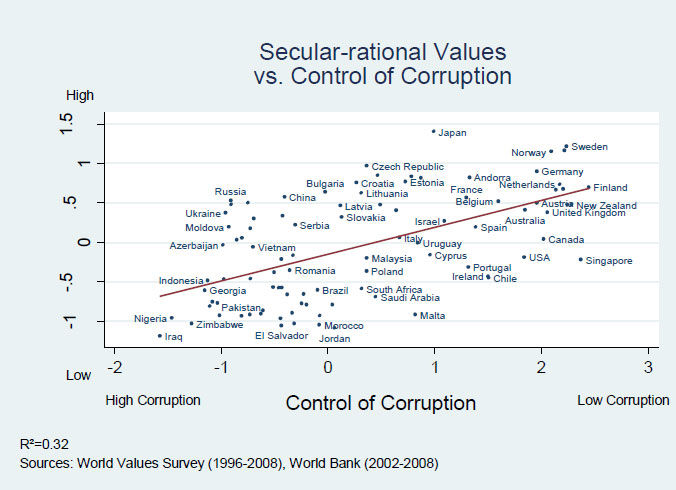
The World Values Survey has some interesting data on how religion and social morality correlates. Unfortunately, the article I'm referring to is from the Norwegian magazine Fri Tanke, but there's always Google Translate.

"[Bo Rothstein] points out that none of the 25 different indicators World Values ​​Survey's measure of human welfare, such as absence of corruption or the degree of confidence increases if religion gets more influence. Rather, it is quite the opposite. The results show that the more a society dominated by secular values, the higher is the human welfare.

- And, add to Rothstein, the same pattern is also evident if one only looks at the country dominated by Christianity
[...]

The degree of religiosity is composed of answers to the following six questions:

- Regardless of whether you go to organized religious practice or not, would you say that you are a religious person, not a religious person, or a convinced atheist?

- Apart from weddings, funerals and baptisms, how often you will meet up at religious arrangements?

- How important is God in your life?

- Do you believe in God?

- Do you believe in life after death?

- Does your religion give you well-being and strength?"
Well, enough talk. Let's see some charts:

Secular-rational values vs. Control of Corruption
Religiosity scale vs. life expectancy
Religiosity scale vs. average schooling years
Traditional values vs. secular rational values

Also, take a look at this Swedish article by Bo Rothstein. (Original)

Friday, October 28, 2011

Better sex without religion, survey shows

"Uh oh. Sex. As America's "war on sex" once again heats up as the country slides toward another presidential election, a new Sex and Secularism study conducted by Kansas University undergraduate Amanda Brown and Dr. Darrel W. Ray is bound to raise some hackles among the religiously faithful. Controversy abounds.

After surveying over 14,500 secularists about their sex lives the study's key findings were as follows:

    Sex improves dramatically after leaving religion.
    Sexual guilt has little staying power after leaving religion.
    Those raised most religious show no difference from those raised least religious in their sexual behavior.
    Those raised most religious experience far more guilt but have just as much sex.
    Religious parents are far worse at educating their children on matters of sex.
    Religious guilt differs in measurable amounts according to denomination.


The authors admit the study was not perfect. It was conducted online, with respondents self-reporting their responses to questions posed, and all of the participants self-identified as currently secular, which could imply a certain motivation on their part to paint a rosy picture of post-religion sexual bliss. The authors feel the sheer number of respondents goes a long way to make up for its methodological weaknesses, and the authors freely admit the purpose of the study was to test six specific hypotheses that can be found on the link bottom of this piece.
[...]
 The study's authors state:

    "Most religions preach strongly against pornography so it is reasonable to think that porn use would be less among the more religious. This survey found that porn use is quite high in all groups and is a key source of sex education for religious teens. The most religious teens said they got their sex education from porn 33% of the time, the less religious 25.2% of the time. The survey found that 90% of men were using pornography by age 21 with no significant difference between those most and least religious. For women, over 50% were using porn by age 21 and 70% at age 30, with little difference between most and least religious.""

Medicalnewstoday.com, 25 May 2011


Thursday, October 27, 2011

In U.S., Increasing Number Have No Religious Identity

"Americans have become increasingly less tied to formal religion in recent decades, with the percentage saying they do not have a specific religious identity growing from near zero in the 1950s to 16% this year and last.

[...]

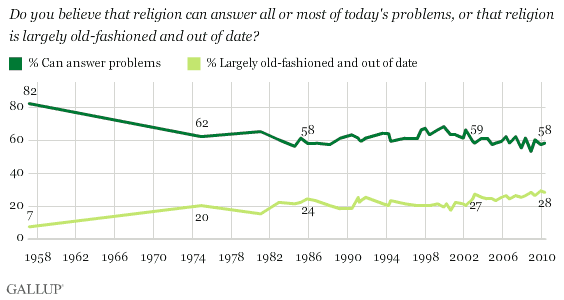
An additional measure Gallup has tracked over time asks Americans if they believe that religion can answer all or most of today's problems, or if they believe religion is largely old-fashioned and out of date.


[...]

Bottom Line
Gallup surveys confirm a downward drift in religious identity among Americans, as well as a slight increase in the number of Americans who view religion as old-fashioned and out of date."

Gallup.com, May 21, 2010

In U.S., 3 in 10 Say They Take the Bible Literally

"Three in 10 Americans interpret the Bible literally, saying it is the actual word of God. That is similar to what Gallup has measured over the last two decades, but down from the 1970s and 1980s. A 49% plurality of Americans say the Bible is the inspired word of God but that it should not be taken literally, consistently the most common view in Gallup's nearly 40-year history of this question. Another 17% consider the Bible an ancient book of stories recorded by man."


Gallup.com, July 8, 2011
Odd fluctuation in recent years.
See the article for lots of other numbers on this issue.

Saturday, October 22, 2011

70 percent of scientists believe religion and science are sometimes in conflict

"They interviewed a scientifically selected sample of 275 participants, pulled from a survey of 2,198 tenured and tenure-track faculty in the natural and social sciences at 21 elite U.S. research universities. Only 15 percent of those surveyed said they view religion and science as always in conflict. Another 15 percent said the two are never in conflict, while 70 percent said they believe religion and science are only sometimes in conflict.

[...]

The study was supported by a grant from the John Templeton Foundation with additional funding from Rice University.


[...]

Many of those surveyed cited issues in the public realm (teaching of creationism versus evolution, stem cell research) as reasons for believing there is conflict between the two. The study showed that these individuals generally have a particular kind of religion in mind (and religious people and institutions) when they say that religion and science are in conflict.

Other findings in the study:

    Scientists as a whole are substantially different from the American public in how they view teaching “intelligent design” in public schools. Nearly all of the scientists – religious and nonreligious alike – have a negative impression of the theory of intelligent design.

    Sixty-eight percent of scientists surveyed consider themselves spiritual to some degree.

    Scientists who view themselves as spiritual/religious are less likely to see religion and science in conflict."

Beliefnet, September 23, 2011
I've seen this survey cited in a number of places and nearly all of them has a headline indicating that science and religion are not in conflict, while the numbers clearly state that 70 per cent thinks religion and science are sometimes in conflict. Only 15 per cent thinks religion and science are never in conflict.