Showing posts with label Agnosticism. Show all posts

Sunday, January 13, 2013

The spiritual but not religious likely to face mental health issues, drug use, study says

"Can being spiritual but not religious lead to mental health issues? The answer is yes, according to a recent study.
The study, published in the January edition of the British Journal of Psychiatry, says spiritual but not religious people, as opposed to people who are religious, agnostic or atheist, were more likely to develop a "mental disorder," "be dependent on drugs" and "have abnormal eating attitudes,” like bulimia and anorexia."


Religion.blogs.cnn.com, January 9th, 2013 

I think this just shows that the benefit of religion isn't the belief itself, but rather the sense of community. But also note that atheists and agnostics do well in the survey.

Here is the abstract.


Tuesday, February 12, 2008

Homicide and religion linked


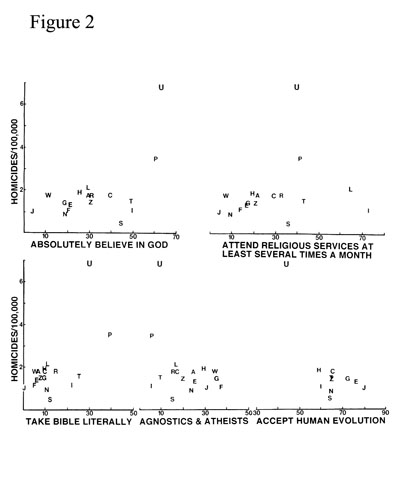
"In general, higher rates of belief in and worship of a creator correlate with higher rates of homicide, juvenile and early adult mortality, STD infection rates, teen pregnancy, and abortion in the prosperous democracies (Figures 1-9). The most theistic prosperous democracy, the U.S., is exceptional, but not in the manner Franklin predicted. The United States is almost always the most dysfunctional of the developed democracies, sometimes spectacularly so, and almost always scores poorly. The view of the U.S. as a “shining city on the hill” to the rest of the world is falsified when it comes to basic measures of societal health. Youth suicide is an exception to the general trend because there is not a significant relationship between it and religious or secular factors. No democracy is known to have combined strong religiosity and popular denial of evolution with high rates of societal health. Higher rates of non-theism and acceptance of human evolution usually correlate with lower rates of dysfunction, and the least theistic nations are usually the least dysfunctional. None of the strongly secularized, pro-evolution democracies is experiencing high levels of measurable dysfunction. In some cases the highly religious U.S. is an outlier in terms of societal dysfunction from less theistic but otherwise socially comparable secular developed democracies. In other cases, the correlations are strongly graded, sometimes outstandingly so.

Legend: A = Australia, C = Canada, D = Denmark, E = Great Britain, F = France, G = Germany, H = Holland, I = Ireland, J = Japan, L = Switzerland, N = Norway, P = Portugal, R = Austria, S = Spain, T = Italy, U = United States, W = Sweden, Z = New Zealand.

Cross-National Correlations of Quantifiable Societal Health with Popular Religiosity and Secularism in the Prosperous Democracies. Gregory S. Paul, 2005.

Plenty of other figures and text in the article.
See also a new article (1. February 2008) by Gregory S. Paul: Why is Secular European Society Doing so Much Better Than God-Fearing America?

Tuesday, February 5, 2008

Freedom of religion has become a mockery and must be abolished

Lately, we have seen a couple of disturbing developments where freedom of religion has been used to make other people's lives miserable. Muslim staff at Sainsbury in England refused to handle alcohol, Muslim staff at Marks & Spencer refused to sell a book of bible stories, Muslim medical students refuse to learn about alcohol or sexual diseases and finally: Muslim medical students are refusing to obey hygiene rules.

This of course comes on top of all the other problems with religion currently. The discerning reader will know that these are not all traditional rules in Islam, but that's besides the point. Religions have always taken strange paths. Martin Luther and John Calvin did not advocate traditional views, but their then untraditional views became religious branches in themselves. With the fundamentalist climate of Islam today it is important that we say stop before we're stuck with useless holier than thou employees who can't do anything because it's against their religion and who use their rights to infringe on our rights.

I think the solution is to scrap the law of freedom of religion. It is not my idea, the Swedish Humanists (including Björn Ulvaeus) did this earlier. Their point was that the law doesn't actually contribute to anything. I have made a chart below, based upon the universal Declaration of Human rights so you can see that even without a special law protecting religion there is a de facto religious freedom protecting religious people:
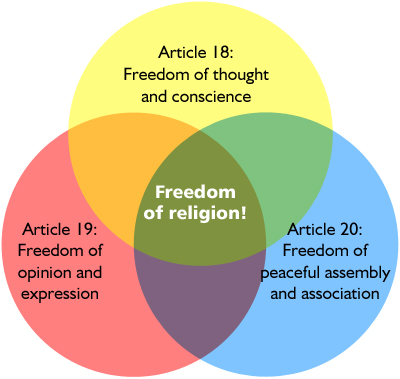
From The Universal Declaration of Human Rights

Article 18
Everyone has the right to freedom of thought, conscience and religion; this right includes freedom to change his religion or belief, and freedom, either alone or in community with others and in public or private, to manifest his religion or belief in teaching, practice, worship and observance.

Article 19 Everyone has the right to freedom of opinion and expression; this right includes freedom to hold opinions without interference and to seek, receive and impart information and ideas through any media and regardless of frontiers.

Article 20 (1) Everyone has the right to freedom of peaceful assembly and association. (2) No one may be compelled to belong to an association.
As you can see, going to church or to mosque and listen to fanciful stories about God and believing them, and retelling them will not be outlawed if freedom of religion is removed.
What will become more difficult however is demand an extra privilege that atheists and agnostics can't have.

Can an Atheist teetotaller refuse to sell alcohol at Sainsbury?
Can an Atheist employee at Marks & Spencer refuse to sell religious books?
Can an Atheist prude refuse to show skin during lifesaving operations?

The answer is no. The golden rule is: If you don't want to sell religious books, then stay out of book shops that stock religious books. If you're an Atheist vegan, and you have big issues with selling meat, then work elsewhere. Easy as that. If Atheists or Theists have ideological or religious ideas that prevents them from doing their job, then they have no right to work there.

I must stress that scrapping such a law is not something that I've always wished for. Freedom of religion was one of the greatest achievements of the Enlightenment, and I am a firm believer in that religion is best fought with reason instead of laws. I want to convince people, not outlaw their ideas. But what was once a "live and let live" law has become a law that some religious people use to pester other people with and introduce religious tyrrany from the ground. That's why it must go.

Saturday, February 2, 2008

Lies, damn lies and 'counterknowledge'

"We do not normally think of creationism and maverick physics as conspiracy theories; but what they have in common with Loose Change is a methodology that marks them as counterknowledge. People who share a muddled, careless or deceitful attitude towards gathering evidence often find themselves drawn to each other's fantasies. If you believe one wrong or strange thing, you are more likely to believe another. Although this has been true for centuries, the invention of the internet has had a galvanising effect. A rumour about the Antichrist can leap from Goths in Sweden to Australian fascists in seconds. Minority groups are becoming more tolerant of each other's eccentric doctrines. Contacts between white and black racists are now flourishing; in particular, the growing anti-Semitism of black American Muslims has been a great ice-breaker on the neo-Nazi circuit."

Damian Thompson, Daily Telegraph, 12/01/2008
I fear this book is getting more and more important every day. Conspiracy theories is clearly the new religion, even for non-religious people. It suits both theists, agnostics and atheists that have complete disregard for reason.While the rest of us go were evidence takes us, the conspiracy theorists use selected facts to build a case around their twisted worldview.
Atheists need to treat this like any other religion, even when it poses like critique of religion, like the hapless Zeitgeist movie. (Any person that actually suggests that Jesus was born 25th December, year 0 or that this is even so central to Christian beliefs that the position of stars that night are of importance - need to have his or her head examined.)


Sunday, January 20, 2008

Swedes don't need a book to be moral

I found an interesting Swedish story in the Christian paper Dagen that I translated the gist of:

"A new survey, the Bible barometre 2008, shows that 32 per cent of Swedes think the bible is important for their own morality and ethics.
Krister Andersson, secretary of the Bible company, says that an earlier survey has shown that the golden rule is at the core of Swedish morality.
When the question is more open: "Is there any writing that strongly affected your ethics and morality?" 20 per cent mentioned the bible. Of the other alternatives, the UN Declaration of Human Rights was the most common with 4 per cent.
But most people, 62 per cent, hadn't read any writing at all that made such an impression.
- This is very surprising. I thought more people were going to say that they had some sort of written or scriptural starting point for their moral judgements, says Krister Andersson.
He was also struck by the variation of writings and writers that were mentioned under "Other". On the list there's among others The Diary of Anne Frank, newspapers, Dalai Lama, Fröding, Greek philosophers, the Swedish Law, the catecism, and the scout law. Some of the asked also mentioned the upbringing they were given by their parents: "I try to be honest and fair to people."
As with the Biblebarometre 2006 and 2007 this year's survey shows that about eveyr tenth person reads the bible at least once a month, while four out of read it only rarely.
Those who consider the bible most important are the older generations, 65 years and older."

Dagen.se, 2008-01-17
What I liked about this survey wasn't merely that it showed how many read or didn't read the bible, but it showed that 62 per cent did not pick up their morality from a particular book.
I think it's fair to say that they hardly discovered their moral principles within their own heads, but that they don't simply stick to one book or one type of philosophy. Throughout life most of us read a lot, listen to a lot, and watch a lot and doing this we absorb a lot of moral reasoning. And we stick to the ideas that make sense to us personally instead of being too dependant on one book. Let's say you need advice, would you not preferably want to get it from more than one person?

It also reminded me about something Dawkins wrote in The God Delusion (p. 265):
"First, how is [the moral zeitgeist] synchronized across so many people? It spreads itself from mind to mind through conversations in bars and at dinner parties, through books and book reviews, through newspapers and broadcasting, and nowadays through the Internet. Changes in the moral climate are signalled in editorials, on radio talk shows, in political speeches, in the patter of stand-up comedians and the scripts of soap operas, in the votes of parliaments making laws and the decisions of judges interpreting them."
On the subject of books, I'll plug a new book from Prometheus books that I think could be worthwhile to read. Knowing myself I'm not sure I would get through its 800 pages, but if you're going to read one book this year, then this might be the book.
Successor to the highly acclaimed Encyclopedia of Unbelief (1985), edited by the late Gordon Stein, the New Encyclopedia of Unbelief is a comprehensive reference work on the history, beliefs, and thinking of America’s fastest growing minority: those who live without religion. All-new articles by the field’s foremost scholars describe and explain every aspect of atheism, agnosticism, secular humanism, secularism, and religious skepticism. Topics include morality without religion, unbelief in the historicity of Jesus, critiques of intelligent design theory, unbelief and sexual values, and summaries of the state of unbelief around the world. More than 130 respected scholars and activists worldwide served on the editorial advisory board and over 100 authoritative contributors have written in excess of 500 entries.

In addition to covering developments since the publication of the original edition, the New Encyclopedia of Unbelief includes a larger number of biographical entries and much-expanded coverage of the linkages between unbelief and social reform movements of the 19th and 20th centuries, including the labor movement, woman suffrage, anarchism, sex radicalism, and second-wave feminism.

The distinguished contributors—philosophers, scientists, scholars, and Nobel Prize laureates—include Robert Alley, Joe Barnhart, David Berman, Sir Hermann Bondi, Vern L. Bullough, Noam Chomsky, Daniel Dennett, Paul Edwards, Barbara Ehrenreich, Antony Flew, Annie Laurie Gaylor, Peter Hare, Van Harvey, Susan Jacoby, Paul Kurtz, Richard Leakey, Gerd Lüdemann, Michael Martin, Martin E. Marty, Kai Nielsen, Steven Pinker, Robert M. Price, Richard Rorty, John R. Searle, Peter Singer, Ibn Warraq, Steven Weinberg, George A. Wells, David Tribe, Sherwin Wine, and many others.

With a foreword by evolutionary biologist and best-selling author Richard Dawkins, this unparalleled reference work provides comprehensive knowledge about unbelief in its many varieties and manifestations.

About the Author
Tom Flynn (Amherst, NY) is the editor of Free Inquiry magazine, director of the Center for Inquiry, founding coeditor of Secular Humanist Bulletin, director of the Robert Green Ingersoll Birthplace Museum, and the author of The Trouble with Christmas, Galactic Rapture, and Nothing Sacred.

Monday, December 3, 2007

Feminist author Taslima Nasreen rewrites novel after death threats from Muslim extremists

"Today she relented under pressure and said that “controversial lines” relating to Islam from the autobiographical novel would be removed.
“The book was written in 2002, based on my memories of Bangladesh in the 1980s, during which time secularism was removed from the Bangladesh constitution. I wrote the book in support of the people who defended secular values. I had no intention to hurt anybody’s sentiment,” she said today from a secret location.
“I have done what I have never done in my life. I have compromised even in a secular India.” She added that she hoped she would now be able to “live peacefully” in India."

Times Online, November 30, 2007
Does Islam threaten free speech? Let me think, yes. I haven't been following the latest development here, but I'll post links to a couple of stories from November about her:

Religious Extremists Riot; Taslima Nasreen Leaves Calcutta
from About Agnosticism / Atheism

India - Feminist Bangladeshi writer Taslima Nasrin in government safe house following violent protests by Muslim extremists
from IFEX All Regions

Taslima episode: analysis of failure of secularism in West Bengal (News From Bangladesh)
from Yahoo! News

Taslima offered a safe haven after riots
Times, 28 November 2007

Taslima reveals weaknesses in India's commitment to secularism
Times of India, 27 November 2007

Muslim fanatics oppose Taslima’s return
Hindustan Times, 25 November 2007

Writer leaves Calcutta after riot
from Internet Infidels News wire

Taslima Nasreen persecuted in India
The Australian, 23 November 2007

Monday, September 17, 2007

Methinks the believers complain too much

"John Humphrys has commissioned a poll from Yougov to help him sell his new book, In God We Doubt. It shows that 16% of the 2,200 people who responded defined themselves as atheists, 9% agnostics, 28% said they believed in God and 26% said they believed in some undefined “something”.
That comes to a total of 79%. The article reporting the poll didn’t say where the other 21% stood on the belief/non-belief spectrum.
42% thought religion harmful, a statistic which Humphrys explains away with a remark so obvious one wonders why he bothered to make it: “One reason might be the publicity attracted by a handful of mad mullahs and their hate-filled rhetoric.”

[...]

And when spokespeople for the 35% who don’t believe begin to emerge – people like Richard Dawkins, Peter Hitchens, AC Grayling and others – they are denounced from the pulpits and the newspaper columns as “fanatics” and “extremists”. There is a positive library of newspaper articles accumulating expressing this opinion.

[...]

What started out as a campaign by fundamentalist Christians to make the word “atheist” into a term of abuse, which could not be uttered without the addition of an adjective such as “extremist” or “fundamentalist”, has now been taken up big time by the establishment intelligentsia who have never been able to shake off their childhood indoctrination. It’s clear they feel guilty when they even try."


Terry Sanderson, National Secular Society, 7. September 2007
An excellent comment!

Sunday, June 24, 2007

Atheists, Agnostics less likely to vote in USA

"A new study by The Barna Group examines the numbers, lifestyles and self-perceptions of America’s atheists and agnostics, contrasting the no-faith audience with those who actively participate in the Christian faith.

[...]

In the study, the no-faith segment was defined as anyone who openly identified themselves as an atheist, an agnostic, or who specifically said they have "no faith." In total, this group represents a surprisingly small slice of the adult population, about one out of every 11 Americans (9%). However, in a nation of more than 220 million adults, that comprises roughly 20 million people.

[...]

Atheists and agnostics are distinct demographically from the active-faith segment. The no-faith audience is younger, and more likely to be male and unmarried. They also earn more and are more likely to be college graduates.

[...]

Atheists and agnostics are also significantly less likely to say they are convinced they are right about things in life (38% versus 55%).

[...]

A Secular, Faith-Resistant Mindset
is More Common among Young Adults

generation current _____ages __ 1992 __ 2007
adult Mosaics ________ 18-22 __ -- _____ 19%
Busters _____________ 23-41 __ 16% ___ 14%
Boomers ____________ 42-60 __ 8% ____ 9%
Elders ______________61+ ____ 4% ____ 6%

[...]

They are less likely than active-faith Americans to be registered to vote (78% versus 89%), to volunteer to help a non-church-related non-profit (20% versus 30%), to describe themselves as "active in the community" (41% versus 68%), and to personally help or serve a homeless or poor person (41% versus 61%). They are also more likely to be registered to vote as an independent or with a non-mainstream political party."

Barna.org June 11, 2007
More numbers in the article.

A lot of the numbers are as expected, but I was surprised about the voting difference. It can mean a disillusion with American politics, which is no surprise, considering the role that religion plays. This also corresponds with the fact that those who do vote are often voting for independents.
But remember: no vote, no change!

A thing that will no doubt look bad for the average American is that the non-faith group is less likely to spend money on charity while at the same time earn more. (Wonder how the stats would have looked if they accidentally phoned Bill Gates!) Considering the younger age, I think this may be an age/family thing. Even if charities for religious purposes are not counted (which dramatically decreased the gap), I think there's a fair chance that churches do collect money also for non-religious purposes, and that non-church goers therefore are not asked as much. Anyway, I don't live there, so I'll let others do the talking.
But just to have said it: in terms of foreign aid, European secular countries do a lot better than the US, so I don't accept the notion that without religion, no-one will care about other people. I've met too many non-believing bleeding heart liberals in my life to think otherwise. It's just that it's organized differently.

Monday, June 18, 2007

Rise of the New Atheists

"A more general issue affects American surveys on religious beliefs, namely, the "social desirability effect," in which respondents are reluctant to give an unpopular answer in a society in which being religious is the norm. What happens when questions are framed to overcome this distortion? The FT/H poll tried to counteract it by allowing space not only for the customary "Not sure" but also for "Would prefer not to say" -- and 6 percent of Americans chose this as their answer to the question of whether they believed in God or a supreme being. Add to this those who declared themselves as atheists or agnostics and, lo and behold, the possible sum of unbelievers is nearly one in four Americans."

Ronald Aronson, The Nation, via Alternet June 16, 2007

The article deals with much more than statistics, and is well worth reading. See also: Are Nearly One-Fourth of Americans Non-Believers?

Tuesday, June 12, 2007

Debaptism 2.0: Fleeing the Flock Via the Net

"Disgruntled Italian Catholics are increasingly turning to the internet to leave the Church by getting "debaptized" -- but typically, the Pope isn't making the process web friendly. Cyberspace is one of the few places lapsed Catholics can get a copy of the formal letter called "actus defectionis" that is required by Church officials to leave the faith. One such letter, downloaded 30,000 times, is the main attraction at the Italian Union of Rationalists and Agnostics, or UAAR, website."

Wired.com 06.07.07


Friday, May 25, 2007

[Comment] Gingrich's War on 'Secularism'

"All 43 American presidents – even those who doubted religion – associated themselves with the Christian faith. Today, it is still far easier for a politician from a fringe religious sect, such as Mormonism, to be a serious national candidate than it would be for an atheist or an agnostic.
Yet, former House Speaker Newt Gingrich is basing his political comeback, in part, on an assertion that the real bias in America is against those who believe in religion and that “radical secularism” is oppressing them.

[...]

There is, of course, a grave danger when a powerful group begins to view itself as the victim, because its real power allows these ersatz oppressed to inflict far greater harm on their imaginary persecutors than could a group with little or no power.

Historically, the world has seen this phenomenon many times, such as when Christians in Europe convinced themselves that they were at the mercy of cunning Jews. Many of the continent’s anti-Jewish pogroms were conducted by Christians convinced that they were simply defending their way of life, that they were the real victims."


Robert Parry, Baltimore Chronicle, May 21, 2007.


Thursday, May 3, 2007

[Stats] Why the gods are not winning

"A myth is gaining ground. The myth seems plausible enough. The proposition is that after God died in the secular 20th century, He is back in a big way as people around the world again find faith. [...]

The evangelical authors of the WCE lament that no Christian "in 1900 expected the massive defections from Christianity that subsequently took place in Western Europe due to secularism…. and in the Americas due to materialism…. The number of nonreligionists…. throughout the 20th century has skyrocketed from 3.2 million in 1900, to 697 million in 1970, and on to 918 million in AD 2000…. Equally startling has been the meteoritic growth of secularism…. Two immense quasi-religious systems have emerged at the expense of the world's religions: agnosticism…. and atheism…. From a miniscule presence in 1900, a mere 0.2% of the globe, these systems…. are today expanding at the extraordinary rate of 8.5 million new converts each year, and are likely to reach one billion adherents soon. A large percentage of their members are the children, grandchildren or the great-great-grandchildren of persons who in their lifetimes were practicing Christians""

edge.org May 1 , 2007


Wednesday, May 2, 2007

[Stats] Atheism: Contemporary Rates and Patterns

"Assessing rates of belief or disbelief among large populations is extremely difficult. Determining what percentage of a given society believes in God – or doesn’t -- is fraught with methodological difficulties, most importantly: 1) low response rates, 2) non-random samples, 3) adverse political or cultural climates, and 4) problematic cross-cultural terminology. A brief discussion of each is warranted before presenting an accumulation of statistics concerning rates and patterns of atheism worldwide.

[...]

According to Inglehart et al (2004), 31% of those in Norway do not believe in God. According to Bondeson (2003), 54% of Norwegians said that they did not believe in “a personal God.” According to Greeley (2003), 41% of Norwegians do not believe in God, although only 10% self-identify as “atheist.” According to Gustafsson and Pettersson (2002), 72% of Norwegians do not believe in a “personal God.” According to Froese (2001), 45% of Norwegians are either atheist or agnostic."

This chapter is forth-coming in the Cambridge Companion to Atheism, edited by Michael Martin, Cambridge University Press, 2005

A very thorough summary! Being Norwegian I took out the part about Norway as an example.

Tuesday, April 17, 2007

[Opinion] Atheism, like any other belief, deserves Americans' respect

"According to the 2001 American Religious Identification Survey conducted by the U.S. Census, 15 percent of the adult population is atheistic, agnostic or otherwise non-religious. In comparison, Jews and Mormons each constitute 1.4 percent of the population, 0.6 percent of Americans are Muslims, and 0.05 percent are Buddhists.

Yet in the U.S. Congress and Senate, the religious demographics do not match up with those of the population. Among the 535 members, only one representative - Pete Stark, D-Calif. - is publicly non-religious. This comes to roughly 0.2 percent of the whole membership of Congress, compared to 15 percent of the public."

Linsen Li, The Kentucky Kernel, Apr 2, 2007
(But of course Atheism is not a belief. ;) )