Saturday, February 11, 2012

Six Reasons Young Christians Leave Church

"No single reason dominated the break-up between church and young adults. Instead, a variety of reasons emerged. Overall, the research uncovered six significant themes why nearly three out of every five young Christians (59%) disconnect either permanently or for an extended period of time from church life after age 15.

Reason #1 – Churches seem overprotective.
Reason #2 – Teens’ and twentysomethings’ experience of Christianity is shallow.
Reason #3 – Churches come across as antagonistic to science.
Reason #4 – Young Christians’ church experiences related to sexuality are often simplistic, judgmental.
Reason #5 – They wrestle with the exclusive nature of Christianity.
Reason #6 – The church feels unfriendly to those who doubt."

Barna.org, September 28, 2011

See the original article for further description of the reasons why young people leave the church.

Tuesday, February 7, 2012

Visions of Angels Described in Bible May Have Been Lucid Dreams

"Sleep researchers say they have established that many of the visions of angels and other religious encounters described in the Bible were likely "the products of spontaneous lucid dreams."

In a sleep study by the Out-Of-Body Experience Research Center in Los Angeles, 30 volunteers were instructed to perform a series of mental steps upon waking up or becoming lucid during the night that might lead them to have out-of-body experiences culminating in perceived encounters with an angel. Half of them succeeded, the researchers said.

[...]

Raduga, whose organization is partly funded by sales of his "practical guide" books on lucid dreaming, designed the experiment to test his theory that many reports of miraculous encounters are actually instances of people experiencing this vibrant, lifelike dream state. If he could coach people to dream a realistic religious encounter, he said, that could prove that many historical accounts of such encounters — such as Elijah's vision in the Bible — are really just products of people's imaginations."

Livescience.com, 21 December 2011

Sunday, February 5, 2012

In the West, religious nations are more sexist

"First of all, let's look at the correlation with a straightforward measure of whether women can be leaders, which was assessed by asking the level of agreement with two questions: “On the whole, men make better political leaders than women do” and “On the whole, men make better business executives than women do.”

Overall, there's a fairly good correlation. But there is an exception, and that's Asian countries.  There are only a few Asian countries in the sample, so it's hard to draw sweeping conclusions. But they are all very sexist, whether their citizens are religious (Thailand, Taiwan) or non-religious (China, Hong Kong, Japan)

So I took these countries out of the analysis - in fact, what's shown in the graphic is only those countries with a predominantly Western, Christian culture (i.e. North and South America, Europe, and Australia).

In these Westernised countries there's a strong, linear relationship between religion and sexism.

In fact, if you narrow the sample a bit more to look only at European countries the fit is even cleaner (I haven't shown this, but it's a remarkably straight line)."


Epiphenom.fieldofscience.com, Tom Rees, November 11, 2011

Religion vs. sexism


Religious people are less likely to take their medicine

"Sarah Finocchario-Kessler, at the University of Kansas, used data from one such drug trial to see what the effect of religious beliefs (and other psychological factors) was on medication taking.

She found that people who put themselves in God's hands really were less likely to take their medicine.

To be precise, people who used a passive religious deferral coping style (e.g. "I don’t try much of anything; simply expect God to take control") were less likely to take their medicine as often as they were supposed to.  On the other hand,  collaborative religious coping "I work together with God as partners" or self-directing religious coping (e.g., "I make decisions about what to do without God’s help" had no effect on whether people took their medicines.

The biggest effect was with those people who scored high on the "God as locus of health control" measure - that means people who agreed with statements like "Whether or not my HIV disease improves is up to God." "


Epiphenom.fieldofscience.com, Tom Rees,  March 02, 2011


Kids are less likely to come with supernatural explanations than adults

"It's pretty much taken as an assumption these days that human beings are 'natural-born believers'. Ask a cognitive scientist who specializes in religion, and they will tell you that our brains are predisposed to all sorts of supernatural concepts.

[...]

And when independent researchers outside the core groups test the hypothesis, they often get results that don't fit the story. That's the case with a new study by Jacqui Woolley, a psychologist at the University of Texas.

She and her colleagues read some short tales to a bunch of kids (67 in total) aged 8, 10 or 12, and also 22 adults. All the stories illustrated a 'difficult to explain' event.

[...]

So they read these stories and then asked the listener how the event could be explained. The surprising thing was that the kids hardly ever offered up supernatural explanations.

[...]

Adults, on the other hand, readily offered up supernatural explanations. There was a clear trend, too, as you can see in the graph - the older the child, the more likely they were to explain these strange happenings by recourse to the supernatural

Epiphenom.fieldofscience.com, Tom Rees, October 04, 2011

Kids are less likely to come with supernatural explanations than adults

Simply being near a church makes people more hostile to outsiders

"In a recent study, Jordan LaBouff (University of Maine) worked with colleagues at Baylor College to discover whether attitudes to different groups are affected by subliminal Christian priming.

[...]

So what effect does religious priming have on ordinary people? To test this, LaBouff stopped people at random outside a church in the Netherlands (and, to check if the effect was culturally specific, a few people outside Westminster Abbey in London). He asked them a series of questions, including asking them to rate their attitudes to different groups on a 1-10 scale.

He also stopped some other people in a location that contained only civic buildings (in England, the location chosen was the Houses of Parliament).

[...]

But, as you can see from the graph, attitudes towards every single group were more hostile when people were asked outside a church. All the differences are statistically significant (except the difference in attitudes towards Christians)."

Epiphenom.fieldofscience.com, Tom Rees, Saturday, February 04

Attitudes towards different groups vary depending on where you ask the question.

Conservative religious beliefs strongly predict U.S. teen birth rates

"Some religions insist on the sexual abstinence before marriage. Isn’t it ironic that the journal Reproductive Health reports a correlation showing that the more religious the state, the higher the rates of teenage pregnancy?


Salon.com, Bernard Starr, Jan 8, 2012

Here's from the report by Reproductive Health:

"Conclusions    
With data aggregated at the state level, conservative religious beliefs strongly predict  U.S. teen birth rates, in a relationship that does not appear to be the result of  confounding by income or abortion rates. One possible explanation for this  relationship is that teens in more religious communities may be less likely to use  contraception. "


Religiosity and teen birth rate in the United States, Joseph M. Strayhorn and Jillian C. Strayhorn

See full report here.

Teen birth rate by religiosity

Saturday, February 4, 2012

Britain is becoming less religious, survey shows

 An interesting survey by NatCen shows that religion is indeed in decline in Britain. Download the PDF on religion here.

"The first point to note is that there is no evidence of a lifecycle effect – that is, as people grow older they become more or less religious. Non-affiliation remains relatively stable as each generation ages; for example, 30 per cent of those born between 1936–1945 did not follow a religion in 1983 (when they were aged 38–47 years), compared with 31 per cent in 2010 (when they were 65–74 years). 

[...]  

Conclusions 
Britain is becoming less religious, with the numbers who affiliate with a religion or attend religious services experiencing a long-term decline. And this trend seems set to continue; not only as older, more religious generations are replaced by younger, less religious ones, but also as the younger generations increasingly opt not to bring up their children in a religion – a factor shown to strongly link with religious affiliation and attendance later in life. 
What does this decline mean for society and social policy more generally? On the one hand, we can expect to see a continued increase in liberal attitudes towards a range of issues such as abortion, homosexuality, same-sex marriage, and euthanasia, as the influence of considerations grounded in religion declines. Moreover, we may see an increased reluctance, particularly among the younger age groups, for matters of faith to enter the social and public spheres at all. The recently expressed sentiment of the current coalition government to “do” and “get” God (Warsi, 2011) therefore may not sit well with, and could alienate, certain sections of the population. "


British Social Attitudes 28, 2011-2012

Now for the charts:
50 per cent has no religion in Britain

No religious affiliation, cohort analysis, 1983–2010
Current religious affiliation, by religious upbringing. Notice how despite having had religious upbringing a huge chunk ends up being non-religious.

Apatheism on the rise in USA survey shows

""The real dirty little secret of religiosity in America is that there are so many people for whom spiritual interest, thinking about ultimate questions, is minimal," says Mark Silk, professor of religion and public life at Trinity College, Hartford, Conn.

[...]

•44% told the 2011 Baylor University Religion Survey they spend no time seeking "eternal wisdom," and 19% said "it's useless to search for meaning."

•46% told a 2011 survey by Nashville-based evangelical research agency, LifeWay Research, they never wonder whether they will go to heaven.

•28% told LifeWay "it's not a major priority in my life to find my deeper purpose." And 18% scoffed at the idea that God has a purpose or plan for everyone.

•6.3% of Americans turned up on Pew Forum's 2007 Religious Landscape Survey as totally secular — unconnected to God or a higher power or any religious identity and willing to say religion is not important in their lives."

USA Today, 1/3/2012


Religious Young Adults Become Obese By Middle Age

"Young adults who frequently attend religious activities are 50 percent more likely to become obese by middle age as young adults with no religious involvement, according to new Northwestern Medicine research. This is the first longitudinal study to examine the development of obesity in people with various degrees of religious involvement.

[...]

Previous Northwestern Medicine research established a correlation between religious involvement and obesity in middle-age and older adults at a single point in time. By tracking participants’ weight gain over time, the new study makes it clear that normal weight younger adults with high religious involvement became obese, rather than obese adults becoming more religious.

[...]

The study, which tracked 2,433 men and women for 18 years, found normal weight young adults ages 20 to 32 years with a high frequency of religious participation were 50 percent more likely to be obese by middle age after adjusting for differences in age, race, sex, education, income and baseline body mass index. High frequency of religious participation was defined as attending a religious function at least once a week."

Northwestern.edu, March 23, 2011


Why Religion Makes Only Some of Us Happy

"Religious people tend to feel better about themselves and their lives, but a new study finds that this benefit may only hold in places where everyone else is religious, too.
According to the new study of almost 200,000 people in 11 European countries, people who are religious have higher self-esteem and better psychological adjustment than the non-religious only in countries where belief in religion is common. In more secular societies, the religious and the non-religious are equally well-off.

[...]

For example, a believer gets a happiness boost in Turkey, where religion is part of the fabric of daily life and taking part means you're doing the "right" thing in your culture. But that same person wouldn't see any benefit in Sweden, where few people care much about religion.

[...]

Nonetheless, the findings suggest that research on religion and happiness in the United States — where religion is relatively important compared with many other nations — may not apply across all cultures."

Livescience.com, 25 January 2012
In other words, it's good for you to be in the in group.

No positive correlation between religion and social morality

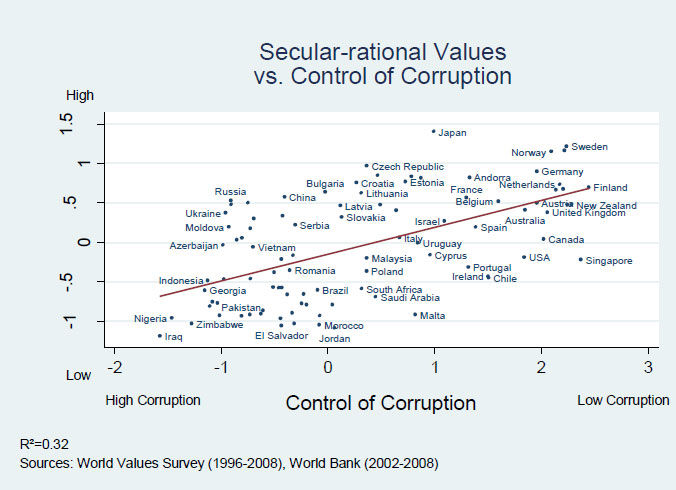
The World Values Survey has some interesting data on how religion and social morality correlates. Unfortunately, the article I'm referring to is from the Norwegian magazine Fri Tanke, but there's always Google Translate.

"[Bo Rothstein] points out that none of the 25 different indicators World Values ​​Survey's measure of human welfare, such as absence of corruption or the degree of confidence increases if religion gets more influence. Rather, it is quite the opposite. The results show that the more a society dominated by secular values, the higher is the human welfare.

- And, add to Rothstein, the same pattern is also evident if one only looks at the country dominated by Christianity
[...]

The degree of religiosity is composed of answers to the following six questions:

- Regardless of whether you go to organized religious practice or not, would you say that you are a religious person, not a religious person, or a convinced atheist?

- Apart from weddings, funerals and baptisms, how often you will meet up at religious arrangements?

- How important is God in your life?

- Do you believe in God?

- Do you believe in life after death?

- Does your religion give you well-being and strength?"
Well, enough talk. Let's see some charts:

Secular-rational values vs. Control of Corruption
Religiosity scale vs. life expectancy
Religiosity scale vs. average schooling years
Traditional values vs. secular rational values

Also, take a look at this Swedish article by Bo Rothstein. (Original)

Friday, October 28, 2011

Better sex without religion, survey shows

"Uh oh. Sex. As America's "war on sex" once again heats up as the country slides toward another presidential election, a new Sex and Secularism study conducted by Kansas University undergraduate Amanda Brown and Dr. Darrel W. Ray is bound to raise some hackles among the religiously faithful. Controversy abounds.

After surveying over 14,500 secularists about their sex lives the study's key findings were as follows:

    Sex improves dramatically after leaving religion.
    Sexual guilt has little staying power after leaving religion.
    Those raised most religious show no difference from those raised least religious in their sexual behavior.
    Those raised most religious experience far more guilt but have just as much sex.
    Religious parents are far worse at educating their children on matters of sex.
    Religious guilt differs in measurable amounts according to denomination.


The authors admit the study was not perfect. It was conducted online, with respondents self-reporting their responses to questions posed, and all of the participants self-identified as currently secular, which could imply a certain motivation on their part to paint a rosy picture of post-religion sexual bliss. The authors feel the sheer number of respondents goes a long way to make up for its methodological weaknesses, and the authors freely admit the purpose of the study was to test six specific hypotheses that can be found on the link bottom of this piece.
[...]
 The study's authors state:

    "Most religions preach strongly against pornography so it is reasonable to think that porn use would be less among the more religious. This survey found that porn use is quite high in all groups and is a key source of sex education for religious teens. The most religious teens said they got their sex education from porn 33% of the time, the less religious 25.2% of the time. The survey found that 90% of men were using pornography by age 21 with no significant difference between those most and least religious. For women, over 50% were using porn by age 21 and 70% at age 30, with little difference between most and least religious.""

Medicalnewstoday.com, 25 May 2011


Intuitive people are more likely to believe in God, study shows

"In a series of studies, researchers at Harvard University found that people with a more intuitive thinking style tend to have stronger beliefs in God than those with a more reflective style. Intuitive thinking means going with one's first instinct and reaching decisions quickly based on automatic cognitive processes. Reflective thinking involves the questioning of first instinct and consideration of other possibilities, thus allowing for counterintuitive decisions.

[...]

Participants who gave intuitive answers to all three problems were 1 ½ times as likely to report they were convinced of God's existence as those who answered all of the questions correctly. That pattern was found regardless of other demographic factors, such as the participants' political beliefs, education or income. "How people think - or fail to think - about the prices of bats and balls is reflected in their thinking, and ultimately their convictions, about the metaphysical order of the universe," the journal article stated.

Participants with an intuitive thinking style also were more likely to have become more confident believers in God over their lifetimes, regardless of whether they had a religious upbringing. Individuals with a reflective style tended to become less confident in their belief in God. The study also found that this pronounced link between differing thinking styles and levels of faith could not be explained by differences in the participants' thinking ability or IQ. "Basic ways of thinking about problem solving in your everyday life are predictive of how much you believe in God," Rand said."

Medicalnewstoday.com, 23 Sep 2011
 I'm tempted to say: "So, they really are more stupid, then?".But that's just my intution which could be wrong.

Thursday, October 27, 2011

In U.S., Increasing Number Have No Religious Identity

"Americans have become increasingly less tied to formal religion in recent decades, with the percentage saying they do not have a specific religious identity growing from near zero in the 1950s to 16% this year and last.

[...]

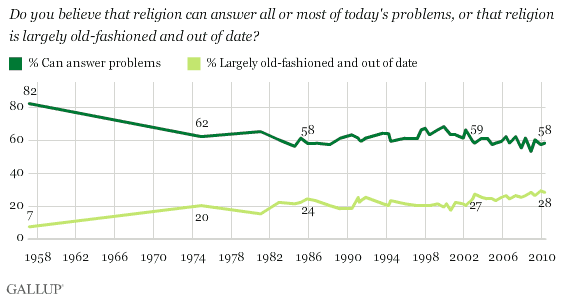
An additional measure Gallup has tracked over time asks Americans if they believe that religion can answer all or most of today's problems, or if they believe religion is largely old-fashioned and out of date.


[...]

Bottom Line
Gallup surveys confirm a downward drift in religious identity among Americans, as well as a slight increase in the number of Americans who view religion as old-fashioned and out of date."

Gallup.com, May 21, 2010

In U.S., 3 in 10 Say They Take the Bible Literally

"Three in 10 Americans interpret the Bible literally, saying it is the actual word of God. That is similar to what Gallup has measured over the last two decades, but down from the 1970s and 1980s. A 49% plurality of Americans say the Bible is the inspired word of God but that it should not be taken literally, consistently the most common view in Gallup's nearly 40-year history of this question. Another 17% consider the Bible an ancient book of stories recorded by man."


Gallup.com, July 8, 2011
Odd fluctuation in recent years.
See the article for lots of other numbers on this issue.

Why do Americans still dislike atheists?

"A growing body of social science research reveals that atheists, and non-religious people in general, are far from the unsavory beings many assume them to be. On basic questions of morality and human decency — issues such as governmental use of torture, the death penalty, punitive hitting of children, racism, sexism, homophobia, anti-Semitism, environmental degradation or human rights — the irreligious tend to be more ethical than their religious peers, particularly compared with those who describe themselves as very religious.

Consider that at the societal level, murder rates are far lower in secularized nations such as Japan or Sweden than they are in the much more religious United States, which also has a much greater portion of its population in prison. Even within this country, those states with the highest levels of church attendance, such as Louisiana and Mississippi, have significantly higher murder rates than far less religious states such as Vermont and Oregon."

Washington Post, Gregory Paul and Phil Zuckerman, April 30

Is religion good for society? See how God's own country compare.

"Take homicide, which is way higher in the United States than in any other advanced country. Same with incarceration – we have more people in prison than China does, and China is four times our size. In no other first world state do so many die as children. Life spans are notably shorter than in other nations. Abortion rates are higher. Also high are gonorrhea and syphilis infections, which are dozens of times lower in parts of Europe. Out of wedlock teen pregnancy? We’re #1. Divorce? Only the Swedes beat us out. Illicit drug use is exceptionally high. As is mental illness. The U.S.is not a total societal basket case, we are typical in suicide rates and alcohol consumption, and score high on marriage rates and income. But when I tallied up the factors used in my Evolutionary Psychology paper on a zero-10 scale American scored a meager three, while the most atheistic democracies scored up to a remarkable eight (none reached 10, there being no utopias.

[...]

So the line that societies cannot help but go to hell in a handcart if they do not follow the dictates of a God is nothing more than a great big lie. Instead, it is the most atheistic democracies, where few ask what Jesus would do, that enjoy the best overall lifestyle conditions. The same trends hold up within the U.S, too: The Northeast is already as secular as parts of Europe and enjoys less dysfunction than the Southeast which is the most conservative Christian; life spans are actually decreasing in the Bible belt. "

Washington Post, Gregory Paul, 10/17/2011

See the full report here: The Chronic Dependence of Popular Religiosity upon Dysfunctional Psychosociological Conditions

Saturday, October 22, 2011

70 percent of scientists believe religion and science are sometimes in conflict

"They interviewed a scientifically selected sample of 275 participants, pulled from a survey of 2,198 tenured and tenure-track faculty in the natural and social sciences at 21 elite U.S. research universities. Only 15 percent of those surveyed said they view religion and science as always in conflict. Another 15 percent said the two are never in conflict, while 70 percent said they believe religion and science are only sometimes in conflict.

[...]

The study was supported by a grant from the John Templeton Foundation with additional funding from Rice University.


[...]

Many of those surveyed cited issues in the public realm (teaching of creationism versus evolution, stem cell research) as reasons for believing there is conflict between the two. The study showed that these individuals generally have a particular kind of religion in mind (and religious people and institutions) when they say that religion and science are in conflict.

Other findings in the study:

    Scientists as a whole are substantially different from the American public in how they view teaching “intelligent design” in public schools. Nearly all of the scientists – religious and nonreligious alike – have a negative impression of the theory of intelligent design.

    Sixty-eight percent of scientists surveyed consider themselves spiritual to some degree.

    Scientists who view themselves as spiritual/religious are less likely to see religion and science in conflict."

Beliefnet, September 23, 2011
I've seen this survey cited in a number of places and nearly all of them has a headline indicating that science and religion are not in conflict, while the numbers clearly state that 70 per cent thinks religion and science are sometimes in conflict. Only 15 per cent thinks religion and science are never in conflict.

Youths are less religious

"In a survey released last year, it was found that 72 percent of millennials were "more spiritual than religious." According to Thom Rainer, president of LifeWay Christian Resources, the group that conducted the study. Rainer explained to USA Today that young adults today do not pray, worship, or read the Bible.

In studying the data of 1,200 18-29 year olds, Rainer found that among the 65 percent who described themselves as Christians, "many are either mushy Christians or Christians in name only; most are just indifferent," said Rainer. "The more precisely you try to measure their Christianity, the fewer you find committed to the faith," he added.

The study found that 65 percent rarely or never pray with others, and 38 percent almost never pray by themselves. In addition, 65 percent rarely or never attend worship services, while 67 percent don not read the Bible or sacred texts."


The Christian Post, Sep. 22 2011

I really can't stand the word "spiritual" but I guess in this case it's better than being religious.

Thursday, October 20, 2011

Religion may become extinct in nine nations, study says

"A study using census data from nine countries shows that religion there is set for extinction, say researchers.

The study found a steady rise in those claiming no religious affiliation.

[...]

The team took census data stretching back as far as a century from countries in which the census queried religious affiliation: Australia, Austria, Canada, the Czech Republic, Finland, Ireland, the Netherlands, New Zealand and Switzerland.

[...]

"The idea is pretty simple," said Richard Wiener of the Research Corporation for Science Advancement, and the University of Arizona.

"It posits that social groups that have more members are going to be more attractive to join, and it posits that social groups have a social status or utility.

[...]

Dr Wiener continued: "In a large number of modern secular democracies, there's been a trend that folk are identifying themselves as non-affiliated with religion; in the Netherlands the number was 40%, and the highest we saw was in the Czech Republic, where the number was 60%."

[...]

And in all the countries, the indications were that religion was headed toward extinction."

BBC News, 22 March 2011

Even in Ireland!

Religious people has higher blood pressure

"Religiosity appears to have little affect on preventing hypertension, or high blood pressure, and those study participants proclaiming to be the most religious were actually the most likely to have hypertension. The study was conducted by medical students at the Loyola University Chicago Stritch School of Medicine and presented on April 30 at the meeting of the Society of Teachers of Family Medicine in New Orleans.

Although a small study presented at a small meeting, it is yet one more report that chisels away at the notion that prayer and belief alone offer significant health benefits.

Many studies indeed have shown that those who attend weekly religious services or participate in church activities have at least marginally better health than non-participants. Yet these studies have focused primarily on physical participation: getting out of the house to a weekly service and being part of a community.

[...]

Marginally significant results aside, these earlier studies could not tease apart what it was about religion — the spiritual act of believing or the physical acts of participating and interacting with neighbors — that provided the purported benefit.
[...]

The Loyola study focused more on the spiritual, not whether a person merely attends church but whether they "carry [their] religion over into all other dealings in life," as cited in the study. Those who were most religious in this regard were the least healthy in terms of high blood pressure.

Other recent studies have focused on spirituality, too, to see if that alone could lower blood pressure, perhaps through mechanisms such as stress reduction. Yet prayer and spirituality were associated with higher blood pressure in a study of more than 3,000 adults published in January 2009 in Social Science Medicine; and they offered no benefit for preventing hypertension for approximately 1,600 women in a study published in June 2009 in Annals of Behavioral Medicine.

Even a life of the cloth seems to provide little protection. The obesity rate among United Methodist clergy is 40 percent, about 10 percent higher than the national rate, as reported in the September 2010 issue of Obesity.

Meanwhile, just about anything that gets someone out of the house can be helpful. Playing bingo, for example, even in a non-religious setting, is associated with a 40-percent reduction in death risk and 65-percent reduction in disability among the elderly, according to a study published in June 2009 in the Archives of Internal Medicine."

LiveScience, Christopher Wanjek, 05 May 2011
I quote this article at length, because it points to a very important effect of religion, the social aspect. So there aren't any metaphysical effects or effects from belief itself, only the effect that getting out of the house provides. Maybe atheists should gather once a week too.

On a personal note, not long ago I actually had fairly high blood pressure. I could hear the blood pumping when I was laying on my bed with the ear to the pillow. Then I started to excercise once a week, and that helped. Now I can't hear the blood pumping anymore.  No need for spirituality, just common sense.