Showing posts with label Sweden. Show all posts

Saturday, February 4, 2012

Why Religion Makes Only Some of Us Happy

"Religious people tend to feel better about themselves and their lives, but a new study finds that this benefit may only hold in places where everyone else is religious, too.
According to the new study of almost 200,000 people in 11 European countries, people who are religious have higher self-esteem and better psychological adjustment than the non-religious only in countries where belief in religion is common. In more secular societies, the religious and the non-religious are equally well-off.

[...]

For example, a believer gets a happiness boost in Turkey, where religion is part of the fabric of daily life and taking part means you're doing the "right" thing in your culture. But that same person wouldn't see any benefit in Sweden, where few people care much about religion.

[...]

Nonetheless, the findings suggest that research on religion and happiness in the United States — where religion is relatively important compared with many other nations — may not apply across all cultures."

Livescience.com, 25 January 2012
In other words, it's good for you to be in the in group.

Thursday, October 27, 2011

Why do Americans still dislike atheists?

"A growing body of social science research reveals that atheists, and non-religious people in general, are far from the unsavory beings many assume them to be. On basic questions of morality and human decency — issues such as governmental use of torture, the death penalty, punitive hitting of children, racism, sexism, homophobia, anti-Semitism, environmental degradation or human rights — the irreligious tend to be more ethical than their religious peers, particularly compared with those who describe themselves as very religious.

Consider that at the societal level, murder rates are far lower in secularized nations such as Japan or Sweden than they are in the much more religious United States, which also has a much greater portion of its population in prison. Even within this country, those states with the highest levels of church attendance, such as Louisiana and Mississippi, have significantly higher murder rates than far less religious states such as Vermont and Oregon."

Washington Post, Gregory Paul and Phil Zuckerman, April 30

Saturday, February 14, 2009

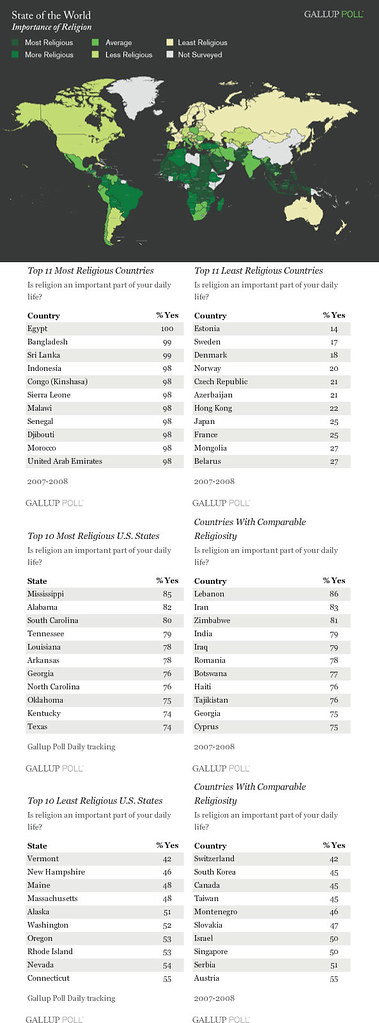
Most and least religious countries in the world

Here's an interesting Gallup survey listing up which countries are most and least religious, and comparison to US states. Always nice to keep around when there are discussions about how important religion is for your well-being. (The poll data is based upon interviews from 2006, 2007 and 2008, the article seems to be brand new: February 9, 2009.)


See also this post about religion and social issues.

Monday, August 25, 2008

Society Without God: What the Least Religious Nations Can Tell Us About Contentment

"Sociologist Zuckerman spent a year in Scandinavia seeking to understand how Denmark and Sweden became “probably the least religious countries in the world, and possibly in the history of the world.” While many people, especially Christian conservatives, argue that godless societies devolve into lawlessness and immorality, Denmark and Sweden enjoy strong economies, low crime rates, high standards of living and social equality. Zuckerman interviewed 150 Danes and Swedes, and extended transcripts from some of those interviews provide the book's most interesting and revealing moments."

Publishers Weekly, 8/11/2008


Considering the sheer amount of American Christians who refer to the Soviet Union as a prime example of what an irreligious society can be like, this should provide some food for thought.

Wednesday, February 20, 2008

Sweden: Muslims required to divorce according to Sharia law

"The social services in Karlshamn are apparently discriminating against Muslims. Muslims who apply for welfare support need to show a certificate that they've been divorced, not only from a court, but also from an imam.
Susanne Loveheim, head of the welfare services in Karlshamn says that it isn't a strange procedure since Muslim custom requires them to go through an imam for the divorce to be considered complete.
The discrimination ombudsman (DO) is critical of this procedure since it discriminates against Muslims. Katri Linna, discrimination ombudsman, says that it's clear that they've been divorced according to Swedish law, and there's no reason for a special certificate. The DO wants the municipality of Karlshamn to stop the special requirement from Muslims. They will continue to take up the matter with the National Board of Health and Welfare and will make sure that they tighten up their guidelines.
Sweden Radio has discovered that Örebro also requires a divorce certificate from an imam. The DO is now considering to start a nation-wide investigation to see how wide-spread this procedure is and whether it's discriminatory against Muslims.

Islamineurope.blogspot.com, February 20, 2008
Now, apart from the shock-horror factor, this poses an interesting problem. Firstly, it shows how unfair a multiculturalist interpretatation of sharia is. There is one law for muslims and one for others. Some nominal Muslims may not feel the need for an Imam to bother, and should not have to deal with him.
However, there's the welfare thing. What if you are a more or less devout Muslim, who do not think that you are properly divorced unless you are divorced by an imam. Technically, a secular divorce then, is no divorce. Yet, you get welfare benefits.
Of course, a proper divorce means you don't live together, but I'm starting to think that this isn't really a multiculturalist invention, it's someone trying to save money by making sure Muslims are through and through divorced.
But it's completely wrong. The only way to deal with this is to make sharia divorces completely irrelevant. Who on earth brought this up in the first place? It should be outlawed.
Muslims must all recognize Swedish law. And Swedish law must recognize Muslims when they do.

Sunday, January 20, 2008

Swedes don't need a book to be moral

I found an interesting Swedish story in the Christian paper Dagen that I translated the gist of:

"A new survey, the Bible barometre 2008, shows that 32 per cent of Swedes think the bible is important for their own morality and ethics.
Krister Andersson, secretary of the Bible company, says that an earlier survey has shown that the golden rule is at the core of Swedish morality.
When the question is more open: "Is there any writing that strongly affected your ethics and morality?" 20 per cent mentioned the bible. Of the other alternatives, the UN Declaration of Human Rights was the most common with 4 per cent.
But most people, 62 per cent, hadn't read any writing at all that made such an impression.
- This is very surprising. I thought more people were going to say that they had some sort of written or scriptural starting point for their moral judgements, says Krister Andersson.
He was also struck by the variation of writings and writers that were mentioned under "Other". On the list there's among others The Diary of Anne Frank, newspapers, Dalai Lama, Fröding, Greek philosophers, the Swedish Law, the catecism, and the scout law. Some of the asked also mentioned the upbringing they were given by their parents: "I try to be honest and fair to people."
As with the Biblebarometre 2006 and 2007 this year's survey shows that about eveyr tenth person reads the bible at least once a month, while four out of read it only rarely.
Those who consider the bible most important are the older generations, 65 years and older."

Dagen.se, 2008-01-17
What I liked about this survey wasn't merely that it showed how many read or didn't read the bible, but it showed that 62 per cent did not pick up their morality from a particular book.
I think it's fair to say that they hardly discovered their moral principles within their own heads, but that they don't simply stick to one book or one type of philosophy. Throughout life most of us read a lot, listen to a lot, and watch a lot and doing this we absorb a lot of moral reasoning. And we stick to the ideas that make sense to us personally instead of being too dependant on one book. Let's say you need advice, would you not preferably want to get it from more than one person?

It also reminded me about something Dawkins wrote in The God Delusion (p. 265):
"First, how is [the moral zeitgeist] synchronized across so many people? It spreads itself from mind to mind through conversations in bars and at dinner parties, through books and book reviews, through newspapers and broadcasting, and nowadays through the Internet. Changes in the moral climate are signalled in editorials, on radio talk shows, in political speeches, in the patter of stand-up comedians and the scripts of soap operas, in the votes of parliaments making laws and the decisions of judges interpreting them."
On the subject of books, I'll plug a new book from Prometheus books that I think could be worthwhile to read. Knowing myself I'm not sure I would get through its 800 pages, but if you're going to read one book this year, then this might be the book.
Successor to the highly acclaimed Encyclopedia of Unbelief (1985), edited by the late Gordon Stein, the New Encyclopedia of Unbelief is a comprehensive reference work on the history, beliefs, and thinking of America’s fastest growing minority: those who live without religion. All-new articles by the field’s foremost scholars describe and explain every aspect of atheism, agnosticism, secular humanism, secularism, and religious skepticism. Topics include morality without religion, unbelief in the historicity of Jesus, critiques of intelligent design theory, unbelief and sexual values, and summaries of the state of unbelief around the world. More than 130 respected scholars and activists worldwide served on the editorial advisory board and over 100 authoritative contributors have written in excess of 500 entries.

In addition to covering developments since the publication of the original edition, the New Encyclopedia of Unbelief includes a larger number of biographical entries and much-expanded coverage of the linkages between unbelief and social reform movements of the 19th and 20th centuries, including the labor movement, woman suffrage, anarchism, sex radicalism, and second-wave feminism.

The distinguished contributors—philosophers, scientists, scholars, and Nobel Prize laureates—include Robert Alley, Joe Barnhart, David Berman, Sir Hermann Bondi, Vern L. Bullough, Noam Chomsky, Daniel Dennett, Paul Edwards, Barbara Ehrenreich, Antony Flew, Annie Laurie Gaylor, Peter Hare, Van Harvey, Susan Jacoby, Paul Kurtz, Richard Leakey, Gerd Lüdemann, Michael Martin, Martin E. Marty, Kai Nielsen, Steven Pinker, Robert M. Price, Richard Rorty, John R. Searle, Peter Singer, Ibn Warraq, Steven Weinberg, George A. Wells, David Tribe, Sherwin Wine, and many others.

With a foreword by evolutionary biologist and best-selling author Richard Dawkins, this unparalleled reference work provides comprehensive knowledge about unbelief in its many varieties and manifestations.

About the Author
Tom Flynn (Amherst, NY) is the editor of Free Inquiry magazine, director of the Center for Inquiry, founding coeditor of Secular Humanist Bulletin, director of the Robert Green Ingersoll Birthplace Museum, and the author of The Trouble with Christmas, Galactic Rapture, and Nothing Sacred.

Friday, September 21, 2007

Offensive stats


Has anyone noticed the way Muslims use statistics these days? Well, the rest of us can use statistics too.

Friday, May 4, 2007

[Warning] US evangelicals aim to influence European law

”—In Britain, the Alliance Defense Fund (ADF), an organization founded by American evangelical leaders, is funding a lawsuit brought by a Christian man who was fired for refusing to work on Sunday. It is also helping to develop the legal strategy.
—In Sweden, ADF played a key role in persuading the Supreme Court to dismiss charges against Ake Green, a pastor who was convicted of hate-crime charges after he delivered a sermon in which he called gays a “deep cancerous tumor in the entire society.”
—In Aruba and the Czech Republic, Pat Robertson’s legal organization, the American Center for Law and Justice (ACLJ), helped defeat bills that would have legalized same-sex unions.
—In France, ACLJ affiliate ECLJ (the European Center for Law and Justice), is staging a legal challenge against an antisect law that it says is being used to clamp down on evangelical Christian churches.
—And on the European Union level, ECLJ is lobbying to block funding for embryonic stem-cell research.”

evangelicalright.com
Oh, and use protection!