Showing posts with label sex. Show all posts

Friday, October 28, 2011

Better sex without religion, survey shows

"Uh oh. Sex. As America's "war on sex" once again heats up as the country slides toward another presidential election, a new Sex and Secularism study conducted by Kansas University undergraduate Amanda Brown and Dr. Darrel W. Ray is bound to raise some hackles among the religiously faithful. Controversy abounds.

After surveying over 14,500 secularists about their sex lives the study's key findings were as follows:

    Sex improves dramatically after leaving religion.
    Sexual guilt has little staying power after leaving religion.
    Those raised most religious show no difference from those raised least religious in their sexual behavior.
    Those raised most religious experience far more guilt but have just as much sex.
    Religious parents are far worse at educating their children on matters of sex.
    Religious guilt differs in measurable amounts according to denomination.


The authors admit the study was not perfect. It was conducted online, with respondents self-reporting their responses to questions posed, and all of the participants self-identified as currently secular, which could imply a certain motivation on their part to paint a rosy picture of post-religion sexual bliss. The authors feel the sheer number of respondents goes a long way to make up for its methodological weaknesses, and the authors freely admit the purpose of the study was to test six specific hypotheses that can be found on the link bottom of this piece.
[...]
 The study's authors state:

    "Most religions preach strongly against pornography so it is reasonable to think that porn use would be less among the more religious. This survey found that porn use is quite high in all groups and is a key source of sex education for religious teens. The most religious teens said they got their sex education from porn 33% of the time, the less religious 25.2% of the time. The survey found that 90% of men were using pornography by age 21 with no significant difference between those most and least religious. For women, over 50% were using porn by age 21 and 70% at age 30, with little difference between most and least religious.""

Medicalnewstoday.com, 25 May 2011


Thursday, April 10, 2008

Muslim sex offenders may opt out of treatment

"Muslim sex offenders may be allowed to opt out of a prison treatment programme because it is against their religion, it has emerged. The Prison Service's Muslim advisor has said there is a "legitimate Islamic position" that criminals should not discuss their crimes with others. Under the Sex Offender Treatment Programme (SOTP), which treats more than 600 prisoners including rapists and sexual killers each year, offenders must discuss their crime, sometimes in groups."

Telegraph.co.uk, 09/04/2008
This is fucking ridiculous.
If they're going to serve longer sentences instead, that's one thing, but if the programme works, then that is the most important aspect. They can not wave their stupid religion for everything :
"Article 9 – Freedom of thought, conscience and religion
2. Freedom to manifest one's religion or beliefs shall be subject only to such limitations as are prescribed by law and are necessary in a democratic society in the interests of public safety, for the protection of public order, health or morals, or for the protection of the rights and freedoms of others.

Convention for the Protection of Human Rights and Fundamental Freedoms, Rome, 4.XI.1950"
It's fairly obvious that if they deny to take part in the programme, and end up raping again, then they have use their religion to infringe upon others' rights.


Sunday, April 6, 2008

Anglo-Saxon attitudes

The March 29th issue of The Economist had some interesting charts showing how Britons and Americans differ on several issues:

It's not surprising how many believes in God and Hell and attitudes to Atheist presidents, but I thought it was interesting to see the differences on Creationism and Intelligent Design in USA. That 20 per cent of Americans believe in Intelligent Design while 40 per cent of them believe in "The Bible" is in a sense good news, because it just shows that the problem is a lack of basic education. Intelligent Design is in many ways more insidious, while the bible version is much more primitive. I think good education stand a better chance with Creationism than with Intelligent Design, because ID is stupidity on a much more abstract level disguising itself as science. You also see that in Britain, there's slightly more people who believe in ID than Creationism.


As for values, the only place they seem to concur is about death penalty.


This chart is a bit difficult to read, but I think it's a summary of how they responded in the other charts after party lines. Notice how even English Conservatives are much more liberal with regards to religion and values than American democrats.

Thursday, March 6, 2008

Virtual Museum of Offensive Art

In these times, when blasphemy is all the rage, the Virtual Museum of Offensive Art is a welcome resource website. You'll find a lot of controversial works of art here, that prudes of all types have wanted to ban. Plenty of blasphemy, but also plenty of sex and a little politics.
(Found at the NewHumanist blog.)

Sunday, March 2, 2008

Spanking Kids Increases Risk Of Sexual Problems As Adults

"Children who are spanked or victims of other corporal punishment are more likely to have sexual problems as a teen or adult, according to new research presented today by Murray Straus, co-director of the Family Research Laboratory at the University of New Hampshire.

[...]


Straus analyzed the results of four studies and found that spanking and other corporal punishment by parents is associated with an increased probability of three sexual problems as a teen or adult:

* Verbally and physically coercing a dating partner to have sex.

* Risky sex such as premarital sex without a condom.

* Masochistic sex
such as being aroused by being spanked when having sex.

“These results, together with the results of more than 100 other studies, suggest that spanking is one of the roots of relationship violence and mental health problems. Because there is 93 percent agreement between studies that investigated harmful side effects of spanking, and because over 90 percent of U.S. parents spank toddlers, the potential benefits for prevention of sexual and relationship violence is large,” Straus says."


ScienceDaily, Mar. 2, 2008
And the reason why I post this here is that corporal punishment is favoured among religious conservatives.
The most grave aspect (after they grow up) is verbal and physical coercion. Can you say rape? It has to be said though, that calling sado-masochism a sexual problem is stretching it a bit far if it's consenting, and not of the extreme variety.(No, it's not my thing)

Now, a little bible reading will do:
Hebrews 12:6 For whom the Lord loveth he chasteneth, and scourgeth every son whom he receiveth.
I looked this up earlier, because at least in Norway, there has been discussions among theologians whether or not this just meant teaching your children to behave. To liberal Christians, this is no doubt a preferable interpretation, (and to society too I must admit).
But after looking it up at Scripturetext.com (hit the Lexicon tab) I think it is safe to say that this is not just about teaching:

As you can see, the word mastigoo is used, meaning to flog, scourge. To put things into perspective, we can have a look at Matthew 20:19: "And shall deliver him to the Gentiles to mock, and to scourge, and to crucify him: and the third day he shall rise again.". And yes, it's the word mastigoo that is used.

You can also see the other places it has been used.

Still, there's another thing that complicates this. Hebrews 12:6 refers to Psalms 94:12: "Blessed is the man whom thou chastenest, O LORD, and teachest him out of thy law;"

"Chasteneth" can be physical, but notice that there's no mention of outright flogging. The reason is that the writer of Hebrews only had access to the Septuagint, the less than perfect Greek translation of the Old Testament. However, from what I can see, mastigoo does not appear in the Septuagint version of Psalms 94:12

Maybe the write of Hebrews was a sadist, but I'll leave it there, because I realize I'm on fairly deep water now. But I think it's safe to say that the verse in Hebrews has caused a lot of grief, and that it's not necessarily the correct reference to Psalms 94:12.
In any case, you don't flog your children like the Romans flogged Jesus.

Reaping the benefits of a good Christian upbringing:

Thursday, February 28, 2008

Ireland is running out of priests

"One-hundred and sixty priests died last year but only nine were ordained. Figures for nuns were even more dramatic, with the deaths of 228 nuns and only two taking final vows for service in religious life.
Based upon these figures The Irish Catholic newspaper predicts that the number of priests will drop from the current 4,752 to about 1,500 by 2028.
The decline in vocations is attributed to the loss of the Church’s authority after a string of sex-abuse scandals. In 1994 the Government collapsed over the mishandling of the case of a paedophile priest Brendan Smyth.

[...]

Ireland is now the vocations blackspot of the world."

The Times, February 27, 2008
In other news:
Pope not Catholic anymore

Sunday, February 24, 2008

The reality of America’s ‘sexual culture’

"Journalist Pamela Druckerman didn’t think it would be hard to discuss sex issues with Alain Giami of the French National Institute of Health and Medical Research.[...]
“What do you call ‘infidelity’? I don’t know what ‘infidelity’ is,” he said, in what the former Wall Street Journal correspondent later described as a “rant.”
“I don’t share this view of things, so I would not use this word,” he added, and then delivered the coup de grace. “It implies religious values.”

[...]

While she didn’t set out to write a book about sex and religion, Druckerman found that in large parts of the world — from Bible Belt cities to Orthodox Jewish enclaves, from Islamic nations to post-Soviet Russia — it’s hard to talk about infidelity without talking about sin, guilt, confession, healing and a flock of other religious topics.
However, she also reached a conclusion that many clergy would find disturbing. When push comes to shove, cheaters are going to do what they’re going to do — whether God is watching or not.

[...]

Recent studies offer a vivid contrast[to the Kinsey report]. In the early 1990s, she noted, 21 percent of American men and 10 percent of women said they had cheated while married. In 2004, 21 percent of men and 12 percent of women said they had strayed at least once.
Meanwhile, 3.8 percent of married French men and 2 percent of married French women say they’ve had an affair during the past year — in one of the world’s most secular nations. And in highly religious America? The parallel figures are 3.9 percent of the married men and 3.1 percent of the women.

[...]

“Even when I talked to religious people about adultery, they weren’t really worried about God, about God striking them down for their sins,” concluded Druckerman. “Americans just don’t think that way now. Even the religious people were more worried about what their families, or perhaps the people in their religious communities, would think of them. ...
“When it comes to matters of infidelity, Christian Americans act more like Americans than they do like Christians.”

The Daily Dispatch, Sunday, February 24, 2008

Friday, February 22, 2008

America still works

"Many observers abroad have the impression that Americans are growing more religious, while Europeans are growing more secular. This simply isn't true. Americans are far more religious than western Europeans, but in the US, no less than in Europe, the long-term trend is towards greater secularism.
In a 2001 study of religious attitudes among Americans, researchers at the City University of New York discovered that the number of Americans who profess no religion had grown from 8.16 per cent in 1990 to 14.17 per cent in 2000. Americans with no religion at all are now the third largest belief group in the US after Catholics and Baptists, and their number, around 30m, is almost as great as that of Baptists, who number around 34m. Moreover, the number of Americans who, even if they believe in God, do not belong to any religious organisation went from 46 per cent in 1990 to a 54 per cent majority by 2000, according to the study.
When the subject is actual church attendance rather than vague spiritual belief, the gap between the US and Europe shrinks further. According to the Gallup millennium survey of religious views, the number of North Americans (the US plus Canada) who attend church at least once a week is 47 per cent, compared with the west European average of 20 per cent. And some scholars say that the number is inflated, because many Americans are embarrassed to tell pollsters how rarely they attend church.
According to the Gallup poll, the number of North Americans who believe that the Bible is "the actual word of God" has fallen from 65 per cent in 1963 to just 27 per cent in 2001. At the same time, attitudes among Americans toward homosexuality, sex out of marriage and censorship are growing steadily more liberal. Abortion is the major exception; younger Americans tend to be more opposed to abortion than their elders. Possibly this reflects the growing use of ultrasound by parents to view their offspring in the womb, a practice which may be inadvertently undermining the distinction that supporters of liberal abortion laws have tried to make between foetuses and babies."
Michael Lind, Prospect Magazine (UK), February 2008
Another interesting development:

[...]

"Some will wish to argue that the slowing growth rate is evidence of an increasing secularization of American postmodern society," said the Rev. Dr. Eileen W. Lindner, editor of the Yearbook. "While such an explanation will satisfy some, caution in drawing such a conclusion is warranted."

[...]


Largest 25 Churches (ranked by membership)

1. The Catholic Church – 67,515,016
2. Southern Baptist Convention – 16,306,246
3. The United Methodist Church – 7,995,456
4. The Church of Jesus Christ of Latter-day Saints – 5,779,316
5. The Church of God in Christ – 5,499,875
6. National Baptist Convention, U.S.A., Inc. – 5,000,000
7. Evangelical Lutheran Church in America – 4,774,203
8. National Baptist Convention of America, Inc. – 3,500,000
9. Presbyterian Church (U.S.A.) – 3,025,740
10. Assemblies of God – 2,836,174
11. African Methodist Episcopal Church – 2,500,000
12. National Missionary Baptist Convention of America – 2,500,000
13. Progressive National Baptist Convention, Inc. – 2,500,000
14. The Lutheran Church - Missouri Synod (LCMS) – 2,417,997
15. Episcopal Church – 2,154,572
16. Churches of Christ – 1,639,495
17. Greek Orthodox Archdiocese of America – 1,500,000
18. Pentecostal Assemblies of the World, Inc. – 1,500,000
19. The African Methodist Episcopal Zion Church – 1,443,405
20. American Baptist Churches in the U.S.A. – 1,371,278
21. United Church of Christ – 1,218,541
22. Baptist Bible Fellowship International – 1,200,000
23. Christian Churches and Churches of Christ – 1,071,616
24. The Orthodox Church in America – 1,064,000
25. Jehovah’s Witnesses – 1,069,530

Christian Post, Feb. 20 2008
I'm satisfied, all right! When the biggest growth is JWs and Mormons, it probably means that "mainstream "Christianity is standing pretty still. See also my previous post on increasingly secular Catholics.

Thursday, February 14, 2008

Statistics on Christians and porn

"* April 6, 2007: 70% of Christians admitted to struggling with porn in their daily lives. From a non-scientific poll taken by XXXChurch, as reported by CNN.
* August 7,2006: 50% of all Christian men and 20% of all Christian women are addicted to pornography. 60% of the women who answered the survey admitted to having significant struggles with lust; 40% admitted to being involved in sexual sin in the past year; and 20% of the church-going female participants struggle with looking at pornography on an ongoing basis.
From the results of a ChristiaNet poll reported by Marketwire.com
* In December of 2000, the National Coalition to Protect Children and Families surveyed 5 Christian Campuses to see how the next generation of believers was doing with sexual purity:
48% of males admitted to current porn use
68% of males said they intentionally viewed a sexually explicit site at the school
* Roger Charman of Focus on the Family's Pastoral Ministries reports that approximately 20 percent of the calls received on their Pastoral Care Line are for help with issues such as pornography and compulsive sexual behavior.
* A 1996 Promise Keepers survey at one of their stadium events revealed that over 50% of the men in attendance were involved with pornography within one week of attending the event.
* In 2000 Christianity Today survey, 33% of clergy admitted to having visited a sexually explicit Web site. Of those who had visited a porn site, 53% had visited such sites “a few times” in the past year, and 18% visit sexually explicit sites between a couple of times a month and more than once a week.
* Out of 81 pastors surveyed (74 males 7 female), 98% had been exposed to porn; 43% intentionally accessed a sexually explicit website
National Coalition survey of pastors. Seattle. April 2000."

Safe Families
It's a long list. (Picked up from kellym78)
Notice how they all "struggle" with porn. Maybe change ISP so they can download faster?

Tuesday, February 12, 2008

Homicide and religion linked


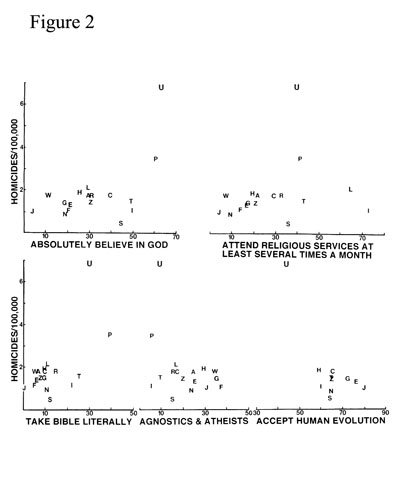
"In general, higher rates of belief in and worship of a creator correlate with higher rates of homicide, juvenile and early adult mortality, STD infection rates, teen pregnancy, and abortion in the prosperous democracies (Figures 1-9). The most theistic prosperous democracy, the U.S., is exceptional, but not in the manner Franklin predicted. The United States is almost always the most dysfunctional of the developed democracies, sometimes spectacularly so, and almost always scores poorly. The view of the U.S. as a “shining city on the hill” to the rest of the world is falsified when it comes to basic measures of societal health. Youth suicide is an exception to the general trend because there is not a significant relationship between it and religious or secular factors. No democracy is known to have combined strong religiosity and popular denial of evolution with high rates of societal health. Higher rates of non-theism and acceptance of human evolution usually correlate with lower rates of dysfunction, and the least theistic nations are usually the least dysfunctional. None of the strongly secularized, pro-evolution democracies is experiencing high levels of measurable dysfunction. In some cases the highly religious U.S. is an outlier in terms of societal dysfunction from less theistic but otherwise socially comparable secular developed democracies. In other cases, the correlations are strongly graded, sometimes outstandingly so.

Legend: A = Australia, C = Canada, D = Denmark, E = Great Britain, F = France, G = Germany, H = Holland, I = Ireland, J = Japan, L = Switzerland, N = Norway, P = Portugal, R = Austria, S = Spain, T = Italy, U = United States, W = Sweden, Z = New Zealand.

Cross-National Correlations of Quantifiable Societal Health with Popular Religiosity and Secularism in the Prosperous Democracies. Gregory S. Paul, 2005.

Plenty of other figures and text in the article.
See also a new article (1. February 2008) by Gregory S. Paul: Why is Secular European Society Doing so Much Better Than God-Fearing America?

Sunday, January 20, 2008

Swedes don't need a book to be moral

I found an interesting Swedish story in the Christian paper Dagen that I translated the gist of:

"A new survey, the Bible barometre 2008, shows that 32 per cent of Swedes think the bible is important for their own morality and ethics.
Krister Andersson, secretary of the Bible company, says that an earlier survey has shown that the golden rule is at the core of Swedish morality.
When the question is more open: "Is there any writing that strongly affected your ethics and morality?" 20 per cent mentioned the bible. Of the other alternatives, the UN Declaration of Human Rights was the most common with 4 per cent.
But most people, 62 per cent, hadn't read any writing at all that made such an impression.
- This is very surprising. I thought more people were going to say that they had some sort of written or scriptural starting point for their moral judgements, says Krister Andersson.
He was also struck by the variation of writings and writers that were mentioned under "Other". On the list there's among others The Diary of Anne Frank, newspapers, Dalai Lama, Fröding, Greek philosophers, the Swedish Law, the catecism, and the scout law. Some of the asked also mentioned the upbringing they were given by their parents: "I try to be honest and fair to people."
As with the Biblebarometre 2006 and 2007 this year's survey shows that about eveyr tenth person reads the bible at least once a month, while four out of read it only rarely.
Those who consider the bible most important are the older generations, 65 years and older."

Dagen.se, 2008-01-17
What I liked about this survey wasn't merely that it showed how many read or didn't read the bible, but it showed that 62 per cent did not pick up their morality from a particular book.
I think it's fair to say that they hardly discovered their moral principles within their own heads, but that they don't simply stick to one book or one type of philosophy. Throughout life most of us read a lot, listen to a lot, and watch a lot and doing this we absorb a lot of moral reasoning. And we stick to the ideas that make sense to us personally instead of being too dependant on one book. Let's say you need advice, would you not preferably want to get it from more than one person?

It also reminded me about something Dawkins wrote in The God Delusion (p. 265):
"First, how is [the moral zeitgeist] synchronized across so many people? It spreads itself from mind to mind through conversations in bars and at dinner parties, through books and book reviews, through newspapers and broadcasting, and nowadays through the Internet. Changes in the moral climate are signalled in editorials, on radio talk shows, in political speeches, in the patter of stand-up comedians and the scripts of soap operas, in the votes of parliaments making laws and the decisions of judges interpreting them."
On the subject of books, I'll plug a new book from Prometheus books that I think could be worthwhile to read. Knowing myself I'm not sure I would get through its 800 pages, but if you're going to read one book this year, then this might be the book.
Successor to the highly acclaimed Encyclopedia of Unbelief (1985), edited by the late Gordon Stein, the New Encyclopedia of Unbelief is a comprehensive reference work on the history, beliefs, and thinking of America’s fastest growing minority: those who live without religion. All-new articles by the field’s foremost scholars describe and explain every aspect of atheism, agnosticism, secular humanism, secularism, and religious skepticism. Topics include morality without religion, unbelief in the historicity of Jesus, critiques of intelligent design theory, unbelief and sexual values, and summaries of the state of unbelief around the world. More than 130 respected scholars and activists worldwide served on the editorial advisory board and over 100 authoritative contributors have written in excess of 500 entries.

In addition to covering developments since the publication of the original edition, the New Encyclopedia of Unbelief includes a larger number of biographical entries and much-expanded coverage of the linkages between unbelief and social reform movements of the 19th and 20th centuries, including the labor movement, woman suffrage, anarchism, sex radicalism, and second-wave feminism.

The distinguished contributors—philosophers, scientists, scholars, and Nobel Prize laureates—include Robert Alley, Joe Barnhart, David Berman, Sir Hermann Bondi, Vern L. Bullough, Noam Chomsky, Daniel Dennett, Paul Edwards, Barbara Ehrenreich, Antony Flew, Annie Laurie Gaylor, Peter Hare, Van Harvey, Susan Jacoby, Paul Kurtz, Richard Leakey, Gerd Lüdemann, Michael Martin, Martin E. Marty, Kai Nielsen, Steven Pinker, Robert M. Price, Richard Rorty, John R. Searle, Peter Singer, Ibn Warraq, Steven Weinberg, George A. Wells, David Tribe, Sherwin Wine, and many others.

With a foreword by evolutionary biologist and best-selling author Richard Dawkins, this unparalleled reference work provides comprehensive knowledge about unbelief in its many varieties and manifestations.

About the Author
Tom Flynn (Amherst, NY) is the editor of Free Inquiry magazine, director of the Center for Inquiry, founding coeditor of Secular Humanist Bulletin, director of the Robert Green Ingersoll Birthplace Museum, and the author of The Trouble with Christmas, Galactic Rapture, and Nothing Sacred.

Monday, December 24, 2007

The Triumph of Reason

"Moderate believers simply compound the problem by providing respectability and cover for the extremists of their ilk. Do I appreciate the more accepting people among the faithful? Sure. Ultimately, though, they are still responsible for perpetuating and propagating their worldview. If we could get to the point where the cafeteria Christians and Muslims are taken out of the equation, we could effectively stamp out the religious violence that occurs every day because it would be acceptable to excoriate faith-based belief systems. We could do exactly what Sam Harris talks about in his book, The End of Faith, which describes the effectiveness of ridicule as a tool for social change. As long as it is taboo to criticize religion, that will be impossible.

[...]

If Ms. Pollitt is looking for a one-track route to de-conversion, she'll likely be looking from now until the day that she dies. Every person is different and will respond to the arguments against religion in many ways."

Kelly O'Connor, OpEdNews.com, December 18, 2007
The first part is a familiar line for many that I agree wholeheartedly with. The last part is something that not many of the whiners realize. I keep hearing these funny solutions, like "Scandinavia has a good welfare system, so welfare will make people secular - not angry atheism". Or it may be some other solution (or most likely non-solution) that incorporates everything but honest arguments for Atheism and rational thinking.

To show how silly this is, let me dwell with the welfare state argument a bit: Scandinavia also has had protestant state churches, homogenous populations, was relieved of religious bigots when the religious bigots went to America in the 1800s, was christened so late we still call it Jul (as in Yule) instead of Christmas and we have cool languages.
I don't know, but it seems to me that welfare itself is not some magical formular for secularisation. I'm all for welfare though, but it won't be enough. (Yeah I know I said I was a Libertarian in my previous post but as it goes: "We're all social democrats". I think Post-Libertarian could be a good expression for me. )

Anyway. Most important: it so happens that religious bigotry many places blocks introduction of state welfare either directly or indirectly. What do you do then? I think it's an open question if USA becomes as secular as Norway first or starts using the same welfare state model first. I wouldn't bet that introducing the welfare state in USA is somehow the easier way to making it a godless satanic darwinian country.
Now as Kelly here points out, people are different. The God Delusion or the RRS for that matter does not work with irrational new age hippies who keep crystal pyramids under their beds. But it might work for a guy who just happened to grow up in a religious area without ever making a conscious choice to join the religion that he belongs to and who's generally a rational person.
In short, there are a few billion people in the world who are still not Atheists, and just as all these people have their particular tastes in sex, politics, interior decorating, music etc. - in the same way they will respond quite differently to Atheist arguments. So we need lots of different Atheist or secular arguments. What we don't need is that people shut up.
There's a lot of things that religious conservatives don't like: New Atheism, feminism, LGBT rights, welfare state, science and probably much more. Much, much, more. Think of these things as fronts, like in a war. The more fronts that surround them, the better. That's the perspective we need.
For instance: I'm not a feminist, but I appreciate wholeheartedly the efforts that feminists make to undermine religious conservatives to relieve women of these insane rules.

Religion is not an object with only one side. It can be attacked from many sides, and New Atheism attacks one side that is wide open.

Tuesday, October 9, 2007

Terry Sanderson: When Diversity Becomes Divisiveness

"The story about Sainsbury’s allowing their Muslim staff to refuse to sell alcohol – or even stack it on shelves if they don’t want to – was widely reported last week. Most people thought it just another minor example of the “political correctness gone mad” tabloid tale. [...] The woman who was refused the morning after pill by a Muslim pharmacist joins the growing number of people who have found themselves confronted with religious objections to perfectly legal activities. We have lived for a long time with the refusal of some Catholic doctors to provide abortion services, and the resistance of religious bodies to the introduction of a law that would permit assisted dying. [...] But now that idea of being exempted from service provision on grounds of religion is expanding. We have had cases of taxi drivers refusing to carry guide dogs in their cabs because of Koranic objections, we have had doctors refusing to prescribe contraception, and a Muslim policeman refusing to guard the Israeli embassy and Jewish policemen demanding to be excused duties on Saturday. Now we have shop workers in supermarkets wanting to pick and choose what goods they will sell."

Terry Sanderson, National Secular Society, 5. October 2007
Seems to me it's a perfectly good reason to avoid hiring religious people. Is it discrimination to avoid hiring a person that is going to discriminate? I don't think so.
It also has to be said that in Islam, it's not even haram to drink alcohol. It's just that they expect it to lead to haram if you have a couple of drinks. But that shouldn't affect selling it. And also, transporting dogs is not haram either.
These Muslims are trying hard to be holier than Muhammed, and they should get no respect.

See also:
The Herald: Sainsbury’s does Islam no favours
Daily Mail: Muslim medical students refuse to learn about alcohol or sexual diseases

Wednesday, August 8, 2007

The World's Stupidest Fatwas

"No central authority controls doctrine in Islam, one of the world’s great religions. The result? A proliferation of bizarre religious edicts against targets ranging from Salman Rushdie to polio vaccinations."

Foreign Policy, July 2007

Monday, August 6, 2007

Prejudice alive and well in America

"By a wide margin, respondents believe Americans think Muslims are the most likely to engage in terrorism (83 percent). Moreover, 42 percent believe Americans would be most concerned about their child dating a Muslim; followed by an atheist (17 percent), and a Mormon (14 percent). In addition:
* 37 percent believe Americans think Catholics are most likely to be involved in sexual abuse-far more than any other religious group.

[...]

62 percent said they believe Americans oppose same-sex marriages. Yet 58 percent would elect a gay person for president-about the same as for an Arab-American (57 percent), and more than for a person over age 70 (51 percent), or for an atheist (51 percent)."


Frost Illustrated, 1. August 2007

Why have sex? Motivations range from greed to God

"New research published in the August issue of Archives of Sexual Behavior has come up with a list of 237 reasons that motivate people to have sex.

[...]

She said she was also surprised that some people said they had sex "to get closer to God." "Most of the literature shows that religious people have more sexual problems," she said. "But several people endorsed the idea that religion and sexuality were actually closely linked."

Baltimore Sun, August 1, 2007

Sunday, August 5, 2007

Thoughts on the Afterlife Among U.S. Adults 50+

"To varying degrees, those surveyed say they believe in...

* God (94%)
* life after death (73%)
* the existence of spirits or ghosts (53%)
* heaven (86%) and hell (70%)

While 66 percent say their confidence in life after death has increased as they've gotten older, 20 percent report being frightened when considering what happens to them when they die. In examining the possible influences of afterlife beliefs and demographic variables, three factors emerge as most strongly related to fear of death:

* being somewhat religious (compared to “very religious” and “not at all religious”)
* believing that death is the end
* belief in the existence of hell

When gender, employment, age, education and marital status are taken into account, [low] income emerges as the only demographic factor significantly related to fear of death and as a strong predictor of being afraid to think about it."

AARP, June 2007
They also made a follow up:

"To begin, we found that people 50 and over tend to be downright conventional in their basic beliefs: nearly three quarters (73 percent) agree with the statement “I believe in life after death.” Women are a lot more likely to believe in an afterlife (80 percent) than men (64 percent).

[...]

Believers show general agreement over the choice of destinations in the afterlife, as well: 86 percent say there’s a Heaven, while somewhat fewer (70 percent) believe in Hell.

[...]

A lot believe there will be sex in the afterlife,

[...]

[T]he richer people are, the less likely they are to believe there’s a Heaven. Among those with a household income of $75,000 or more per year, 78 percent believe in Heaven—compared with 90 percent of those earning $25,000 or less. Similarly, 77 percent of college-educated people think there’s a Heaven, compared with 89 percent of those who have a high school diploma or less."

AARP, September & October 2007
More in the article (can't quote it all!.)

Monday, July 9, 2007

Ten Politically Incorrect Truths About Human Nature

"4. Most suicide bombers are Muslim
Suicide missions are not always religiously motivated, but according to Oxford University sociologist Diego Gambetta, editor of Making Sense of Suicide Missions, when religion is involved, the attackers are always Muslim. Why? The surprising answer is that Muslim suicide bombing has nothing to do with Islam or the Quran (except for two lines). It has a lot to do with sex, or, in this case, the absence of sex.
What distinguishes Islam from other major religions is that it tolerates polygyny. By allowing some men to monopolize all women and altogether excluding many men from reproductive opportunities, polygyny creates shortages of available women. If 50 percent of men have two wives each, then the other 50 percent don't get any wives at all.
So polygyny increases competitive pressure on men, especially young men of low status. It therefore increases the likelihood that young men resort to violent means to gain access to mates.

[...]

It is the combination of polygyny and the promise of a large harem of virgins in heaven that motivates many young Muslim men to commit suicide bombings. Consistent with this explanation, all studies of suicide bombers indicate that they are significantly younger than not only the Muslim population in general but other (nonsuicidal) members of their own extreme political organizations like Hamas and Hezbollah. And nearly all suicide bombers are single."

Psychology Today Magazine, Jul/Aug 2007

Sunday, June 17, 2007

Brain gets a thrill from charity

"-- Knowing your money is going to a good cause can activate some of the same pleasure centers in your brain as food and sex, U.S. researchers said Thursday.
People who participated in a study got a charge knowing that their money went to a charity -- even when the contribution was mandatory, like a tax. They felt even better when they voluntarily made a donation, researchers found.

[...]

He and colleagues were hoping to find out whether there was something in the act of giving itself -- and not just the social and egotistical reward of being a philanthropist -- that offers satisfaction.
"The fact that we find pleasurable activity in those mandatory tax-like situations strongly suggests the existence of pure altruism," he said."

CNN, June 14, 2007
Another article proving that we do not need religion to wish to do good things for other people.

260 reports of abuse yearly in Protestant churches

"The three companies that insure the majority of Protestant churches in America say they typically receive upward of 260 reports each year of young people under 18 being sexually abused by clergy, church staff, volunteers or congregation members.

[...]

Religious groups and victims' supporters have been interested in the figure ever since the Roman Catholic sex abuse crisis hit five years ago. The church has revealed that there have been 13,000 credible accusations against Catholic clerics since 1950 -- 228 a year.
Protestant numbers have been harder to come by because the denominations are less centralized than the Catholic church."
Chicago Sun Times, June 15, 2007