Showing posts with label atheist. Show all posts

Thursday, August 9, 2012

Number of atheists around the world is rising

"According to the latest global poll released by RedC Opinion Poll, part of WIN-Gallup International, a world-wide network of leading opinion pollsters, the number of self-declared atheists in the world has risen by 9% since the measure was last taken in 2005.

The massive poll, conducted in 57 countries (not, apparently, including Britain) among 51,000 people asked a single question "Irrespective of whether you attend a place of worship or not, would you say you are a religious person, not a religious person or a convinced atheist?"

It shows that on average 59% of the world said that they think of themselves as religious, whereas 23% think of themselves as not religious and 13% think of themselves as convinced atheists. Naturally there are enormous variations from country to country.

The countries with most self-described atheists are China (47%); Japan (31%), Czech Republic (30%), France (29%), South Korea (15%), Germany (15%), Netherlands (14%), Austria (10%), Iceland (10%), Australia (10%) and Ireland (10%).

The most religious countries are: Ghana (where 96% of people define themselves as religious), Nigeria (93%), Armenia (92%), Fiji (92%), Macedonia (90%), Romania (89%), Iraq (88%), Kenya (88%), Peru (86%) and Brazil (85%).

One of the most dramatic reductions in the proportion of the population considering themselves religious occurred in Ireland: from 69% in 2005 to 47% in 2012, placing Ireland on the index of religious belief at position 43 out of 57 countries.

The poll also showed that the poorer people were, the more likely they were to be religious.

One anomaly that the pollsters have themselves questioned is in Turkey, where those who say they are religious is only 23% while those defining themselves as non-religious is 73% (self-defined atheists 2%)."


National Secular Society, 08 Aug 2012
Good news indeed. Here's the full report.

Here's a couple of charts from the report:

Notice on the last chart that women are slightly more atheist than men. This contradicts most other polls, but it's nevertheless a good thing. Also notice how relatively many Muslims are non-religious compared to, say, Catholics. A lot of Jews are non-religious, but that was to be expected.

Tuesday, July 10, 2012

Atheists don't change their view when confronted with death

"Are there atheists in foxholes? That timeless question (the literal answer to which is yes) is a shorthand way of asking whether, when confronted by their own mortality, even nonbelievers’ thoughts turn to God.

Research published earlier this year tentatively concluded that they do. But a new study, conducted by scholars from three countries, reports that death-related thoughts lead us to reaffirm whatever belief system gives our lives meaning—and for atheists, that’s something other than religious faith."


Pacific Standard, July 10, 2012

Tuesday, April 10, 2012

Canadians trust the non-religious more than the religious

"67 per cent of those surveyed said they trusted “people who are religious” in general, and even more respondents — 73 per cent — expressed trust in “people who are not religious.”


[...]


Just 42% of those polled agreed with the statement “religion is an important part of my life,” with women (46%) more likely to value religious activity than men (37%) by a clear margin.


[...]


Only 30% of those aged 18 to 24 agreed that religion is important to their life, while respondents aged 65 and older were most likely (56%) to consider religion a force in their life.

Likewise, an expressed belief in God was lowest (56%) among the youngest group of respondents and highest (79%) among the oldest."


Nationalpost.com, Apr 6, 2012

H/T to Friendly Atheist

Saturday, November 20, 2010

I Can't Believe It's Not Religion


As every atheist knows, it can often be an exasperating task to explain that atheism is not a religion, and well, I guess this picture won't be of any help.

Monday, April 7, 2008

American Atheists and Agnostics divorce rate below average

"In addition to finding that four out of every five adults (78%) have been married at least once, the Barna study revealed that an even higher proportion of born again Christians (84%) tie the knot. That eclipses the proportion among people aligned with non-Christian faiths (74%) and among atheists and agnostics (65%).


Barna Group, March 31, 2008
Not such a big surprise, but I post it so you can all see that Atheists and Agnostics fare pretty well in their marriages. One could argue that since these infidels are less inclined to marry, they ought to have a higher success rate anyway. On the other hand one could argue that religious people seem to marry for less than good reasons.
I see Asians have a low divorce rate, no thanks to Muslims who (depending on their denomination) can have four wives and marry and divorce for a night. I mean, I wonder what the divorce rate in Iran is where one-night-stands, I mean marriages, are accepted.
"Malaysian man gets divorced twice in one day
It is not unusual for the many wives of a Muslim man to put up with each other for the good of the household, but two Malaysian women got along so well they decided to leave their husband at the same time."

Guardian, April 2 2008
That also reminds me:
"The extravagant side of Mohammed bin Laden's nature made itself evident when it came to women. Islam permits a man four wives at a time, and divorce is a simple matter, at least for a man, who only needs to declare, "I divorce you." Before his death, Mohammed bin Laden officially had fathered fifty-four children from twenty-two wives. The total number of wives he procured is impossible to determine, since he would often "marry" in the afternoon and divorce that night. An assistant followed behind to take care of any children he might have left in his wake. He also had a number of concubines, who stayed in the bin Laden compound if they bore him children. "My father used to say that he had fathered twenty-five sons for the jihad," his seventeenth son, Osama, later remembered."

Lawrence Wright - The Looming Tower (p71)
So there you see, Osama bin Laden shows what will happen when parents divorce!
That doesn't bode well for USA, which is the country with the highest divorce rate (despite being such a God-fearing country).

Lastly, a bit cheesy video with different, and lower divorce rates:

62% Long Island Catholics without religious moral guidance

"As Pope Benedict XVI's visit to New York and Washington, D.C., approaches, a Newsday poll has found that Long Island Catholics view religion and prayer as critical parts of their lives, though they may dissent from church stances on major issues such as allowing priests to marry or the ordination of women.

[...]

The survey found Benedict XVI's visit -- his first to the United States since his election to the papacy three years ago -- is sparking excitement, but not as much as Pope John Paul II's visit in 1995, according to a poll conducted then by Newsday. Some 58 percent of respondents were "very interested" or "mildly interested" in the April 15-20 visit, compared with 66 percent for John Paul II's visit.

[...]

The poll also found Long Island Catholics still consider "moral guidance" the most meaningful aspect of their faith, though it declined from 48 percent in 1995 to 38 percent. It was followed by the sacraments, which 33 percent said was the most meaningful aspect, up from 27 percent in 1995. Other areas lagged far behind: church teachings on social issues (5 percent), closeness with other parishioners (7 percent) and spiritual example of priest and nuns (5 percent).

[...]

Bonner of Molloy College said the relatively high rankings of moral guidance and the sacraments showed that "we must be doing something right." He added, "If people don't get moral guidance from their spiritual leaders where are they going to get it?"

Newsday.com, April 5, 2008
Having heard countless accusations against Atheists that we have no moral guidance, it is with some amusement I see that 62% of Long Island Catholics do not look for moral guidance in their faith. I guess (most) Long Island Catholics and Atheists aren't that different after all - when it comes to morals.

Sunday, April 6, 2008

Anglo-Saxon attitudes

The March 29th issue of The Economist had some interesting charts showing how Britons and Americans differ on several issues:

It's not surprising how many believes in God and Hell and attitudes to Atheist presidents, but I thought it was interesting to see the differences on Creationism and Intelligent Design in USA. That 20 per cent of Americans believe in Intelligent Design while 40 per cent of them believe in "The Bible" is in a sense good news, because it just shows that the problem is a lack of basic education. Intelligent Design is in many ways more insidious, while the bible version is much more primitive. I think good education stand a better chance with Creationism than with Intelligent Design, because ID is stupidity on a much more abstract level disguising itself as science. You also see that in Britain, there's slightly more people who believe in ID than Creationism.


As for values, the only place they seem to concur is about death penalty.


This chart is a bit difficult to read, but I think it's a summary of how they responded in the other charts after party lines. Notice how even English Conservatives are much more liberal with regards to religion and values than American democrats.

Saturday, March 29, 2008

The Intolerant Tolerance


The headline refers to a particular Norwegian debate, but it is fairly relevant to the Atheist movement. I wrote a blog post about in Norwegian, but here's one for the international market!
A common criticism levelled at conservative Christians have been that they are intolerant, especially towards gays. This type of criticism generally comes from liberals, and it's not concerned with scripture. It doesn't really care about religion at all, just tolerance.
In 2004, a Norwegian political commentator and editor, Harald Stanghelle, then warned that this tolerance (that the liberals advocated) was getting increasingly intolerant towards believers, and writing a piece about this, he used the phrase "the intolerant tolerance". The case in question was about how politicians wanted to force a Norwegian missionary organisation called Misjonsforbundet to allow gays and unwed couples into their organisation. Stanghelle is by no means a religious conservative, so it was not a right-wing backlash or anything. He was merely preaching tolerance towards the intolerant.
Late in February, this year, a whole shit storm was kicked up because Aftenposten, the paper that Stanghelle works for(and where he's the political editor), awarded a local Islamist, Mohammed Usman Rana, 10 000 NOK for an op-ed called "The secular extremism" where he criticized that Norwegians are intolerant towards religion. (Rana had earlier said this "I disapprove of the death penalty for homosexuality, but I am not a theologian or an Islam scholar and so I will not answer to what they do in other countries.",(English) so you know the type.). And in a comment a few days after Rana's op-ed was published, and all Hell broke loose, Stanghelle wrote a piece to defend the decision. It was called "Triumph of the godless?" and again he wrote about "the intolerant tolerance",– three times.
Stanghelle is, however, missing the point. Not everyone who puts on their shiny armour is out to fight for tolerance, but justice –- for instance. For what is right, not for what is tolerant. I don't think it was tolerance that was on the minds of those politicians who wanted also religious organisations to abide by Norwegian law, I think it was a sense of justice, and a feeling that they were fighting for the rights of a minority.
Justice can mean that you instead of handing out tolerance in all directions, be it towards Nazis or EMOs, you actively support the group that is most deserving.
Justice is not a simple concept. Those who believe they know what is right and wrong can be seriously mistaken, and will occasionally walk straight into fanaticism. The road to Hell is truly paved with good intentions. However, tolerance is also a good intention. It is in fact quite rare to hear people not advocating something with some or another good intention.
The difference between the two types of arguments(justice vs. tolerance), is that the ones who are concerned with justice, and what is right and wrong make an ethical judgement, while the tolerant doesn't have to. This is not to say that tolerant people do not think ethically, but an argument based on tolerance alone does not need to be founded on any other foundation than "Who cares?"
When I tolerate something, it's because I don't care. I tolerate bad music and art, and I tolerate traffic up to a certain point but if I say that I tolerate violent crime and exploitation, then my tolerance looses its charm. Then it's merely laissez faire.
In Stanghelle's comment from 2004, he wrote about Misjonsforbundet denying openly gays and unwed couples to get membership. He wrote that their opinion is hardly original, that it's shared by religious organisations throughout the world. But that "it doesn't fit the Norwegian zeitgeist in 2004".
He may think that his argumentum ad populum works to his advance, but it's quite to the contrary. Yes, Misjonsforbundet does not represent a minority. Strong forces in Russia, USA, the Middle East, Africa and probably lots of other places, are pressuring to force the homos back into the closet once and for all. It means that Misjonsforbundet is merely a part of a larger international tendency, and we have an obligation to do our job here.
So then the question is: do we want justice or tolerance? If we choose tolerance, we will have to expect to be criticized for not being tolerant enough to those we disagree with. It's a sort of Catch 22. You may perfectly well be tolerant if you like, but once you work against intolerance, you're not any better yourself. In the 90s, in Norway, anti-racists made the error that they used "tolerance" as a slogan, even if they were not particularly tolerant when they met a racist on the street. Instead of saying that they somehow promoted tolerance, which they weren't, they should have said that they were against racism because its unfair. That would do it. I'm against racism. It's not because I'm tolerant. I'm against it because it's unscientific, it's unfair, and it's bad for society. I don't need to resort to "tolerance".
And when I defend gays against religion, it's not because I'm tolerant towards the gays, but because I think it's the only right thing to do and the antipathy against gays is hardly scientific. I don't do it unconditionally. I know my bible, and I know that it does not favour homosexuality. And if there are good scientific arguments against, say adoption for gays, I would be listening (so far there's only been religious ad hoc-noise). The point is: gays have the best case. Not necessarily to become members of a religious organisation, but by being a minority that religious people throughout the world are violently picking on.
I only have to chose between defending people who are the way they are because of biology and between defending people who are as bigoted as they are because of theology. I rank biology over religious bigotry any day.
Intolerant tolerance becomes a problem to Stanghelle as well, because he's tolerant to Islamists and he prefer that we are too. So it's another Catch 22: he is intolerant to our intolerance towards their intolerance. Might it not have been be better if he had merely said he was for or against gays in Misjonsforbundet, or if he was for or against what Mohammed Usman Rana wrote?
The problem with tolerance as an ideal is that it does not inform us, because all roads are just as valid. But if one point of view is reasonable and the other is hair-raising, it doesn't mean that a compromise between the two is the best option.
It is also far more interesting to hear religious criticism against Atheism than smartass "Everything is all right stop this arguing right now" from other Atheists or liberal religious people.
One argument is an argument you can answer, and maybe even agree upon. The other one is authoritarian, merely inviting you to shut up.
I'm by no means against tolerance. A liberal society is after all the best kind of society, and intolerance is a negative thing to me too. But tolerance and intolerance are simply very vague terms that don't mean anything. I mean, Stanghelle would never have said that it was unfair that Misjonforbundet could not bar gay and unwed couples from becoming members. It's not unfair at all, that they have to abide by Norwegian law. He just picked the buzz word of all modern democracies, tolerance, and pretended it meant anything at all, but even a liberal society has to be protected by the law.

Tolerance can also be self-exterminating when you're up against forces that are generally more intolerant than average, like Islamists. Tolerance can therefore not be absolute. You can be against violence, even if you retain your right to self defence.

"We have the right not to tolerate the intolerant. We should tolerate even them whenever we can do so without running a great risk; but the risk may become so great that we cannot allow ourselves the luxury. Karl Popper, paraphrase by Richard Robinson, An Atheist's Values (page 215)
In Norway, there's a Neo-Nazi/Neo-Pagan group called Vigrid. I tolerate them. It's because there are not one or two billions of these morons in the world. But if Vigrid is awarded 10 000NOK for writing their opinions in Aftenposten, then I will have to protest.


Tuesday, March 25, 2008

Gorbachev Dispels 'Closet Christian' Rumors; Says He is Atheist

"Gorbachev, the last communist leader of the Soviet Union, confronted speculations that he had been a closeted Christian during an interview with the Russian news agency Interfax. "Over the last few days some media have been disseminating fantasies – I can't use any other word – about my secret Catholicism, citing my visit to the Sacro Convento friary, where the remains of St. Francis of Assisi lie," Gorbachev said, according to an Interfax article posted Friday. "To sum up and avoid any misunderstandings, let me say that I have been and remain an atheist,” he stated."

Christian Post/Interfax, Mar. 24 2008
Good for Gorbie!

Don't worry, plenty of other Communists were Christians.
Christian proletars of the world, unite with this shirt today!

Monday, March 24, 2008

Christian think tank doesn’t know the difference between atheism and secularism

"A new survey by the Christian “think tank” Theos shows that there are more people in Britain who describe themselves as atheists and doubters than there are self-described Christians. Theos manages to interpret this as a failure of secularism.
Theos describes itself as a “public theology think tank”. Well, it had better get its thinking cap on and reconsider the honesty of its approach.
The poll, conducted for Theos by ComRes, questioned 1100 people about what they believed, and although it was presented by Theos as proof of Britain’s continued “spirituality”, it was actually very bad news for the churches.
When asked “How would you describe your beliefs?” A total of 48% of respondents said either “I am a doubter” or “I am an atheist”. Only 38% said they were “a Christian who doesn’t go to Church regularly” and 8% said they were Christians who “regularly attends church”. This rather dramatically contradicts the finding of the 2001 census, which showed 72% of people describing themselves as Christians.
When asked about their opinions on Jesus, a total of 41% of the ComRes respondents said they thought he never existed or they didn’t know whether he existed or not. Only 40% definitely thought he was “the son of God”. 26% thought that the Easter story had no real meaning today. Only 31% disagreed with the statement that “death marks the end of human existence”. Only 9% believed in “physical resurrection”.
These results were launched by Theos with the claim: “The new Theos Easter research makes uncomfortable reading for those who would claim Britain is, in any meaningful sense, secular.”

National Secular Society, 20 March 2008
Read the poll results in full
Read the Theos analysis of the results

Faith in figures

"I enjoy the occasional dose of fire and brimstone from the Reverend David Robertson (Letters, 18 March), but he should be careful of bearing false witness by selectively quoting statistics.
In chapter seven of the 2005 Scottish Household Survey, tables for religious affiliation by age show that 33 per cent of Scots profess no religious belief, not the 19 per cent he quotes, while 46 per cent in the 16-24 age group and 48 per cent in the 25-34 age group profess no belief."

Alistair McBay, National Secular Society, Scotsman (letters) 19 March 2008


See also: Britons losing religious beliefs

Friday, March 14, 2008

The seed of Communism was a Christian seed


In the, admittedly, futile discussions on Atheism and Communism it seems a lot of people have problems seeing that Communism is an ideology where Atheism is only a detail. I have earlier written a post called Lenin warns against "bald Atheist propaganda" where I show that Lenin was much more concerned with economic issues, rather than "bourgeois materialism".
However, having just taken a look at Vox Day's flea called "The Irrational Atheist", I see he is propagating the communist strawman as usual. (I was going to go through his points here, but I'll leave that to some other time, because this is already too long and I want to hit the publish button.)

At this point I have to make it clear what is a valid argument against Atheism with respect to Communism. Communism shows that even without religion, shit can happen. So far, I have no problem with this argument.

What is an outright lie is that Communism could not have happened without Atheism, or that Atheism somehow resulted in communism since everything was allowed without Christians morals. And further: to imply that "New Atheism" leads directly back to Communism or something similar.

Vox Day spend some time trying to rebut Sam Harris' point that Communism was in many ways a religion. I think Harris is right, not because he slanders religion by doing so, but because the Communists had a fairly religious and outright puritanical zeal.
But that's besides the point.
We can turn it around and say that Christianity is a spiritual ideology. By this I mean that there's metaphysics (which Communism lacks) and there's explanations of how to live (which Communism has). The common trait between Communism and Christianity is first and foremost that they try to tell us how to do things and they have ideals.

So, how does Christianity fit in with Communism? Can you be a Christian Communist? Sure you can, although if you're a Christian Libertarian writing for a Dominionist paper like World Nut Daily, then this has probably never crossed your mind. In the Lenin post mentioned earlier, Lenin advocated that Atheists should not be a divisive force, by turning away Christians.
But perhaps more interesting is that the origin of Communism as an ideology can be traced right back to the reformation:
"Germany had her Social Reformers as early as the Reformation. Soon after Luther had begun to proclaim church reform and to agitate the people against spiritual authority, the peasantry of Southern and Middle Germany rose in a general insurrection against their temporal lords. Luther always stated his object to be, to return to original Christianity in doctrine and practice; the peasantry took exactly the same standing, and demanded, therefore, not only the ecclesiastical, but also the social practice of primitive Christianity. They conceived a state of villainy and servitude, such as they lived under, to be inconsistent with the doctrines of the Bible; they were oppressed by a set of haughty barons and earls, robbed and treated like their cattle every day, they had no law to protect them, and if they had, they found nobody to enforce it. Such a state contrasted very much with the communities of early Christians and the doctrines of Christ, as laid down in the Bible. Therefore they arose and began a war against their lords, which could only be a war of extermination. Thomas Münzer, a preacher, whom they placed at their head, issued a proclamation, [162] full, of course, of the religious and superstitious nonsense of the age, but containing also among others, principles like these: That according to the Bible, no Christian is entitled to hold any property whatever exclusively for himself; that community of property is the only proper state for a society of Christians; that it is not allowed to any good Christian to have any authority or command over other Christians, nor to hold any office of government or hereditary power, but on the contrary, that, as all men are equal before God, so they ought to be on earth also. These doctrines were nothing but conclusions drawn from the Bible and from Luther’s own writings; but the Reformer [Martin Luther] was not prepared to go as far as the people did; notwithstanding the courage he displayed against the spiritual authorities, he had not freed himself from the political and social prejudices of his age; he believed as firmly in the right divine of princes and landlords to trample upon the people, as he did in the Bible. [...]“Kill them like dogs!” he exclaimed. The whole tract is written with such an animosity, nay, fury and fanaticism against the people, that it will ever form a blot upon Luther’s character; it shows that, if he began his career as a man of the people, he was now entirely in the service of their oppressors. The insurrection, after a most bloody civil war, was suppressed, and the peasants reduced to their former servitude.
If we except some solitary instances, of which no notice was taken by the public, there has been no party of Social Reformers in Germany, since the peasants’ war, up to a very recent date."

Frederick Engels: Progress of Social Reform On the Continent
Martin Luther may not have been amused, but the seed of Communism was sown, and it was a Christian seed.
Engels also write about more recent times:
"It is, however, curious, that whilst the English Socialists are generally opposed to Christianity, and have to suffer all the religious prejudices of a really Christian people, the French Communists, being a part of a nation celebrated for its infidelity, are themselves Christians. One of their favourite axioms is, that Christianity is Communism, “le Christianisme c'est le Communisme”. This they try to prove by the bible, the state of community in which the first Christians are said to have lived, etc. But all this shows only, that these good people are not the best Christians, although they style themselves so; because if they were, they would know the bible better, and find that, if some few passages of the bible may be favourable to Communism, the general spirit of its doctrines is, nevertheless, totally opposed to it, as well as to every rational measure."
Engels, being an Atheist can hardly conceal his scorn for Christian Communists. One is tempted to agree, but in this day and age, where Christianity has become fairly adaptive, when you can be both gay and Christian it's not difficult to realize that Christian Communists were more than capable of using their religion as an argument for social change. What is important here is this: Their theological interpretations were different from those of Vox Day, but nevertheless rooted in religion. (Vox Day is probably no less on the fringes than the Christian Communists were.)

Now, let's introduce a man who was of importance to both Engels and Marx. Wilhelm Wetling:
"One of these men, William Weitling, a native of Magdeburg in Prussia, and a simple journeyman-tailor, resolved to establish communities in his own country. This man, who is to be considered as the founder of German Communism[...]"
The founder of German Communism, no less! Franz Mehring may continue:
[Weitling and Proudhon] were the first members of the modern proletariat to provide historical proof of the intellect and vigour of the proletariat, proof that it could free itself, and they were the first to break down the vicious circle in which the working-class movement and socialism revolved. To this extent therefore they opened up a new epoch, and their work and their activity were exemplary and exercised a fruitful influence on the development of scientific socialism. No one has praised the beginnings of Weitling and Proudhon more generously than Marx. That which the critical analysis of Hegelian philosophy had given him as the result of speculative thought, he now saw confirmed in real life chiefly by Weitling and Proudhon.

Franz Mehring, Karl Marx: The Story of His Life (Marxists.org)

Weitling was clearly important, but what kind of character was he?
"Other members of the League of the Just fled to Switzerland, the most influential among them being Wilhelm Weitling (1809-1864). A tailor by trade, one of the first German revolutionists from among the artisan proletariat, Weitling, like many other German artisans of the time, peregrinated from town to town. In 1835 he found himself in Paris, but it was in 1837 that he settled there for long. In Paris he became a member of the League of the Just and familiarized himself with the teachings of Hugues Lamennais, the protagonist of Christian socialism, of Saint-Simon and Fourier. There he also met Blanqui and his followers. Towards the end of 1838 he wrote, at the request of his comrades, a pamphlet called Mankind As It Is and As It Ought To Be, in which he championed the ideas of communism.
In Switzerland Weitling and some friends, after an unsuccessful attempt to propagandise the Swiss, began to organise circles among the German workers and the emigrants. In 1842 he published his chief work, Guarantees of Harmony and Freedom. In this book he developed in greater detail the views he had expressed in 1838.
Influenced by Blanqui, Weitling's ideas differed from those of other contemporary utopians, in that he did not believe in a peaceful transition into communism. The new society, a very detailed plan of which was worked out by him, could only be realised through the use of force. The sooner existing society is abolished, the sooner will the people be freed. The best method is to bring the existing social disorder to the last extreme. The worse, the better! The most trustworthy revolutionary element which could be relied upon to wreck present society was, according to Weitling, the lowest grade proletariat, the lumpenproletariat, including even the robbers.

[...]

He was still trumpeting his idea that robbers and bandits were the most reliable elements in the war against the existing order. He did not attach much weight to propaganda. He visualised the future in the form of a communist society directed by a small group of wise men. To attract the masses, he deemed it indispensable to resort to the aid of religion. He made Christ the forerunner of communism, picturing communism as Christianity minus its later accretions.

[...]

In 1844 Weitling was one of the most popular and renowned men, not only among German workers but also among the German intelligentsia."

David Riazanov: "Karl Marx and Frederick Engels, An Introduction to Their Lives and Work" (Marxists.org)
Notice that Wilhelm Weitling's Christian beliefs in no way hindered him in advocating a most brutal revolution, utilizing criminal elements. And despite Weitling later falling out of the good company, it's clear that Marx and Engels had much to learn from the Christian Weitling, or they would not have continued to throw praise on him.

Marx and Engels, were Atheists to the core, however. There's no doubt about that. But you can at the same time see that the inspiration for Communism as ideology was prior to them in many ways driven by religious arguments. Communism never came about because of Atheism. Communism merely assumed Atheism, but Atheism was not a priority.
I must again refer to Lenin:
"At the same time Engels [...] condemned [...] an explicit proclamation of atheism, in the sense of declaring war on religion. [...] Engels called their vociferous proclamation of war on religion a piece of stupidity, and stated that such a declaration of war was the best way to revive interest in religion and to prevent it from really dying out.

[...]

Why does religion retain its hold on the backward sections of the town proletariat, on broad sections of the semi-proletariat, and on the mass of the peasantry? Because of the ignorance of the people, replies the bourgeois progressist, the radical or the bourgeois materialist. And so: “Down with religion and long live atheism; the dissemination of atheist views is our chief task!” The Marxist says that this is not true, that it is a superficial view, the view of narrow bourgeois uplifters."

V. I. Lenin, The Attitude of the Workers’ Party to Religion, 1900
Some other writings:
"The term [Communism] spread rapidly, so that Karl Marx could entitle one of his first political articles of 16 October 1842 Der Kommunismus und die Augsburger Allgemeine Zeitung. He noted that ‘communism’ was already an international movement, manifesting itself in Britain and Germany besides France, and traced its origin to Plato. He could have mentioned ancient Jewish sects and early Christian monasteries too. [...]The first attempts to arrive at a communist society (leaving aside early, medieval and more modern christian communities)[...]"

Ernest Mandel, Communism (The New Palgrave: A Dictionary of Economics), (1990)

"The history of early Christianity has notable points of resemblance with the modern working-class movement. Like the latter, Christianity was originally a movement of oppressed people: it first appeared as the religion of slaves and emancipated slaves, of poor people deprived of all rights, of peoples subjugated or dispersed by Rome. Both Christianity and the workers' socialism preach forthcoming salvation from bondage and misery; Christianity places this salvation in a life beyond, after death, in heaven; socialism places it in this world, in a transformation of society. Both are persecuted and baited, their adherents are despised and made the objects of exclusive laws, the former as enemies of the human race, the latter as enemies of the state, enemies of religion, the family, social order. And in spite of all persecution, nay, even spurred on by it, they forge victoriously, irresistibly ahead. Three hundred years after its appearance Christianity was the recognized state religion in the Roman World Empire, and in barely sixty years socialism has won itself a position which makes its victory absolutely certain."

On The History Of Early Christianity By Frederick Engels, From Die Neue Zeit, Vol. 1, 1894-95 (PDF)

OK, so now I've shown that Communism as an ideology had its root in Christianity, in the Reformation to be more precise, and that Communists in the 1800s could perfectly well be Christians, that the immediate "forefather" of Marx and Engels was a Christian with a taste for violent revolutions, and that Lenin didn't mind Christian support for a higher goal and that Millitant Atheists were persona non grata in the struggle for world communism.

What I'm not trying to do is to shift all the blame back onto Christianity. It's not what it is about. This is about putting Communism were it belongs: with the workers' rights and all those things that most of us learnt at school. But it's also important to see that the ideals of Communism did indeed have their root in Christianity. However, Atheism became a tenet of Communism as we know it today, and it was a bit more important than mustaches, but as Lenin pointed out, Bourgeois atheism existed long before (modern) Communism and it continued to exist independently from Communism in the West during the Cold War.
And Atheism is still on the rise while Communism is dead.

I for one will continue my narrow Bourgeois Atheist uplifting.

I would have liked to dig more, and throw more evidence on the table(there is more), but to go through all sorts of Communist writings is time consuming. Marxists.org has an excellent archive. Browse it or use Google to search like this "site:marxists.org Weitling Christian". There is also an article at Wikipedia called Christian Communism.

Thursday, March 6, 2008

Faith propaganda: "Forgiveness has God on its side"

"People who believe in God or a new-age spiritual force are less likely to hold a grudge, a study of Australians has found.
A survey of almost 500 people has confirmed what many always suspected - faith helps believers forgive where secular people continue to hold onto their blame."

[...]

"The results showed that it doesn't matter what you believe in, but if you believe in something, have faith in something, it means you're more likely to forgive," said researcher Adam Fox, who led the study overseen by professor of psychology Trang Thomas.
"That indicates that there's something in the system of thought connected to spirituality that helps people to accept others and their actions."
The researchers were unable to compare individual religions due to "ethical considerations", but said there was only "slight differences" between each."
The Age, Australia, February 12, 2008
Now, this isn't surprising at all when you see what kind of moral dilemmas the participants were presented with. (Scroll down to Transgression Narrative Test of Forgiveness (TNTF))
The five moral dilemmas were "secular" dilemmas, that is, dilemmas were people from all sorts of backgrounds would feel pretty much the same, like being betrayed. And apparently, the religious were able to forgive the transgressions better than their secular counterparts. Bummer.
But if they're going to measure whether or not religious people are more forgiving overall, then why not ask about moral dilemmas with a religious touch too?

Say, dilemmas like this:
6. "Your daughter leaves your family to live with an Atheist with a pierced nose. They do not marry."
7. "You ask your son if he won't marry soon, and he avoids the question. The next day, you see him kissing a male friend in the park."
8. "After countless episodes of violence, a Danish cartoonist decides to measure your tolerance by mocking something you hold very dear. He draws the Prophet Muhammed with a bomb."
9. "Being an Orthodox Jew, you have a servant to take care of things on the Sabbath, since you're too holy to even make yourself dinner. However, on this particular Sabbath, the servant does not show up, so you can't eat until the Sabbath is over."
10. "Are you still mad about the Jews who killed Jesus 2000 years ago?"
11. "You're tricked into drinking alcohol, and get rather tipsy and are tricked into eating pork or non-kosher food as well."
OK, I could go on forever. But the point is: what is being betrayed by someone compared to breaking a religious taboo? A taboo that for an Atheist is not even worth considering? Atheists have preferences as anyone else, and we don't necessarily believe in forgiveness at any cost. But the taboos are few and far between, and that means that there's very little chance that you offend an Atheist ∞. Atheists have less toes that can be stepped on, and if you do step on an Atheist's toes, you don't simultaneously step on God's toes thereby damning you both to Hell.

Now, I could be forgiving, thinking that it's the reporter who didn't get it right(it happens all the time), but notice that they couldn't compare individual religions because of "ethical considerations". But they could use a survey to lie about how forgiving religious people are compared to infidels?
It has to be said, that this survey's goal seems to have been to learn about various religious groups, while the secular group was merely a control group. But I guess once the results were in showing how unforgiving the secular group were, they were too good not to be published, despite not being true.

Whom should I contact if I have any questions?
Please contact Professor Trang Thomas in the first instance on -. If your require support for any issue that may have resulted from your participation, you may approach any one of the following contacts below that can assist you in finding a support service appropriate to addressing your needs:

* Islamic Council of Victoria: Rowan Gould (Chief Executive Officer), -
* Kollel Menachem Lubavitch: Rabbi Groner (Rabbi), -
* Swanston Street Church of Christ: Alan Baker (Associate Pastor), -
* City Life Church: Ask for ‘Pastor on duty', -
* Crossway Baptist Church: Ask for ‘Pastor on duty', -
[* Surprise, no Godless infidel on duty]

Yours sincerely

Adam Fox B. App. Sci. Hon. (Psychology)
Trang Thomas Professor of Psychology

Thursday, February 28, 2008

How to successfully convert a true Atheist

A blog post by BGH at The Information Paradox dealt with the blogger's exasperation over former atheists:
"Well if you are a believer now, then you weren't an atheist for the right reasons, because the claims of theism still lack empirical evidence."
On the surface, this is a No True Scotsman fallacy, that they were never true Atheists to begin with (it is ironic of course that the originator of the No True Scotsman, Anthony Flew, himself is an ex-atheist). Being an Atheist doesn't in itself really require any thinking, so you can be an Atheist with a poor understanding of why you are an Atheist. Whether such an Atheist can be defined as true is difficult to asses, since the only requirement of being an Atheist is not to believe in God.
However, in most people's view it is quite true that being an Atheist without knowing why means that you are not an Atheist for the right reasons, and it is furthermore true that unless there is any evidence for god on the table, then your reasons for caving in to religion are quite poor(so I agree wholeheartedly with BGH). So, there's no reason to be smug about your conversion and "former atheism" when it just shows you were in it for the wrong reasons.

So anyway, I decided to make a flow chart to educate people on this issue:

Tuesday, February 26, 2008

The List of Things That Offend Muslims

The Amboy Times has a year old blogpost called "The List of Things That Offend Muslims". It is a post that keeps growing, as readers submit new stories about some complaint from some Muslim about some aspect of society the rest of us may take for granted. (I submitted the story about a grandmother who was refused service by Muslim staff when she tried to buy a book on bible stories for children.)
A lot of comments, both at Amboy times and at The Friendly Atheist say that it is unfair to use these loonies as examples of what Muslims in general do. I don't really think anyone does that(and most of us are quite happy to cheer at reasonable Muslims), but the fact remains: these complaints keep coming and they drag all Muslims with them down into the mud.
Of course, Christians have been complaining too, for 2000 years. Being persecuted is part of but their image. But complaints have weakened over time, though perhaps less so in USA.

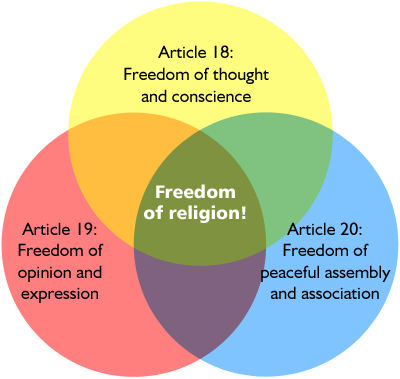
It is all these complaints, whether they come from Muslims or anyone else(they are not alone), that made me think differently about Freedom of Religion. There should be a freedom to believe, express yourself and gather. But these outlandish demands must be curtailed. In the post "Freedom of religion has become a mockery and must be abolished" I mentioned that the beliefs, expressions and being able to gather is guaranteed even without Freedom of Religion:


However, I could have done more than that. I know there are some reasonable demands that goes outside the strictly intellectual frame. I then checked out the "European Convention for the Protection of Human Rights and Fundamental Freedoms"

As you see, here are some limitations:
Article 9 – Freedom of thought, conscience and religion
1. Everyone has the right to freedom of thought, conscience and religion; this right includes freedom to change his religion or belief and freedom, either alone or in community with others and in public or private, to manifest his religion or belief, in worship, teaching, practice and observance.
2. Freedom to manifest one's religion or beliefs shall be subject only to such limitations as are prescribed by law and are necessary in a democratic society in the interests of public safety, for the protection of public order, health or morals, or for the protection of the rights and freedoms of others.
I think it is time that the devout community stop thinking of religious freedom as being able to do what they like in the name of their own religion. There are very real limitations, and they are here for very good reasons.
This is not just in the interest for Atheists to focus on. The example with the grandmother and the bible stories show as much. Not to mention that medical students disobeying hygiene rules because they are so much holier than the rest of us end up putting us all at risk.

The worst thing about many of these demands is that they're easy to see through as modern fundamentalism, and not rooted in a traditional interpretation of religion.

A note on Walkers Crisps and alcohol:
Before:
[The isolation of alcohol] as a relatively pure compound was first achieved by Muslim chemists who developed the art of distillation during the Abbasid caliphate, the most notable of whom were Jabir ibn Hayyan (Geber), Al-Kindi (Alkindus) and al-Razi (Rhazes). The writings attributed to Jabir ibn Hayyan (721-815) mention the flammable vapors of boiled wine. Al-Kindi (801-873) unambiguously described the distillation of wine.[2]
Today:
Furious Muslims have heavily criticised Walkers crisps after it emerged that certain varieties of the manufacturer's products contain trace elements of alcohol.
How the mighty have fallen. These Walkers whiners are not only a nuisance to modern secular society, they are a disgrace to their own heritage.

I'll end with a recent Memri clip of a reasonable Muslim:
Shiite Saudi Scholar Hassan Al-Saffar Laments the State of the Sciences in the Arab and Islamic World

Sunday, February 24, 2008

Bulgaria debates bringing religious studies back into schools

"[...] Under a bid to promote respect for minority rights, optional studies on Christianity or Islam were actually introduced about a decade ago though only 14,000 students nationwide follow the course on their respective religion.
But these classes "are attracting less and less interest," said an opponent to the government's plan, Lyutfi Mestan, [...] "Instead of teaching tolerance, this type of religious study has divided pupils," he insisted.[...]
During communism, church-going was not tolerated so when the regime fell in 1989, people reacted by crowding back into churches. Traditional rituals were revived for Easter and Christmas and are still largely followed, even if only 30 percent of Bulgarians define themselves as believers.

[...]

Many Bulgarians still confuse religious faith and superstition, a 2004 Gallup poll showed.
Half of all people in this east European country still believe in black magic and fear the evil eye, while one in five people believe ghosts exist, black cats bring bad luck and that one can talk to the dead, according to the poll.
Gallup analyst Andrey Raychev suggested that imposing religious studies on an atheist population could be "dangerous" if religion was only presented in a good light without discussing the Crusades, the Inquisition or moments when religious fervor led to repression and abuse.
This would be "a grave error", he insisted.

AFP, 23. February 2008

Saturday, February 23, 2008

Sign here against Sharia in Britain: One law for all!

"Faith-based arbitration, where people agree to settle disputes in by the judgement of a religious figure is a highly problematic form of privatising law: using laws which are not publicly enacted, in forums which are not monitored, with no right of appeal, often within environments where women's rights are routinely subordinated to traditional and patriarchal cultures and beliefs which threaten the welfare of women and children.
Arbitration is an acitivity which should be entered into willingly: yet the ability to make an independent choices within a relationship is based in equality in social and economic choices, which is rare in society generally, is even rarer amongst those who cleave to traditional gender roles. Some women face violence for resisting pressures put on them in the name of religion or culture; many others face rejection from the family or community, isolation, financial hardships and other pressures.
The rights of equality between men and women, gay and straight, the rights to divorce and child custody on equal terms, and the criminalisation of domestic violence and marital rape have been hard-fought for by human rights activists over centuries, and continue to be fought for across the world. It is a deeply backward step for human rights to withdraw rights from the weakest and most powerless sectors of society. Women's, and children's, powerlessness will be legitimized and enforced, codified into law.
Given the central role of family in most societies, religious elites seek to strengthen their control and influence over their communities by controlling family relationships. Religious laws—especially in family matters—have long been a battleground. For many women, the family is the source of patriarchal oppression, and those forces which seek to normalise religious interference into private life are often the same ones which seek the control of women and girls.
Fundamentalism in all major religions involves similar views on gender relations and sexuality. Among other things, it seeks to establish and strengthen male-dominated control over the family and restrict women's sexual and social freedoms. Recognising a right for religious figures to intervene in family affairs priveleges the fundamentalist forces by definition, strengthening the worldwide growth of fundamentalism, and eroding women's hard won rights.
We ask our political representatives to respect and protect women’s constitutionally and internationally protected human rights by ensuring access to a single, uniform family law regime. Equally, we ask that religious freedoms of the majority not be confined to the interpretation of a limited few."

Middle-eastern women's campaign against faith-based arbitration and sharia law

Notice that you can sign under at "UK" and "Worldwide".
I urge all Atheist bloggers with any sense of justice to sign and pass this around.

Friday, February 22, 2008

America still works

"Many observers abroad have the impression that Americans are growing more religious, while Europeans are growing more secular. This simply isn't true. Americans are far more religious than western Europeans, but in the US, no less than in Europe, the long-term trend is towards greater secularism.
In a 2001 study of religious attitudes among Americans, researchers at the City University of New York discovered that the number of Americans who profess no religion had grown from 8.16 per cent in 1990 to 14.17 per cent in 2000. Americans with no religion at all are now the third largest belief group in the US after Catholics and Baptists, and their number, around 30m, is almost as great as that of Baptists, who number around 34m. Moreover, the number of Americans who, even if they believe in God, do not belong to any religious organisation went from 46 per cent in 1990 to a 54 per cent majority by 2000, according to the study.
When the subject is actual church attendance rather than vague spiritual belief, the gap between the US and Europe shrinks further. According to the Gallup millennium survey of religious views, the number of North Americans (the US plus Canada) who attend church at least once a week is 47 per cent, compared with the west European average of 20 per cent. And some scholars say that the number is inflated, because many Americans are embarrassed to tell pollsters how rarely they attend church.
According to the Gallup poll, the number of North Americans who believe that the Bible is "the actual word of God" has fallen from 65 per cent in 1963 to just 27 per cent in 2001. At the same time, attitudes among Americans toward homosexuality, sex out of marriage and censorship are growing steadily more liberal. Abortion is the major exception; younger Americans tend to be more opposed to abortion than their elders. Possibly this reflects the growing use of ultrasound by parents to view their offspring in the womb, a practice which may be inadvertently undermining the distinction that supporters of liberal abortion laws have tried to make between foetuses and babies."
Michael Lind, Prospect Magazine (UK), February 2008
Another interesting development:

[...]

"Some will wish to argue that the slowing growth rate is evidence of an increasing secularization of American postmodern society," said the Rev. Dr. Eileen W. Lindner, editor of the Yearbook. "While such an explanation will satisfy some, caution in drawing such a conclusion is warranted."

[...]


Largest 25 Churches (ranked by membership)

1. The Catholic Church – 67,515,016
2. Southern Baptist Convention – 16,306,246
3. The United Methodist Church – 7,995,456
4. The Church of Jesus Christ of Latter-day Saints – 5,779,316
5. The Church of God in Christ – 5,499,875
6. National Baptist Convention, U.S.A., Inc. – 5,000,000
7. Evangelical Lutheran Church in America – 4,774,203
8. National Baptist Convention of America, Inc. – 3,500,000
9. Presbyterian Church (U.S.A.) – 3,025,740
10. Assemblies of God – 2,836,174
11. African Methodist Episcopal Church – 2,500,000
12. National Missionary Baptist Convention of America – 2,500,000
13. Progressive National Baptist Convention, Inc. – 2,500,000
14. The Lutheran Church - Missouri Synod (LCMS) – 2,417,997
15. Episcopal Church – 2,154,572
16. Churches of Christ – 1,639,495
17. Greek Orthodox Archdiocese of America – 1,500,000
18. Pentecostal Assemblies of the World, Inc. – 1,500,000
19. The African Methodist Episcopal Zion Church – 1,443,405
20. American Baptist Churches in the U.S.A. – 1,371,278
21. United Church of Christ – 1,218,541
22. Baptist Bible Fellowship International – 1,200,000
23. Christian Churches and Churches of Christ – 1,071,616
24. The Orthodox Church in America – 1,064,000
25. Jehovah’s Witnesses – 1,069,530

Christian Post, Feb. 20 2008
I'm satisfied, all right! When the biggest growth is JWs and Mormons, it probably means that "mainstream "Christianity is standing pretty still. See also my previous post on increasingly secular Catholics.