Showing posts with label education. Show all posts

Saturday, February 4, 2012

No positive correlation between religion and social morality

The World Values Survey has some interesting data on how religion and social morality correlates. Unfortunately, the article I'm referring to is from the Norwegian magazine Fri Tanke, but there's always Google Translate.

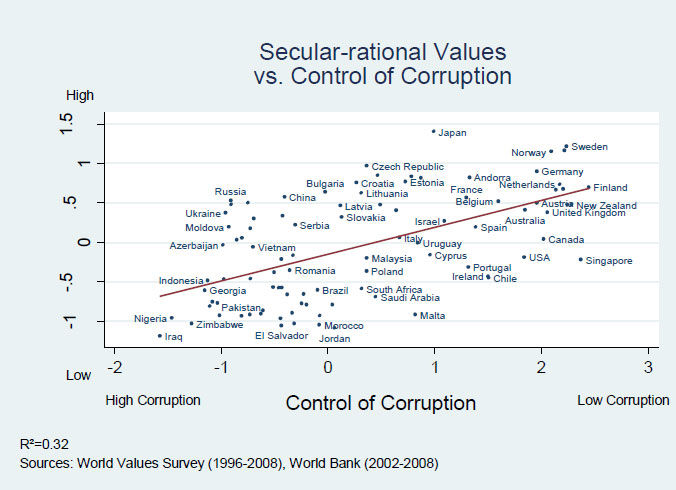
"[Bo Rothstein] points out that none of the 25 different indicators World Values ​​Survey's measure of human welfare, such as absence of corruption or the degree of confidence increases if religion gets more influence. Rather, it is quite the opposite. The results show that the more a society dominated by secular values, the higher is the human welfare.

- And, add to Rothstein, the same pattern is also evident if one only looks at the country dominated by Christianity
[...]

The degree of religiosity is composed of answers to the following six questions:

- Regardless of whether you go to organized religious practice or not, would you say that you are a religious person, not a religious person, or a convinced atheist?

- Apart from weddings, funerals and baptisms, how often you will meet up at religious arrangements?

- How important is God in your life?

- Do you believe in God?

- Do you believe in life after death?

- Does your religion give you well-being and strength?"
Well, enough talk. Let's see some charts:

Secular-rational values vs. Control of Corruption
Religiosity scale vs. life expectancy
Religiosity scale vs. average schooling years
Traditional values vs. secular rational values

Also, take a look at this Swedish article by Bo Rothstein. (Original)

Saturday, October 15, 2011

Hygiene more important than religion to mothers survey shows

I came across this international survey via NSS:
It shows that religion has the lowest priority among mothers and fathers whereas hygiene has the top priority.
Here's the full report (page 22). (See also Sca.com for more information about who produced the survey).

Sunday, April 6, 2008

Anglo-Saxon attitudes

The March 29th issue of The Economist had some interesting charts showing how Britons and Americans differ on several issues:

It's not surprising how many believes in God and Hell and attitudes to Atheist presidents, but I thought it was interesting to see the differences on Creationism and Intelligent Design in USA. That 20 per cent of Americans believe in Intelligent Design while 40 per cent of them believe in "The Bible" is in a sense good news, because it just shows that the problem is a lack of basic education. Intelligent Design is in many ways more insidious, while the bible version is much more primitive. I think good education stand a better chance with Creationism than with Intelligent Design, because ID is stupidity on a much more abstract level disguising itself as science. You also see that in Britain, there's slightly more people who believe in ID than Creationism.


As for values, the only place they seem to concur is about death penalty.


This chart is a bit difficult to read, but I think it's a summary of how they responded in the other charts after party lines. Notice how even English Conservatives are much more liberal with regards to religion and values than American democrats.

Monday, March 31, 2008

Conservative Protestants' Religious Beliefs Contribute to Their Low Wealth, Duke Study Shows

"Duke Sociology Professor Lisa A. Keister examines how religion affects the wealth of believers [...]
The study examines why conservative Protestants are dramatically overrepresented at the bottom of the U.S. wealth distribution and concludes that the cultural understandings that accompany conservative Protestant beliefs influence wealth ownership directly and indirectly.

[...]

Religious beliefs affect conservative Protestants’ wealth in a number of ways. They influence wealth ownership directly by shaping the values that people use to make work and financial decisions. In particular, Biblical references to God’s exclusive ownership of worldly goods lead to practices which are likely to reduce saving and asset accumulation.
Using the Economic Values Survey and the National Longitudinal Study of Youth, the study found that conservative Protestants tend to hold the following beliefs:
-- Divine advice, advice from clergy and other religious advice about money and work have merit. More conservative Protestants than other people surveyed are likely to pray about financial decisions, for example.
-- Excess accumulation of wealth is undesirable. More conservative Protestants said money prevents one from knowing God than other people surveyed.
Religious belief also can influence net worth indirectly through behavior that impedes the accumulation of wealth. This behavior includes:
-- Low educational attainment. Education is one of the strongest predictors of wealth, and conservative Protestants have significantly less education than members of other faiths.
-- Conservative Protestants tend to have children relatively early and to have large families, both of which make saving difficult. Also, conservative Protestant women tend not to work outside the family, which also reduces the ability to save. Saving and the resulting growth of assets “are perhaps the single biggest predictors of total adult wealth,” the study says.

[...]

Keister notes that the results could be influenced by the conservative Protestants’ socioeconomic class, but she found that religion had a significant effect after controlling for class background, adult class and other indicators such as parents’ education and income.
Nor does race appear to be responsible for the effect of conservative Protestantism on wealth. She found that the effect was stronger among black conservative Protestants, but was significant among whites as well."

Dukenews, March 24, 2008
See also the report: “Conservative Protestants and Wealth: How Religion Perpetuates Asset Poverty”

This is very interesting, and I have to say, sad. It just goes to show how religion contributes to their poverty, thereby dragging them further down into ignorance. I'm not one to say that getting rich is the only good thing in the world, but being poor is hardly desirable either. Especially not when you live in a country where ending up in a hospital can be very expensive.
The Conservative Protestant fear of wealth is also an interesting reminder of the old ties between Christianity and Communism.

Also, that Blacks are poorer can therefore in part be explained by their widespread religiosity. As Norm Allen said in a Point of Inquiry Podcast, in the old days, the Church was the only free space they had. Here's two podcasts with him that I highly recommend March 14. 2008 and November 24. 2006.

Friday, February 29, 2008

Indonesia: Mass trances are in vogue

"Religion, education and development have done little to budge widespread acceptance of the supernatural among Indonesia's diverse ethnic and religious groups. "In Indonesia, trance is tied up with culture," said Lidia Laksana Hidajat, research coordinator in the psychology faculty of Jakarta's Atma Jaya University.

[...]

"They were working in silence. That's one of the requirements of a trance to happen - it's usually quiet and when they are engaged in monotonous activity."
Suddenly, one of the workers started screaming and her body went stiff. The one next to her started crying and went stiff too. Others tried to help but soon they started too in a kind of domino effect.
A local Muslim leader was summoned, but his prayers had no effect. Eventually, the exhausted women fell asleep and upon awakening they remembered nothing.
Hidajat concluded that the mass trance had more to do with exhaustion and stress than evil spirits.

[...]

"Often they are people who are very religious or under pressure. They were also from low socio-economic backgrounds and many said they didn't have happy childhoods," she said.
"All the trance dancers I met in Bali had similar vulnerable personalities."

iol.co.za, February 25 2008

Monday, February 25, 2008

Faith school boom 'creates division'

"The rapid growth of faith-based schools under the previous federal government has threatened the social cohesion of the nation, according to Deputy Prime Minister Julia Gillard's most senior education adviser.

[...]

Professor McGaw's remarks reflect a profound shift in education in the past two decades, with more than 200,000 children — almost 40% of non-government school students — now attending a religious school outside the main Catholic, Anglican and Uniting systems.
The change has meant that, for instance, increasing numbers of children are taught creationism as part of their science classes."

The Age, Australia, February 25, 2008

Monday, January 28, 2008

How alternative are youths and grown-ups?

I earlier posted a PDF with some interesting international statistics in my Norwegian blog, but the charts are easy to grasp and there's a brief explanation in English under each chart too:

First of all, the PDF is a combination of two studies: 1. ROSE (The relevance of science education) (International, 15 yearolds) og 2. The Eurobarometer. (Europe, grown-ups). You'll most likely find the information elsewhere in English if you need it, but the charts can be enlightening.
Read more about ROSE here in English.


I'll breiefly explain what the charts shows
Part 1. Rose (15 yearolds, international)

Page 8: Mean H28. taken herbal medicines or had, alternative treatments (acupuncture, homeopathy, yoga, healing, etc.)
A little difference between genders, but Northern Europe are the least interested and Africa the most.

Page 9: Mean C12. Interest for alternative therapies (acupuncture, homeopathy, yoga, healing, etc.) and how effective they are.
In this chart, you'll see a very big difference between the genders in Europe. Boys have little interest while
girls have more interest than both women and men in the third world countries.

Page 10: Mean H2. read my horoscope (telling future from the stars)
Also very big differences between the genders all over Europe. Almost all girls have read it. In Africa, there's little difference bwteen the genders, and they all read the horoscope less than European girls

Page 11: Mean C9. Interest for astrology and horoscopes, and whether the planets can influence human beings
While European girls still are much more interested than men, it is nowhere near the same as having merely read the horoscope. African countries top the score here.

The rest pretty much explain themselves
Page 12: Mean C11. Interest for life and death and the human soul
Page 13: Mean C13. Interest for why we dream while we are sleeping, and what the dreams may mean
Page 14: Mean C14. Interest for ghosts and witches, and whether they may exist
Page 15 Mean C15. Interest for thought transference, mind-reading, sixth sense, intuition, etc.

Page 16: Mean E34. Interest for why religion and science sometimes are in conflict
This is an interesting chart. It can be interpreted in two ways. Say, in Norway, most youths are not interested in learning about this. Is it because they're less religious over all, or is it because religion here is more adapted to the scientific outlook, and the conflict is less obvious than elsewhere?

Part 2: Eurobarometer, (grown-ups, Europe)
(Some of the questions are normal health questions and I'll skip them)

Page 26: Praying? (last year, to cure a health problem)
This is the graph I posted on top here.The numbers are all over the place, but women are always praying the most.

Page 27: Tried homeopathy? (last year, to cure a health problem)
Page 28: Herbal medicine? (last year, to cure a health problem)
Page 29: Tried Ostheopathy? (last year, to cure a health problem)
Page 30: Tried meditation or yoga? (last year, to cure a health problem)


Sunday, January 20, 2008

Strong atheists prepare for battle against religion


"Strong atheists prepare for battle against religion
Atheism is an increasingly stronger and well organized participant in the political debate in the Western world. This in particular, is due to that Atheists generally have better education and are more involved in politics.


By Morten Rasmussen and Sidsel Nyholm

With conferences, professional debaters and political backing Atheism has in few years become a professional participant in the discussion about science, religion and politics. In Denmark, Ateistisk Selskab experienced an annual doubling of its membership, so the organisation now has 750 members. In Sweden, Riksdagen [the parliament] is discussing a bill about state funding of the Swedish atheists in Humanisterna, that today amounts to 4200 persons and every day get another 10 nye members. In Norway the non-religious Human-Etisk Forbund already state funded and with its 67.000 members [72.000 as of 2008] it is only to be surpassed by the Norwegian [state]church.

In the book "Gudløs"["Godless"], that will soon be out, the religion sociologist Peter Lüchau, at the University of Copenhagen, has taken a closer look at how the atheists scored in a large European value survey. According to him it is in particular the profile of the atheists, that has gained them a lot of ground in the debate in the western world.
– Atheists are not ordinary people. Statistics show that they have a higher level of education, are more left oriented and are clearly more poltically active than the average European. They are used to act when they are not satisfied, and in particular, they have the resources and ability to get in the media, says Peter Lüchau.
Outspoken atheists like Richard Dawkins and Sam Harris have additionally put their mark on the bestseller lists with their books, that with titles like "The God Delusion" and "The End of Faith" directly attack religion. And with increasing media coverage follows a growing interest, says Morten Warmind, religion sociologist at the University of Copenhagen.
– If you send a TV programme about making candles, more people will start to make candles. And as religion generally fills more debate, it's a natural consequence that atheism also appear in the media and thereby creates more interest, says Morten Warmind and stresses that the increasingly professional atheism corresponds with a growing religiosity.

–The debate on religion has become more polarized during the last few years. It means that there's suddenly an involvement among people whom earlier only had an interest for the subject, but wasn't organized according to their values and outlook. And this goes for both camps, says Morten Warmind.
In an interview with Kristeligt Dagblad today, one of the world's most prominent atheists, Richard Dawkins, is still bent on a direct confrontation with religion.
– I don't care about the non-believers who try to play around with liberal clergy and say that "It doesn't matter all that much, if we believe in God or not, as long as we're all happy and jolly together", he says and urges the world's "closet atheists" to stand up and be counted.

Kristeligt Dagblad, 05. jan 2008

Friday, January 18, 2008

Catholic Church shown to be economical with the statistical truth

"New research shows that the Catholic population in Britain is falling dramatically, despite Church claims that new immigrants from Eastern Europe are bringing about a revival.
The new figures, from the Pastoral Research Centre, show that the numbers actively participating in Catholic life in England and Wales has fallen by more than half a million in the last 11 years. The statistics — compiled independently of the Church — are based on the number of people baptised in the last 50 years and more recent marriages, baptisms and deaths. It shows that many of today's Catholic adults are not returning to the Church to marry or baptise their own children or bury their dead.

[...]

Mr Spencer said: "Mass immigration is masking a huge alienation among the Catholic community. There is a huge unexplained loss of people to be found when you look at those who were baptised as babies, but who are not getting married or holding funerals and subsequent baptisms in Church."
Mr Spencer said that his statistics showed that 530,000 Catholics had ceased even minimal involvement with the Church since 1997, whereas official Church statistics put it at 72,000.

[...]

The new figures show that in 1958 almost 68,700 couples were married in a Catholic Church, whereas in 2005 just 14,700 Catholic weddings took place.
Most controversially, he found the number of late baptisms had risen over the last 50 years. In 1958 there were fewer than 5,000 baptisms of children between one and seven. In 2005 this had risen to 16,000. Mr Spencer attributed this to the need to prove baptism in order to get a place in a Catholic school.

[...]

Mr Sanderson said that the late baptism phenomenon reinforced the idea that the selection criteria that faith schools enjoy are forcing people to be dishonest, underhand and to act against their conscience in order to get their children a place in a state school of their choice. We do not accept that any admissions criteria are 'fair' which are religiously discriminatory or privilege religious schools to the detriment of community schools."
National Secular Society, 18 January 2008

Thursday, December 27, 2007

Rich Mayfield: It is not the time to leave religion unchallenged

"When a writer’s life is threatened for musing upon the less savory sayings of Muhammad, for instance, or when a college professor is silenced and accused of being anti-Semitic for criticizing the policies of Israel, our ability to objectively pursue intellectual insight suffers another blow. Sacrosanct belief systems can certainly be worthy of respect, even reverence, but they should hold no elevated status in an educational forum. Religions and religious systems should be subject to the same objective scrutiny as any other current or historical endeavor receives. Avoiding analyzing a religion for fear of offending its adherents makes a mockery of intellectual inquiry.
One of the great temptations of this hyper-sensitivity to religion is the current tendency to eliminate all religious references in the classroom. Appreciated or not, the Bible is arguably the most influential book in the development of Western civilization and yet most public schools shy away from offering a curriculum that includes any analysis of the book at all. Countless political movements, innumerable works of literature, causes of war and forces for peace have been shaped by biblical passages and inspired by scriptural interpretations and yet one is hard pressed to find much reference to the Bible anywhere in the classroom.

It is a prickly issue to be sure, but its difficulty should not be resolved by simply avoiding the problem."

Rich Mayfield, Summit Daily, December 14, 2007
So much religion, so little understanding and... they can't even talk about it.
It's scary as hell.

More than half of Europe are "fuzzy believers"

"THIS WEEK church pews will be filled with those who turn up only for high days, holidays, hatches, matches and despatches.
But this group of uncommitted believers who are attached to no particular church but who have a real and genuine interest in spiritual matters have been classified into a new denomination called "Fuzzy Fidelity" by researchers.
The headache for the established churches is that this group now makes up more than half the European population.

[...]

"The fuzzy faithful have become so numerous because people are ceasing to be actively religious much more quickly than they are becoming wholly secular," said Voas.
"The sheer size of this group means that upon their attitudes and behaviour will hang the future role of religion in Britain.

[...]

Voas has divided this group into subgroups "Spiritual Seekers" and "Sheilaists". Spiritual Seekers have beliefs about the afterlife and fate that have nothing to do with organised religion.
The term Sheilaists derives from an interview with a woman called Sheila who defined her religious conviction as: "Sheilaism: I just have a little voice in my head.""

Sunday Herald, December 27, 2007
The fuzziness is silly, but preferable of course to literal interpretation. And in a purely Darwinian sense, I think it will win over other ways to be religious, simply because people don't necessarily need to compromise either faith or reason and say: "Look, my religion forbids me to use my head. I need to pretend we're still in the bronze age". Plus, there's the added bonus of no religious bosses so there's not going to be powerful churches to mess up education and what not.

See also:
Every Fifth German Professes "Deep Religious" Convictions
"The study suggests that young people between 18 and 29 years of age in Germany have stronger religious convictions than their parents, though they don't necessarily act on them.

[...]

Nigeria, Brazil, India and Morocco reported with over 90 percent the highest rates of religiosity. In Europe, Germany ranks behind Italy and Poland, but ahead of Great Britain and France in terms of the number of practicing believers."

Deutsche Welle, 17.12.2007

Wednesday, December 26, 2007

Non-believers mushroom in Switzerland

"When it comes to the growth of secularism in Switzerland, the figures speak for themselves.
More than one in ten of the Swiss population – 810,000 people – claims "no religious affiliation", up almost 60 per cent on a decade earlier.
[...]
According to Bovay, religion is no longer being passed down from the parent to child as it was in the past, and children are being allowed to decide for themselves at an earlier age.
With more young people turning away from religion and older believers dying off, Bovay expects the number of non-affiliated to increase for the foreseeable future."
Swissinfo.ch, August 20, 2007
It's not all well, though, because creationists are popping up too:
A heated debate over the inclusion of creationism in a school science book highlights the success Swiss evangelicals are having sowing seeds of doubt about evolution.
The debate over the textbook raises questions about why increasing numbers of Swiss are willing to turn away from science and accept creationist views that God created the earth a few thousand years ago.
[...]
But the Swiss proponents of creationism are working on fertile ground. An international survey last year found that 30 per cent of the Swiss reject evolution, one of the highest rates in Europe."
Swissinfo.ch, November 28, 2007

Wednesday, December 19, 2007

The Real Reason the Religious Right is Losing America

"It has long been understood that popular religiosity tends to sink as education and income levels rise. It is now understood that additional factors have sped up secularization in most first world nations. An extensive economic safety net, including universal health care, has left most westerners so secure that few feel a need to seek the aid and protection of supernatural powers and they have abandoned the churches in droves. America is the last advanced democracy to feel the full impact of secularization because the Republican alliance with conservative evangelicals that constitute a third of the nation and corporate interests has succeeded in preventing the adoption of a strong safety net.
Middle class Americans are in serious danger of financial ruin if they lose their job or health insurance and mobility from poverty to the middle class is unusually low by western standards.
But here’s the twist. The very same corporations are doing all they can to turn America into a nation of materialistic, hedonistic consumers and the public has in the main gone along with the project. The results are plain to see on the entertainment TV that is a sea of the non-traditionalist values their corporate owners favor. It was the retail chains that got rid of the Blue Laws that used to keep people in church on Sunday rather than at Wal-Mart and Home Depot."

Gregory Paul, OpEdNews.com, December 16, 2007
Worth reading. Some useful links in the text too.

Saturday, December 1, 2007

Quebec secularizes religious education

"As of next September, parents in Quebec will have no choice but to send their children to a secularized “one-size-fits-all” course on moral education, the National Post reported.
Even private religious schools will be required to offer the course. Called Ethics and Religious Culture, it which will give equal emphasis to Christianity, Judaism, aboriginal spirituality, Islam, Hinduism and Buddhism.

[...]

Many observers are worried that the course’s relativistic approach will make it even harder for parents with orthodox beliefs and teachers in faith-based schools to communicate their values to the next generation."

Today's Family News, November 7, 2007
Yes, it will make it harder for fanatics to brainwash their children. Not bad at all. Take a look at a summary of the program here. (PDF) Alternative and longer story here, from Canada.com

The church is responsible for today's moral mess

"Irish society in 1953 was morally adrift because it had no focus other than enforced blind obedience to a particular religious moral code. It is as painfully adrift ethically today because, having abandoned its blind obedience to that narrow, hypocritical and cruelly cold code, it has not been equipped with the mental and philosophical agility to formulate any other.
And that is entirely the fault of the education system controlled and operated by the Church. Surely if Ireland has turned out a crass, money-grubbing, vulgar, possession-worshipping population without finer philosophical values, it is the fault of the education system as provided by the Church? Nobody else was teaching a moral code."

Emer O'Kelly, Independent.ie, November 11 2007
A good piece on how the Irish Church's monopoly of morality meant that secular morality, that wasn't based upon subservience only, suffered. Morality get more feet to stand on in a secular country that allows different philosophies to exist. In a secular country, morality doesn't stand and fall with the silly belief in a ghost.

Saturday, October 6, 2007

Some good tools for Bible studies

I've been reading a little bible lately and also discussed it with believers. This, of course, can be straeneous, but you learn a lot as you go.

The most obvious, and probably the most well-known tool among Atheists is Skeptic's Annotated Bible. It takes you right to the goodies. It has to be said, that sometimes it tends to take a worst case interpretation of verses, so whatever you do, you need to read it in context. But as for showing you the good stuff, and the subjects you need, it is pretty perfect.
Notice that SAB also provides you with links to articles about the subjects at hand, even including apologist rebuttals. You get both sides then, so you can prepare for counterarguments.

Skeptic's Annotated Bible is the King James version, and it is not always the most reliable translation. Therefore, Biblegateway is good because it allows you to easily compare different translations, also non-English. For generally searching the KJV bible, Blue Letter Bible is the most easy to use.

A tool I found today however is a real goodie: Scripturetext.com. You look up a passage at the upper left and you can see different translations below, including Greek and Hebrew if you push those tabs. The real nice part is to hit the Lex tab because you get dictionary definitions of each word in Hebrew/Greek so you can easier see if the translations into English (etc.) could have had different meanings. And you can probably counter the more blunt attempts by apologists to explain away about what the words "really" says.
I now also noticed that Blue Letter Bible has a similar function to Scripturext. When you have a list of bibleverses, you can hit the C tab for Concordance on the left. Then you'll see al the words of a verse, and their Hebrew/Greek counterparts as well as Strong's numbers. Click a number, and you'll get a list of all the places that the same Greek/Hebrew word has been used in the bible.

Here are also two informative sites:
The Rejection of Pascal's Wager. Don't let you scare away by the title, because there's much more than Pascal-bashing. If you read up on the texts on Paul and Jesus and scriptures, you get introduced to a lot of good research, complete with references and all. I'd wish the site had a better structure, but there's a lot to be learned.

Religious Tolerance is also good. It's not an Atheist site, but gives you information about beliefs and theology from a critical and liberal view in addition to providing the conservative view. This can often be illuminating.

Last year I read Who Wrote The Bible by Richard E. Friedman. It's about the Documentary Hypothesis, which says that the five first books in the Bible were not written about Moses, and gives some pretty interesting insights into higher Bible criticism. I don't think anything compares to get the introduction from this book, but even so, here are some OK links on the subject of the Documentary Hypothesis:
Article at University of Pennsylvania website and example using the flood story.
Article at Religious Tolerance.

Well, that's enough research for now!

Friday, October 5, 2007

European lawmakers condemn efforts to teach creationism

"The Parliamentary Assembly of the Council of Europe condemned efforts to teach creationism in schools Thursday in a vote that underlined concern about the rise of a new socially conservative agenda in several countries.
Members of the assembly, which monitors human rights, approved 48 to 25 a report that attacked advocates of creationism for seeking "to impose religious dogma" and to promote "a radical return to the past" at the expense of children's education."

International Herald Tribune, October 4, 2007
What they voted for.


Anyway, this is great news!

Norway flourishes as secular nation

"Rev. Rick Mason notes that atheism is on the rise. He blames Christian fundamentalism. Certainly the ineptness, dishonesty and lack of ethics of the overtly God-fearing Bush administration may be turning people off on God.
A case study shows what this could mean for America. Norway has embraced secularism at the expense of its Christian roots. A 2005 survey conducted by Gallup International rated Norway the least religious country in Western Europe.
In Norway, 82.9 percent of the population are members of the Evangelical Lutheran Church (they are automatically registered at birth and few bother to be unregistered). However, only approximately 10 percent regularly attend church services and identify themselves as being personally Christian.
A 2006 survey found: 29 percent believe in a god or deity; 23 percent believe in a higher power without being certain of what; 26 percent don't believe in God or higher powers; 22 percent have doubts.
Depending on the definition of atheism, Norway thus has between 26 percent and 71 percent atheists. The Norwegian Humanist Association is the world's largest humanist association per capita.
And what has secularism done to Norway? The Global Peace Index rates Norway the most peaceful country in the world. The Human Development Index, a comparative measure of life expectancy, literacy, education and standard of living, has ranked Norway No. 1 every year for the last five years.
Norway has the second highest GDP per capita in the world, an unemployment rate below 2 percent, and average hourly wages among the world's highest.

David N. Miles, Montgomery Advertiser (letters), October 5, 2007 (also at Dawkins.)
While I knew this already, this pleased me no end to read! And I have to say that in the early 90s I never thought I'd sit here 15 years later and cheer that religion is on the retreat here.
Of course, the case of Norway doesn't say that secularisation leads to prosperity(there's the oil and everything), but it says firmly that secularisation does not lead to immoral chaos, which is what many Christians want you to believe.
And just so there's no jealousy, it has to be said that Norways neighbours fare no worse. ;)

See also: Norway: 68 percent skeptical to religious organisations

Friday, September 28, 2007

Why are we Muslims so self-destructive?

At an ifthar (breaking of fast) gathering last week, Rahim, a handsome young Muslim doctor and I chatted about this and that, and the end of our world: "Do you think refined and educated Muslims will survive this century? Or will we become extinct? I feel I don't know who I am any more. My parents, too, say the same. Barbaric Muslims are stronger than us, more stupid and ignorant, but stronger, you know."

[...]

Look today at India and Pakistan, neighbours, twin nations with identical histories and values. While the former is poised to challenge the economic and cultural power of the West, the latter is imploding and joins the ever-growing club of failed Muslim states. India has shameful problems – extreme poverty, corruption, greed, the caste system, Islamophobia and misogynist cultural practices – but, unlike Pakistan, it also has a free press and democracy, and its population understands the importance of education and enlightenment.
Come to our isles and the same stark contrast emerges. British Asians of Indian background (including Muslims from India) are top of the league tables in schools, universities, business and the professions. They are mentally agile, inquisitive, and encouraged to strive by their families. With some individual exceptions, British Muslims of Pakistani and Bangladeshi backgrounds languish at the bottom of all indicator tables. It is heartbreaking."

Yasmin Alibhai-Brown, Independent, 24 September 2007

Atheism: teaching a taboo

"McCormick is teaching the first atheism class ever offered at Sacramento State. And the topic, he said, makes some uncomfortable, even hateful.
"Some recent polls show that atheists are the most reviled people in American society, even more than homosexuals and minority groups… That all suggests that we've got some irrational and dangerous commitments surrounding the topic of God," McCormick said.

[...]

He took the initiative to write the proposal for his new atheism class, even though he says he did get "a few raised eyebrows" along the way. Philosophy Chair Thomas Pyne, a colleague and a church-goer, said "I was for it (the class)...it's certainly a live issue right now."

The State Hornet, 9/19/07
He also has his own blog here: Atheism: Proving The Negative

In a sense I would say that all scientific roads lead to Atheism by undermining traditional religious views and constantly offering a materialistic view, but I think that a course like this can be good to stop the demonizing that exists some places.