Showing posts with label secularisation. Show all posts

Tuesday, April 10, 2012

Canadians trust the non-religious more than the religious

"67 per cent of those surveyed said they trusted “people who are religious” in general, and even more respondents — 73 per cent — expressed trust in “people who are not religious.”


[...]


Just 42% of those polled agreed with the statement “religion is an important part of my life,” with women (46%) more likely to value religious activity than men (37%) by a clear margin.


[...]


Only 30% of those aged 18 to 24 agreed that religion is important to their life, while respondents aged 65 and older were most likely (56%) to consider religion a force in their life.

Likewise, an expressed belief in God was lowest (56%) among the youngest group of respondents and highest (79%) among the oldest."


Nationalpost.com, Apr 6, 2012

H/T to Friendly Atheist

Wednesday, March 28, 2012

A third of Americans are non-religious

Here's the result of a new Gallup survey of American religiosity:

"Gallup classifies 40% of Americans nationwide as very religious -- based on their statement that religion is an important part of their daily life and that they attend religious services every week or almost every week. Another 32% of Americans are nonreligious, based on their statement that religion is not an important part of their daily life and that they seldom or never attend religious services. The remaining 28% of Americans are moderately religious, because they say religion is important but that they do not attend services regularly or because they say religion is not important but still attend services.


[...]

Mississippi is the most religious U.S. state, and is one of eight states where Gallup classifies at least half of the residents as "very religious." At the other end of the spectrum, Vermont and New Hampshire are the least religious states, and are two of the five states -- along with Maine, Massachusetts, and Alaska -- where less than 30% of all residents are very religious. See full list here


[...]


Results are based on telephone interviews conducted as part of the Gallup Daily tracking survey Jan. 1-Dec. 31, 2011, with a random sample of 353,492 adults, aged 18 and older, living in all 50 U.S. states and the District of Columbia."

Gallup.com, March 27, 2012

Saturday, March 3, 2012

2030: The year Britain will cease to be a Christian nation with the march of secularism

"The march of secularism means Britain may no longer be a Christian country in just 20 years, a report said yesterday.

If trends continue, the number of non-believers is set to overtake the number of Christians by 2030."


Daily Mail, 3rd March 2012


Thursday, February 16, 2012

Muslims in Wales pass on their faith at higher rates than other religions

"The Cardiff University study, published online today in the journal Sociology, says that the proportion of adult Muslims actively practising the faith they were brought up in as children was 77%. That compares with 29% of Christians and 65% of other religions.

The study also found that 98% of Muslim children surveyed said they had the religion their parents were brought up in, compared with 62% of Christians and 89% of other religions.

The team analysed data from the Home Office’s 2003 Citizenship Survey data, using 13,988 replies from adults and 1,278 from young people aged 11 to 15.

[...]

Home Office statistics show that 74% of people in Wales are Christians but that only 7% of those attend church."


Walesonline.co.uk, Feb 13 2012 (Found via Islam in Europe)
Talk about "good and bad news"! The downside of such a study is that many people who identify as Christians, but don't give a toss about religion in their daily life, will suddenly feel the urge to compete with the muslims. Instead of embracing our secular future, they may turn around and cling to the past only because the Muslims do it.
On the other hand, 27% apostates within Islam is not a bad number considering how Islam is portrayed.

Tuesday, February 14, 2012

Poll reveals majority of UK Christians support secular outlook

"Results of a poll carried out by Ipsos MORI for the Richard Dawkins Foundation for Reason and Science (UK) show that UK Christians are overwhelmingly secular in their attitudes on a wide range of issues.

[...]

The poll revealed that, on balance, significantly more Christians:

    agree that the law should apply equally to everyone, regardless of their religion or belief (92% v 2%)
    oppose religion having special influence on public policy (74% v 12%)
    oppose the UK having an official state religion (46% v 32%)
    oppose seats being reserved for Church of England bishops in the House of Lords (32% v 25%)
    support the costs of hospital chaplains being met by the chaplain's religious organisation rather than from NHS budgets (39% v 32%)
    want state-funded schools to teach knowledge about the world's main faiths even-handedly, rather than inculcate beliefs (57% v 15% solely Christian inculcation or 8% inculcate other school faith)
    approve of sexual relations between two adults of the same sex than do not (46% v 29%)
    approve of an adult woman's right to have an abortion within the legal time limit (62% v 20%)
    support the legalisation of assisted suicide in the case of terminally ill adult patients with safeguards (59% v 21%)"

National Secular Society, 14 Feb 2012
See lengthy press releases with lots more numbers here:
RDFRS UK/Ipsos MORI Poll #1: How religious are UK Christians?
RDFRS UK/Ipsos MORI Poll #2: UK Christians oppose special influence for religion in public policy

Here are the full results of the poll (PDF)

See also:
"The kind of conservative religious aggression that claims 'anti-Christian discrimination' every time Christians are asked to treat others fairly and equally in the public square is a threatened response to the loss of top-down religion's social power. So is overbearing 'Christian nation' rhetoric, and the 'culture wars' that some hardline believers and non-believers may seek to launch and win against each other.

[...]

"Likewise, Richard Dawkins may not be a subtle, unbiased or persuasive analyst of religion overall, but it would be entirely unhelpful for believers to dismiss this survey because they disagree with its commissioner in other respects. Its content evidently needs further and deeper analysis, alongside other data, than the initial response to it has allowed."


Ekklesia (Christian think-tank)

Daily Telegraph: Christians don't want religion to 'influence public life'


Saturday, February 4, 2012

Britain is becoming less religious, survey shows

 An interesting survey by NatCen shows that religion is indeed in decline in Britain. Download the PDF on religion here.

"The first point to note is that there is no evidence of a lifecycle effect – that is, as people grow older they become more or less religious. Non-affiliation remains relatively stable as each generation ages; for example, 30 per cent of those born between 1936–1945 did not follow a religion in 1983 (when they were aged 38–47 years), compared with 31 per cent in 2010 (when they were 65–74 years). 

[...]  

Conclusions 
Britain is becoming less religious, with the numbers who affiliate with a religion or attend religious services experiencing a long-term decline. And this trend seems set to continue; not only as older, more religious generations are replaced by younger, less religious ones, but also as the younger generations increasingly opt not to bring up their children in a religion – a factor shown to strongly link with religious affiliation and attendance later in life. 
What does this decline mean for society and social policy more generally? On the one hand, we can expect to see a continued increase in liberal attitudes towards a range of issues such as abortion, homosexuality, same-sex marriage, and euthanasia, as the influence of considerations grounded in religion declines. Moreover, we may see an increased reluctance, particularly among the younger age groups, for matters of faith to enter the social and public spheres at all. The recently expressed sentiment of the current coalition government to “do” and “get” God (Warsi, 2011) therefore may not sit well with, and could alienate, certain sections of the population. "


British Social Attitudes 28, 2011-2012

Now for the charts:
50 per cent has no religion in Britain

No religious affiliation, cohort analysis, 1983–2010
Current religious affiliation, by religious upbringing. Notice how despite having had religious upbringing a huge chunk ends up being non-religious.

No positive correlation between religion and social morality

The World Values Survey has some interesting data on how religion and social morality correlates. Unfortunately, the article I'm referring to is from the Norwegian magazine Fri Tanke, but there's always Google Translate.

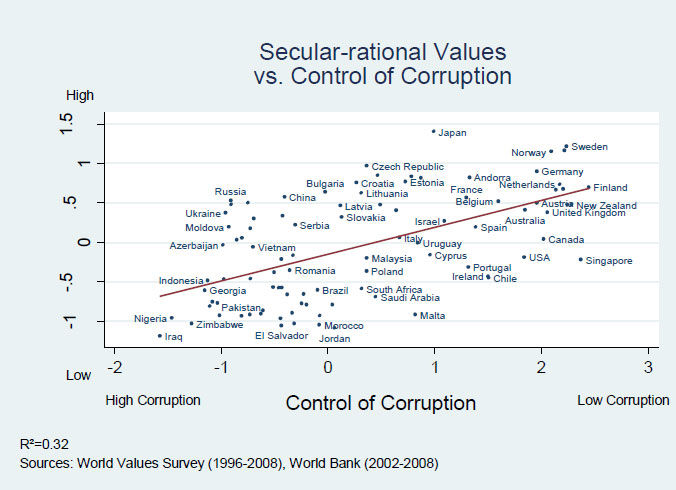
"[Bo Rothstein] points out that none of the 25 different indicators World Values ​​Survey's measure of human welfare, such as absence of corruption or the degree of confidence increases if religion gets more influence. Rather, it is quite the opposite. The results show that the more a society dominated by secular values, the higher is the human welfare.

- And, add to Rothstein, the same pattern is also evident if one only looks at the country dominated by Christianity
[...]

The degree of religiosity is composed of answers to the following six questions:

- Regardless of whether you go to organized religious practice or not, would you say that you are a religious person, not a religious person, or a convinced atheist?

- Apart from weddings, funerals and baptisms, how often you will meet up at religious arrangements?

- How important is God in your life?

- Do you believe in God?

- Do you believe in life after death?

- Does your religion give you well-being and strength?"
Well, enough talk. Let's see some charts:

Secular-rational values vs. Control of Corruption
Religiosity scale vs. life expectancy
Religiosity scale vs. average schooling years
Traditional values vs. secular rational values

Also, take a look at this Swedish article by Bo Rothstein. (Original)

Thursday, October 27, 2011

In U.S., Increasing Number Have No Religious Identity

"Americans have become increasingly less tied to formal religion in recent decades, with the percentage saying they do not have a specific religious identity growing from near zero in the 1950s to 16% this year and last.

[...]

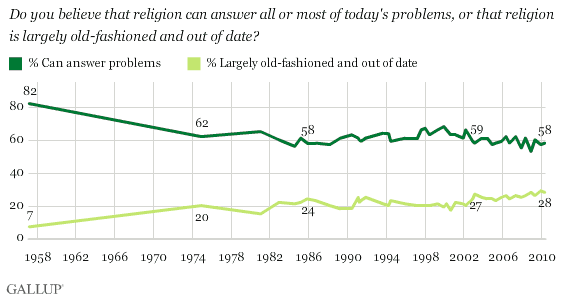
An additional measure Gallup has tracked over time asks Americans if they believe that religion can answer all or most of today's problems, or if they believe religion is largely old-fashioned and out of date.


[...]

Bottom Line
Gallup surveys confirm a downward drift in religious identity among Americans, as well as a slight increase in the number of Americans who view religion as old-fashioned and out of date."

Gallup.com, May 21, 2010

Saturday, October 22, 2011

Youths are less religious

"In a survey released last year, it was found that 72 percent of millennials were "more spiritual than religious." According to Thom Rainer, president of LifeWay Christian Resources, the group that conducted the study. Rainer explained to USA Today that young adults today do not pray, worship, or read the Bible.

In studying the data of 1,200 18-29 year olds, Rainer found that among the 65 percent who described themselves as Christians, "many are either mushy Christians or Christians in name only; most are just indifferent," said Rainer. "The more precisely you try to measure their Christianity, the fewer you find committed to the faith," he added.

The study found that 65 percent rarely or never pray with others, and 38 percent almost never pray by themselves. In addition, 65 percent rarely or never attend worship services, while 67 percent don not read the Bible or sacred texts."


The Christian Post, Sep. 22 2011

I really can't stand the word "spiritual" but I guess in this case it's better than being religious.

Thursday, October 20, 2011

Religion may become extinct in nine nations, study says

"A study using census data from nine countries shows that religion there is set for extinction, say researchers.

The study found a steady rise in those claiming no religious affiliation.

[...]

The team took census data stretching back as far as a century from countries in which the census queried religious affiliation: Australia, Austria, Canada, the Czech Republic, Finland, Ireland, the Netherlands, New Zealand and Switzerland.

[...]

"The idea is pretty simple," said Richard Wiener of the Research Corporation for Science Advancement, and the University of Arizona.

"It posits that social groups that have more members are going to be more attractive to join, and it posits that social groups have a social status or utility.

[...]

Dr Wiener continued: "In a large number of modern secular democracies, there's been a trend that folk are identifying themselves as non-affiliated with religion; in the Netherlands the number was 40%, and the highest we saw was in the Czech Republic, where the number was 60%."

[...]

And in all the countries, the indications were that religion was headed toward extinction."

BBC News, 22 March 2011

Even in Ireland!

Irreligious countries are happier

"Circumstances predict religiousness," he said. "Difficult circumstances lead more strongly to people being religious. And in religious societies and in difficult circumstances, religious people are happier than nonreligious people. But in nonreligious societies or more benign societies where many people's needs are met, religious people aren't happier -- everyone's happier."


ScienceDaily Aug. 8, 2011
This should settle the discussion on religiousness and happiness. Irreligious people has a harder time in religious countries, but if irreligious people are the majority, then everyone's better off. The map in this post (which I think is from the Gallup poll this study is based on) is also pretty self-explanatory.

Saturday, October 15, 2011

Religion in retreat in Britain

"A large-scale survey of British attitudes has been carried out by YouGov–Cambridge (a collaboration between pollsters YouGov and the University of Cambridge’s Department of Politics and International Studies) has some revealing statistics on religion. A representative sample of 64,303 adult Britons aged 18 and over responded.


78% (82% of the over-55s) agreed and 12% disagreed that religion should be a private matter and had no place in politics

In response to the question “What is your religion?” 40% of adults professed no religion, 55% were Christian and 5% of other faiths – age made a major difference, with only 38% of the 18–34s being Christian and 53% having no religion, whereas for the over-55s the figures were 70% and 26% respectively

35% described themselves as very or fairly religious and 63% as not very or not at all religious – there were no big variations by demographics (even by age), but Londoners (41%) did stand out as being disproportionately religious, doubtless reflecting the concentration of ethnic minorities in the capital

79% agreed and 11% disagreed that religion is a cause of much misery and conflict in the world today

72% agreed and 15% disagreed that religion is used as an excuse for bigotry and intolerance, with a high of 81% inScotlandwhere sectarianism has often been rife

35% agreed and 45% disagreed that religion is a force for good in the world, dissenters being more numerous among men (50%) than women (41%)


[...]


Full tables can be seen here."


National Secular Society, 23 Sep 2011
Lots more numbers in the article.


Hygiene more important than religion to mothers survey shows

I came across this international survey via NSS:
It shows that religion has the lowest priority among mothers and fathers whereas hygiene has the top priority.
Here's the full report (page 22). (See also Sca.com for more information about who produced the survey).

Wednesday, October 12, 2011

The shrinking [Christian] majority

"Britain is still a Christian country but the drift towards secularism continues. 

[...] 

The headline figures suggest that the United Kingdom remains a predominantly religious and mostly Christian country. Almost seven in ten (68.5 per cent) identify themselves to researchers as Christians -- far more than the 15 per cent who regularly attend church. Less than a quarter (23 per cent) profess no religion at all (although in Wales, the figure is considerable higher, at close to one in three. Of the population as a whole, 4.4% is Muslim -- more than all other minority faiths put together -- but still less than one person in 20. (The full IHS figures can be found here.) 
This picture of stability may be something an illusion, however. The last time this survey was conducted, in 2009-2010, the figure for Christian affiliation was 71.4 per cent and for no religion was just 20 per cent. A movement of 3 per cent from a Christian identity to a non-religious one in a single year is potentially a dramatic one. The annual population survey, which has included a religion question since 2004, records what looks like a consistent pattern. In 2004-2005, the figures stood at around 78 per cent Christians and less than 16 per cent having no belief. " 

New Statesman, Nelson Jones, 29 September 2011

America's secular revival

"Five signs that, despite the GOP's efforts, religion's impact on U.S. politics will soon decline

1. American religious belief is becoming more fractured 

[...]


2. Non-belief — and acceptance of non-belief — on the rise 
Last month was the first time atheists were knocked from the top of America’s most hated list, an honor that now belongs to the Tea Party. While this development may have more to do with the fact that the mainstream media’s love affair with the Tea Party is not shared by most Americans, it also dovetails with increased visibility and acceptance of atheism. 

[...]

3. Growing numbers of young people who do not identify as religious  
As recently as 1990, all but 7 percent of Americans claimed a religious affiliation, a figure that had held constant for decades. Today, 17 percent of Americans say they have no religion, and these new “nones” are very heavily concentrated among Americans who have come of age since 1990. Between 25 percent and 30 percent of twentysomethings today say they have no religious affiliation — roughly four times higher than in any previous generation. 

[...]


4. Hate group that exploited religion to bash gays hemorrhaging funds 
In 2008, Focus on the Family had to cut its staff by 18 percent. Last week, FOTF had to do another round of cuts, again citing a drop in donations (though it claims the lower funding is a result of tough economic times). 

[...]

5. Getting married by friends 
A study last year by TheKnot.com and WeddingChannel.com showed that 31 percent of their users who married in 2010 used a family member or friend as the officiant, up from 29 percent in 2009, the first year of the survey."
Salon Mag/Alternet Sep 29, 2011

Sunday, October 9, 2011

Rising atheism in America puts 'religious right on the defensive'

"The exact number of faithless is unclear. One study by the Pew Research Centre puts them at about 12% of the population, but another by the Institute for the Study of Secularism in Society and Culture at Trinity College in Hartford puts that figure at around 20%. Most experts agree that the number of secular Americans has probably doubled in the past three decades – growing especially fast among the young. It is thought to be the fastest-growing major "religious" demographic in the country. 

[...] 

There are other indications, too. For a long time studies have shown that about 40% of US adults attend a church service weekly. However, other studies that actually counted those at church – rather than just asking people if they went – have shown the true number to be about half to two-thirds of that figure."

Guardian.co.uk, Saturday 1 October 2011

Feelgood article in The Guardian.

Monday, August 8, 2011

Why Atheism Will Replace Religion: New Evidence

"Atheists are heavily concentrated in economically developed countries, particularly the social democracies of Europe. In underdeveloped countries, there are virtually no atheists. Atheism is a peculiarly modern phenomenon. Why do modern conditions produce atheism? In a new study to be published in August, I provide compelling evidence that atheism increases along with the quality of life (1).

[...]

The reasons that churches lose ground in developed countries can be summarized in market terms. First, with better science, and with government safety nets, and smaller families, there is less fear and uncertainty in people's daily lives and hence less of a market for religion. At the same time many alternative products are being offered, such as psychotropic medicines and electronic entertainment that have fewer strings attached and that do not require slavish conformity to unscientific beliefs."

Psychologytoday.com, Nigel Barber, Ph.D, July 14, 2011


Good news!

Friday, June 20, 2008

Christianity 'could die out within a century'


"Research by the Orthodox Jewish organisation Aish found that just over a third of people thought religions like Christianity and Judaism would still be practiced in Britain in 100 years' time.
Although four in 10 people said they would choose to be a member of the Christian religion, almost the same number said they would rather practice no religion at all.
Buddhism however, proved more attractive than both Islam and Judaism, and was chosen by nine per cent of those questioned.
Aish UK's executive director Rabbi Naftali Schiff said the results of the YouGov poll of 2,000 people were alarming.
"It clearly demonstrates that religion, including Judaism, is becoming unattractive to the British public."

[...]

Research published earlier this year suggested that church attendance is declining so fast that the number of regular churchgoers will be fewer than those attending mosques within a generation.
According to Religious Trends, an analysis of religious practice in Britain, the huge drop off in attendance means that the Church of England, Catholicism and other denominations will become financially unviable.
In contrast, the number of actively religious Muslims is predicted to increase from about one million today to 1.96 million in 2035.

Telegraph.co.uk, 20/06/2008

No cause for alarm!
And for the panic mongers, this will definitely affect Islam too. Practising Muslims prefer to live in religious countries, even if they are Christian, and probably for good reasons.

Sunday, April 13, 2008

Churches crumble in France

"Some communities have dynamited churches deemed too expensive to maintain. Others have taken a less radical approach, selling them as housing.
In traditionally Roman Catholic France, fewer than 5 percent of the nation's 62 million people attend Mass every week, down from 27 percent a half-century ago, according to a survey of more than 29,000 people published by the Ifop polling agency in 2006."

Star Tribune, April 11, 2008

Friday, April 11, 2008

Only 38% of Britons believe in God

"To start with, we discover that only 38% of British respondents to a Eurobarometer Survey said they believed in God.
Other figures then give an indication of just how confused the nation is about religion. In reply to the question "Do you regard yourself as belonging to any particular religion?" 45.8% said they didn't. The most astonishing figure of all is that those belonging to the CofE/Anglicans have dropped from 29.3% to 22.2% in just a decade. That this has not been national news can only be because it is no surprise and/or people want to keep it quiet. Obviously some of the drop can be attributed to deaths, but not when the drop is so massive. So where have the rest of them migrated to? The figures suggest that it is to "Christian – no denomination" and no religion, both of which showed 3% – 5% increases. It seems plausible that "Christian – no denomination" is a half way house for the cultural Christians who bolstered the 72% figure in the 2001 Census before they join those of "no religion".
With the exception of the Roman Catholics, presumably because of Eastern European immigration, all other Christian denominations are much reduced, as are Buddhists. There are large proportional increases for Hindus and (surprisingly) Jews and above all Muslims (from 1.8% to 3.3%), and in some communities they may well be in the majority.
Incredibly, 13% of men and 15% of women claimed that they attended a religious service once a week or more. Even the churches own figures don't support that."

Terry Sanderson, National Secular Society, 11 April 2008