Showing posts with label christianity. Show all posts

Friday, June 29, 2012

Less crime if you believe in Hell?

"Belief in hell keeps down criminal activity, but belief in heaven actually boosts it, according to a pair of researchers at the universities of Oregon and Kansas.

Azim Shariff and Mijke Rhemtulla scoured 30 years of international values-based surveys and found societies that put more stock in supernatural benevolence than supernatural punishment have higher national crime rates. The relationship is so significant, they found, that it is a stronger predictor of crime rates than are economic factors such as gross domestic product and income equality."


The Globe and Mail, Jun. 25 2012
I understood immediately that there were issues with this research. Comparing crime statistics between countries, when crime is reported differently makes no sense at all. I may be prejudiced but I my first thought was that belief in Hell correlates with poor crime statistics. I might as well post the graph right away (which is picked up from Epiphenom which also has a critical article):

It's a bit hard to read with only two letters abbreviations but you can see that Norway (NO) and Sweden (SE) are ranking high here. Yes, I live in one of the most crime infested countries. I wish I lived in Egypt (EG) which you will see on the bottom.

Here's a critical examination:

"Interpol merely gathers and reports nonlethal crime statistics provided by member nations without standardizing or vetting it [19, 22]. For example, assaults are reported at a rate about 6 times higher in Australia and Sweden than in Canada and France, this level of disparity is suspect. Rates of theft are reported to be twice as high in Sweden as in France; are the former actually twice as larcenous as the French, or are the latter twice as unlikely to file a report, or is the reality somewhere in-between? Similarly suspicious discrepancies exist in International Crime Victims Survey results. Reported rates of rape are two to twenty times higher in the U.S. than in other 1st world nations [24,25], but this only means that American females report being raped at far higher rates, not that American males are more prone to committing sexual assaults. Nonlethal crimes are difficult to compare even between the relatively uniform 1st world countries, they only grow worse when comparing 2nd and 3rd world nations with greater disparities between the quality of crime reporting."

Plosone.org, GregorySPaul on 24 Jun 2012
 The only statistic you can reliably compare is homicide, but even there there are issues:

"In contrast, Jensen found that more homicide is more strongly linked to greater popular support for the reality of hell than for heaven [12] -- he suggests that “malevolent” forms of religion produce inferior results compared to “benevolent” -- Sharif and Rhemtulla do not cite Jensen or explain the disparity in their results with his. Sharif and Rhemtulla find that more homicide weakly correlates with more belief in God, Rees [5] as well as Jensen [12] found a positive relationship in a large sample of nations. In the more uniform prosperous democracies the only example with high levels of homicide, the U.S., has the highest levels of religiosity including belief in heaven and hell [6]. The advanced democracies with the least, and remarkably low, homicide are the most atheistic. (It would be interesting to analyze correlations between measures of religiosity and homicide in different economic categories of nations.) Potential reasons that deity worship and scripture contribute to lethal violence have been proffered [6-8,13-15].
How crime in general corresponds to differing levels and types of religiosity remains inherently uncertain, but the most atheistic democracies appear to suffer relatively modest nonlethal misdemeanors and felonies, and definitely enjoy very low lethal violence. All studies agree that the most reliably measured crime, homicide, tends to be higher in less atheistic countries. Studies are contradictory regarding how homicide correlates with differing belief beliefs in the afterlife, further analysis may clear this up."
In short: Bollocks.


Tuesday, March 6, 2012

One Jesus for liberals, another for conservatives

"New research shows how believers tailor Christian teachings to fit their own political viewpoint

[...]

A study led by Lee Ross of Stanford University in California has found that the Jesus of liberal Christians is very different from the one envisaged by conservatives. The researchers asked respondents to imagine what Jesus would have thought about contemporary issues such as taxation, immigration, same-sex marriage and abortion. Perhaps not surprisingly, Christian Republicans imagined a Jesus who tended to be against wealth redistribution, illegal immigrants, abortion and same-sex marriage; whereas the Jesus of Democrat-voting Christians would have had far more liberal opinions. The Bible may claim that God created man in his own image, but the study suggests man creates God in his own image."

Johnjoe McFadden, Guardian.co.uk, 4 March 2012
This just goes to show that socalled religious morals are no more founded in absolute truths than secular morals. Religious people fool themselves into thinking that they act upon what their religion objetively tells them. But in reality, they first compile a set of religious morals they're satisfied with and then goes on to act (more or less) accordingly:


Saturday, March 3, 2012

2030: The year Britain will cease to be a Christian nation with the march of secularism

"The march of secularism means Britain may no longer be a Christian country in just 20 years, a report said yesterday.

If trends continue, the number of non-believers is set to overtake the number of Christians by 2030."


Daily Mail, 3rd March 2012


Tuesday, February 21, 2012

The Church wins the award for intolerance

"To say that religion is part of our culture, therefore we should cherish it, is a circular argument. The Church spent a thousand years intolerantly stamping out rival strands of culture, insisting that every ritual from birth to death be celebrated in its halls. So yes, it is part of my culture."

MATT RIDLEY, THE TIMES, 21 February 2012
An excellent quote in an otherwise nice piece.

Thursday, February 16, 2012

Muslims in Wales pass on their faith at higher rates than other religions

"The Cardiff University study, published online today in the journal Sociology, says that the proportion of adult Muslims actively practising the faith they were brought up in as children was 77%. That compares with 29% of Christians and 65% of other religions.

The study also found that 98% of Muslim children surveyed said they had the religion their parents were brought up in, compared with 62% of Christians and 89% of other religions.

The team analysed data from the Home Office’s 2003 Citizenship Survey data, using 13,988 replies from adults and 1,278 from young people aged 11 to 15.

[...]

Home Office statistics show that 74% of people in Wales are Christians but that only 7% of those attend church."


Walesonline.co.uk, Feb 13 2012 (Found via Islam in Europe)
Talk about "good and bad news"! The downside of such a study is that many people who identify as Christians, but don't give a toss about religion in their daily life, will suddenly feel the urge to compete with the muslims. Instead of embracing our secular future, they may turn around and cling to the past only because the Muslims do it.
On the other hand, 27% apostates within Islam is not a bad number considering how Islam is portrayed.

Tuesday, February 14, 2012

Poll reveals majority of UK Christians support secular outlook

"Results of a poll carried out by Ipsos MORI for the Richard Dawkins Foundation for Reason and Science (UK) show that UK Christians are overwhelmingly secular in their attitudes on a wide range of issues.

[...]

The poll revealed that, on balance, significantly more Christians:

    agree that the law should apply equally to everyone, regardless of their religion or belief (92% v 2%)
    oppose religion having special influence on public policy (74% v 12%)
    oppose the UK having an official state religion (46% v 32%)
    oppose seats being reserved for Church of England bishops in the House of Lords (32% v 25%)
    support the costs of hospital chaplains being met by the chaplain's religious organisation rather than from NHS budgets (39% v 32%)
    want state-funded schools to teach knowledge about the world's main faiths even-handedly, rather than inculcate beliefs (57% v 15% solely Christian inculcation or 8% inculcate other school faith)
    approve of sexual relations between two adults of the same sex than do not (46% v 29%)
    approve of an adult woman's right to have an abortion within the legal time limit (62% v 20%)
    support the legalisation of assisted suicide in the case of terminally ill adult patients with safeguards (59% v 21%)"

National Secular Society, 14 Feb 2012
See lengthy press releases with lots more numbers here:
RDFRS UK/Ipsos MORI Poll #1: How religious are UK Christians?
RDFRS UK/Ipsos MORI Poll #2: UK Christians oppose special influence for religion in public policy

Here are the full results of the poll (PDF)

See also:
"The kind of conservative religious aggression that claims 'anti-Christian discrimination' every time Christians are asked to treat others fairly and equally in the public square is a threatened response to the loss of top-down religion's social power. So is overbearing 'Christian nation' rhetoric, and the 'culture wars' that some hardline believers and non-believers may seek to launch and win against each other.

[...]

"Likewise, Richard Dawkins may not be a subtle, unbiased or persuasive analyst of religion overall, but it would be entirely unhelpful for believers to dismiss this survey because they disagree with its commissioner in other respects. Its content evidently needs further and deeper analysis, alongside other data, than the initial response to it has allowed."


Ekklesia (Christian think-tank)

Daily Telegraph: Christians don't want religion to 'influence public life'


Saturday, February 11, 2012

Six Reasons Young Christians Leave Church

"No single reason dominated the break-up between church and young adults. Instead, a variety of reasons emerged. Overall, the research uncovered six significant themes why nearly three out of every five young Christians (59%) disconnect either permanently or for an extended period of time from church life after age 15.

Reason #1 – Churches seem overprotective.
Reason #2 – Teens’ and twentysomethings’ experience of Christianity is shallow.
Reason #3 – Churches come across as antagonistic to science.
Reason #4 – Young Christians’ church experiences related to sexuality are often simplistic, judgmental.
Reason #5 – They wrestle with the exclusive nature of Christianity.
Reason #6 – The church feels unfriendly to those who doubt."

Barna.org, September 28, 2011

See the original article for further description of the reasons why young people leave the church.

Tuesday, February 7, 2012

Visions of Angels Described in Bible May Have Been Lucid Dreams

"Sleep researchers say they have established that many of the visions of angels and other religious encounters described in the Bible were likely "the products of spontaneous lucid dreams."

In a sleep study by the Out-Of-Body Experience Research Center in Los Angeles, 30 volunteers were instructed to perform a series of mental steps upon waking up or becoming lucid during the night that might lead them to have out-of-body experiences culminating in perceived encounters with an angel. Half of them succeeded, the researchers said.

[...]

Raduga, whose organization is partly funded by sales of his "practical guide" books on lucid dreaming, designed the experiment to test his theory that many reports of miraculous encounters are actually instances of people experiencing this vibrant, lifelike dream state. If he could coach people to dream a realistic religious encounter, he said, that could prove that many historical accounts of such encounters — such as Elijah's vision in the Bible — are really just products of people's imaginations."

Livescience.com, 21 December 2011

Sunday, February 5, 2012

In the West, religious nations are more sexist

"First of all, let's look at the correlation with a straightforward measure of whether women can be leaders, which was assessed by asking the level of agreement with two questions: “On the whole, men make better political leaders than women do” and “On the whole, men make better business executives than women do.”

Overall, there's a fairly good correlation. But there is an exception, and that's Asian countries.  There are only a few Asian countries in the sample, so it's hard to draw sweeping conclusions. But they are all very sexist, whether their citizens are religious (Thailand, Taiwan) or non-religious (China, Hong Kong, Japan)

So I took these countries out of the analysis - in fact, what's shown in the graphic is only those countries with a predominantly Western, Christian culture (i.e. North and South America, Europe, and Australia).

In these Westernised countries there's a strong, linear relationship between religion and sexism.

In fact, if you narrow the sample a bit more to look only at European countries the fit is even cleaner (I haven't shown this, but it's a remarkably straight line)."


Epiphenom.fieldofscience.com, Tom Rees, November 11, 2011

Religion vs. sexism


Saturday, February 4, 2012

Britain is becoming less religious, survey shows

 An interesting survey by NatCen shows that religion is indeed in decline in Britain. Download the PDF on religion here.

"The first point to note is that there is no evidence of a lifecycle effect – that is, as people grow older they become more or less religious. Non-affiliation remains relatively stable as each generation ages; for example, 30 per cent of those born between 1936–1945 did not follow a religion in 1983 (when they were aged 38–47 years), compared with 31 per cent in 2010 (when they were 65–74 years). 

[...]  

Conclusions 
Britain is becoming less religious, with the numbers who affiliate with a religion or attend religious services experiencing a long-term decline. And this trend seems set to continue; not only as older, more religious generations are replaced by younger, less religious ones, but also as the younger generations increasingly opt not to bring up their children in a religion – a factor shown to strongly link with religious affiliation and attendance later in life. 
What does this decline mean for society and social policy more generally? On the one hand, we can expect to see a continued increase in liberal attitudes towards a range of issues such as abortion, homosexuality, same-sex marriage, and euthanasia, as the influence of considerations grounded in religion declines. Moreover, we may see an increased reluctance, particularly among the younger age groups, for matters of faith to enter the social and public spheres at all. The recently expressed sentiment of the current coalition government to “do” and “get” God (Warsi, 2011) therefore may not sit well with, and could alienate, certain sections of the population. "


British Social Attitudes 28, 2011-2012

Now for the charts:
50 per cent has no religion in Britain

No religious affiliation, cohort analysis, 1983–2010
Current religious affiliation, by religious upbringing. Notice how despite having had religious upbringing a huge chunk ends up being non-religious.

Thursday, October 27, 2011

In U.S., 3 in 10 Say They Take the Bible Literally

"Three in 10 Americans interpret the Bible literally, saying it is the actual word of God. That is similar to what Gallup has measured over the last two decades, but down from the 1970s and 1980s. A 49% plurality of Americans say the Bible is the inspired word of God but that it should not be taken literally, consistently the most common view in Gallup's nearly 40-year history of this question. Another 17% consider the Bible an ancient book of stories recorded by man."


Gallup.com, July 8, 2011
Odd fluctuation in recent years.
See the article for lots of other numbers on this issue.

Is religion good for society? See how God's own country compare.

"Take homicide, which is way higher in the United States than in any other advanced country. Same with incarceration – we have more people in prison than China does, and China is four times our size. In no other first world state do so many die as children. Life spans are notably shorter than in other nations. Abortion rates are higher. Also high are gonorrhea and syphilis infections, which are dozens of times lower in parts of Europe. Out of wedlock teen pregnancy? We’re #1. Divorce? Only the Swedes beat us out. Illicit drug use is exceptionally high. As is mental illness. The U.S.is not a total societal basket case, we are typical in suicide rates and alcohol consumption, and score high on marriage rates and income. But when I tallied up the factors used in my Evolutionary Psychology paper on a zero-10 scale American scored a meager three, while the most atheistic democracies scored up to a remarkable eight (none reached 10, there being no utopias.

[...]

So the line that societies cannot help but go to hell in a handcart if they do not follow the dictates of a God is nothing more than a great big lie. Instead, it is the most atheistic democracies, where few ask what Jesus would do, that enjoy the best overall lifestyle conditions. The same trends hold up within the U.S, too: The Northeast is already as secular as parts of Europe and enjoys less dysfunction than the Southeast which is the most conservative Christian; life spans are actually decreasing in the Bible belt. "

Washington Post, Gregory Paul, 10/17/2011

See the full report here: The Chronic Dependence of Popular Religiosity upon Dysfunctional Psychosociological Conditions

Saturday, October 22, 2011

Youths are less religious

"In a survey released last year, it was found that 72 percent of millennials were "more spiritual than religious." According to Thom Rainer, president of LifeWay Christian Resources, the group that conducted the study. Rainer explained to USA Today that young adults today do not pray, worship, or read the Bible.

In studying the data of 1,200 18-29 year olds, Rainer found that among the 65 percent who described themselves as Christians, "many are either mushy Christians or Christians in name only; most are just indifferent," said Rainer. "The more precisely you try to measure their Christianity, the fewer you find committed to the faith," he added.

The study found that 65 percent rarely or never pray with others, and 38 percent almost never pray by themselves. In addition, 65 percent rarely or never attend worship services, while 67 percent don not read the Bible or sacred texts."


The Christian Post, Sep. 22 2011

I really can't stand the word "spiritual" but I guess in this case it's better than being religious.

Saturday, October 15, 2011

A rough decade for American congregations

"A new decade-long survey of American congregations shows religious health and vitality are weaker than they were 10 years ago.

[...]


Congregations are also having hard times financially, the survey found.  In 2000, 31% of survey participants reported excellent financial health.  In 2010, that number plummeted to just 14%.

[...]

Roozen writes that a variety of factors led to the decline, but overall, there are fewer Americans in the pews, and "... more than 1 in 4 American congregations had fewer than 50 in worship in 2010, and just under half had fewer than 100. Overall, median weekend worship attendance of your typical congregation dropped from 130 to 108 during the decade, according to the FACT surveys."

[...]

The decline hit across religious and denominational lines, sparing no one, Roozen wrote. He said that "no single category or kind of congregation ... was exempt from the decadal downsizing of worship attendance."

The data came from Faith Communities Today surveys and represents 11,077 congregations and 120 denominations of Christian, Jewish, and Muslim traditions, the institute said."


CNN Belief Blog, September 20th, 2011

Wednesday, October 12, 2011

Doing good is not the preserve of the religious

"This point was demonstrated yet again last week by the latest figures from the government's citizenship survey. In terms of civic engagement and formal volunteering, the figures show no significant difference between those with a religion and those with no religion (57% and 56% respectively). There is scarcely any difference in participation between those with no religion and self-described Christians (56% and 58%). At 44%, the proportion of Hindus and Muslims participating in civic engagement and formal volunteering is actually lower than the proportion of non-religious people doing so, and the lowest of all groups. This is no flash in the pan – it is a continuing feature of the figures over a number of years. 

The figures supplement other data that makes the same point, not only from previous years' citizenship surveys. In 2007, Faith and Voluntary Action, from the National Council of Voluntary Organisations found that "religious affiliation makes little difference in terms of volunteering", and as a matter of simple numbers, the overwhelming majority of the voluntary, community and charity sector in the UK are secular.

Guardian.co.uk, Andrew Copson, 26 September 2011
Just as I've been thinking but it's really nice to have the statistics now.

The shrinking [Christian] majority

"Britain is still a Christian country but the drift towards secularism continues. 

[...] 

The headline figures suggest that the United Kingdom remains a predominantly religious and mostly Christian country. Almost seven in ten (68.5 per cent) identify themselves to researchers as Christians -- far more than the 15 per cent who regularly attend church. Less than a quarter (23 per cent) profess no religion at all (although in Wales, the figure is considerable higher, at close to one in three. Of the population as a whole, 4.4% is Muslim -- more than all other minority faiths put together -- but still less than one person in 20. (The full IHS figures can be found here.) 
This picture of stability may be something an illusion, however. The last time this survey was conducted, in 2009-2010, the figure for Christian affiliation was 71.4 per cent and for no religion was just 20 per cent. A movement of 3 per cent from a Christian identity to a non-religious one in a single year is potentially a dramatic one. The annual population survey, which has included a religion question since 2004, records what looks like a consistent pattern. In 2004-2005, the figures stood at around 78 per cent Christians and less than 16 per cent having no belief. " 

New Statesman, Nelson Jones, 29 September 2011

Friday, October 29, 2010

Half of American Christians can't say what Christianity has contributed to Society

"The people who seemed least aware of either the positive or negative contributions of Christians were the largest segment of Christians: Notionals. Along with the unchurched, Notional Christians were the segment most likely to not be able to identify either a positive or negative contribution of American Christians. Notionals currently represent about half of all Christians in the U.S.
Most of the non-Christian segments of the population cited serving the poor and underprivileged as the best thing that Christians have done.
Overall, there was a more extensive and diverse list of complaints about Christians and their churches than there was of examples of the benefits they have provided to society."

Barna.org October 25, 2010
For a list of complaints and grievances, scroll down to "Negative Contributions". Notably, Evangelicals are hard critics of American Christianity.

"When asked to identify what they thought were the negative contributions of Christians to American society in recent years, the most frequent response was violence or hatred incited in the name of Jesus Christ. One out of five Americans mentioned such vitriolic attitudes. This was most likely to be mentioned by people associated with non-Christian faiths (35%) and by evangelicals (31%)."

Saturday, February 14, 2009

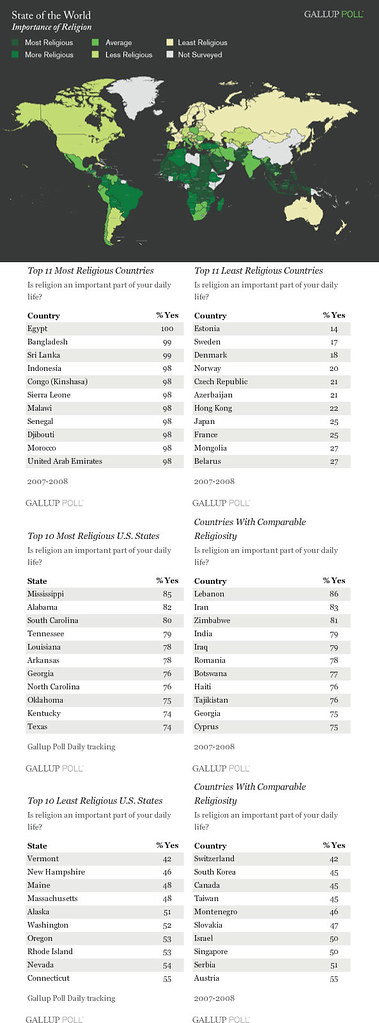
Most and least religious countries in the world

Here's an interesting Gallup survey listing up which countries are most and least religious, and comparison to US states. Always nice to keep around when there are discussions about how important religion is for your well-being. (The poll data is based upon interviews from 2006, 2007 and 2008, the article seems to be brand new: February 9, 2009.)


See also this post about religion and social issues.