Showing posts with label europe. Show all posts

Sunday, February 5, 2012

In the West, religious nations are more sexist

"First of all, let's look at the correlation with a straightforward measure of whether women can be leaders, which was assessed by asking the level of agreement with two questions: “On the whole, men make better political leaders than women do” and “On the whole, men make better business executives than women do.”

Overall, there's a fairly good correlation. But there is an exception, and that's Asian countries.  There are only a few Asian countries in the sample, so it's hard to draw sweeping conclusions. But they are all very sexist, whether their citizens are religious (Thailand, Taiwan) or non-religious (China, Hong Kong, Japan)

So I took these countries out of the analysis - in fact, what's shown in the graphic is only those countries with a predominantly Western, Christian culture (i.e. North and South America, Europe, and Australia).

In these Westernised countries there's a strong, linear relationship between religion and sexism.

In fact, if you narrow the sample a bit more to look only at European countries the fit is even cleaner (I haven't shown this, but it's a remarkably straight line)."


Epiphenom.fieldofscience.com, Tom Rees, November 11, 2011

Religion vs. sexism


Tuesday, February 26, 2008

Catholic Church blamed for high abortion rate

"Who carries the greatest responsibility for the deaths of unborn children in this country? I accuse the leader of the Catholic church in England and Wales, His Eminence Cardinal Cormac Murphy-O'Connor. I charge that he is partly to blame for our abnormally high abortion rate.

[...]

A study published in the Lancet shows that between 1995 and 2003, the global rate of induced abortions fell from 35 per 1,000 women each year to 29. This period coincides with the rise of the "globalised secular culture" the Pope laments. When the figures are broken down, it becomes clear that, apart from the former Soviet Union, abortion is highest in conservative and religious societies. In largely secular western Europe, the average rate is 12 abortions per 1,000 women. In the more religious southern European countries, the average rate is 18. In the US, where church attendance is still higher, there are 23 abortions for every 1,000 women, the highest level in the rich world. In central and South America, where the Catholic church holds greatest sway, the rates are 25 and 33 respectively. In the very conservative societies of east Africa, it's 39. One abnormal outlier is the UK: our rate is six points higher than that of our western European neighbours.

[...]

When the Pope tells bishops in Kenya - the global centre of this crisis - that they should defend traditional family values "at all costs" against agencies offering safe abortions, or when he travels to Brazil to denounce its contraceptive programme, he condemns women to death."

George Monbiot, Guardian, February 26 2008

Why religion is in decline or changing for the better all over the world

"Yet breathless warnings about rising religious fervor and conflicts to come ignore two basic facts. First, many areas of the world are experiencing a decline in religious belief and practice. Second, where religions are flourishing, they are also generally evolving—very often in ways that allow them to fit more easily into secular societies, and that weaken them as politically disruptive forces.

[...]


We have seen how rapidly religion has spread in the past, claiming adherents from competing faiths before the competition knew what hit them. Both secularism and secularly inspired ways of being religious are spreading just as rapidly—maybe even more so. Historians may one day look back on the next few decades, not as yet another era when religious conflicts enveloped countries and blew apart established societies, but as the era when secularization took over the world. "


March 2008 Atlantic Monthly
A very thorough and uplifting article on the state of religion and secularism.

Also a good excuse to post this graph again:

Friday, February 15, 2008

Karen Armstron on secularism

"Q: Is the separation of religion from politics practicable in the context of Islam?
A: It has worked very well for us in the west, and one of the reasons for that is that when we did mix religion and politics during our modernisation period, it was a horror. There were terrible wars of religion in the 17th century that left 35 percent of the population dead. This was one of the great catastrophes of European history, and it was that experience which made the enlightenment - people said, ‘No, we’ll keep politics out of religion.’ Now, we had a long time to develop institutions - we didn’t have to do it overnight.
In the Muslim world, secularism has been introduced far too rapidly. When Kemal Ataturk secularised Turkey, he closed down all the madrassas and pushed the Sufis underground; the Shah of Iran used to make the soldiers go out with their bayonets, taking off the women’s veils and ripping them into pieces in front of them. In this context, secularism seems like an assault upon religion — it is too quick, and this has given it a bad name.

The News(Pakistan), February 03, 2008
She's right here. It is tragic that secularism has been given a bad name in the Middle East, simply because it was forced upon people. (Same thing with USSR for that matter.) However, if there's a time for secularism among Muslims, it's now. We can hardly let 35% of the population die so they will appreciate secularism they way we do. But no bayonets.
"My next book will be titled ‘The Case for God.’ It looks at some of the modern atheists; the movement of atheism; and how the present-day atheism is due to bad modern theology. The book will be with the publisher by September 2009."

Tuesday, February 12, 2008

Homicide and religion linked


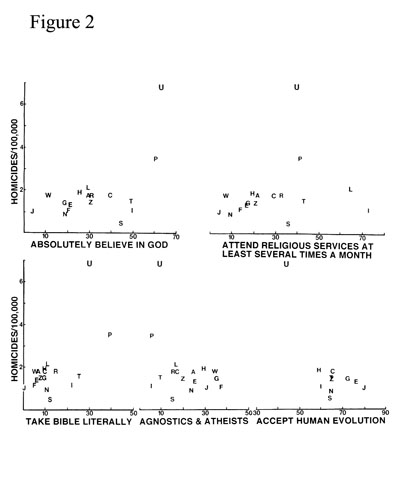
"In general, higher rates of belief in and worship of a creator correlate with higher rates of homicide, juvenile and early adult mortality, STD infection rates, teen pregnancy, and abortion in the prosperous democracies (Figures 1-9). The most theistic prosperous democracy, the U.S., is exceptional, but not in the manner Franklin predicted. The United States is almost always the most dysfunctional of the developed democracies, sometimes spectacularly so, and almost always scores poorly. The view of the U.S. as a “shining city on the hill” to the rest of the world is falsified when it comes to basic measures of societal health. Youth suicide is an exception to the general trend because there is not a significant relationship between it and religious or secular factors. No democracy is known to have combined strong religiosity and popular denial of evolution with high rates of societal health. Higher rates of non-theism and acceptance of human evolution usually correlate with lower rates of dysfunction, and the least theistic nations are usually the least dysfunctional. None of the strongly secularized, pro-evolution democracies is experiencing high levels of measurable dysfunction. In some cases the highly religious U.S. is an outlier in terms of societal dysfunction from less theistic but otherwise socially comparable secular developed democracies. In other cases, the correlations are strongly graded, sometimes outstandingly so.

Legend: A = Australia, C = Canada, D = Denmark, E = Great Britain, F = France, G = Germany, H = Holland, I = Ireland, J = Japan, L = Switzerland, N = Norway, P = Portugal, R = Austria, S = Spain, T = Italy, U = United States, W = Sweden, Z = New Zealand.

Cross-National Correlations of Quantifiable Societal Health with Popular Religiosity and Secularism in the Prosperous Democracies. Gregory S. Paul, 2005.

Plenty of other figures and text in the article.
See also a new article (1. February 2008) by Gregory S. Paul: Why is Secular European Society Doing so Much Better Than God-Fearing America?

Tuesday, February 5, 2008

EU official: Half of European anti-Semitism related to radical Islam

"Some 50 percent of anti-Semitic incidents on the European continent are connected to radical Islamic elements, according to a senior European Commission official.
The figure comes from European Commissioner for Justice, Freedom and Security Franco Frattini, who is responsible in the EU for combating racism and anti-Semitism in Europe. Frattini mentioned it in a conversation with Minister for Diaspora Affairs Isaac Herzog last week, and said it was based on European Union reports.
The Jerusalem Post, Feb 2, 2008

Monday, January 28, 2008

How alternative are youths and grown-ups?

I earlier posted a PDF with some interesting international statistics in my Norwegian blog, but the charts are easy to grasp and there's a brief explanation in English under each chart too:

First of all, the PDF is a combination of two studies: 1. ROSE (The relevance of science education) (International, 15 yearolds) og 2. The Eurobarometer. (Europe, grown-ups). You'll most likely find the information elsewhere in English if you need it, but the charts can be enlightening.
Read more about ROSE here in English.


I'll breiefly explain what the charts shows
Part 1. Rose (15 yearolds, international)

Page 8: Mean H28. taken herbal medicines or had, alternative treatments (acupuncture, homeopathy, yoga, healing, etc.)
A little difference between genders, but Northern Europe are the least interested and Africa the most.

Page 9: Mean C12. Interest for alternative therapies (acupuncture, homeopathy, yoga, healing, etc.) and how effective they are.
In this chart, you'll see a very big difference between the genders in Europe. Boys have little interest while
girls have more interest than both women and men in the third world countries.

Page 10: Mean H2. read my horoscope (telling future from the stars)
Also very big differences between the genders all over Europe. Almost all girls have read it. In Africa, there's little difference bwteen the genders, and they all read the horoscope less than European girls

Page 11: Mean C9. Interest for astrology and horoscopes, and whether the planets can influence human beings
While European girls still are much more interested than men, it is nowhere near the same as having merely read the horoscope. African countries top the score here.

The rest pretty much explain themselves
Page 12: Mean C11. Interest for life and death and the human soul
Page 13: Mean C13. Interest for why we dream while we are sleeping, and what the dreams may mean
Page 14: Mean C14. Interest for ghosts and witches, and whether they may exist
Page 15 Mean C15. Interest for thought transference, mind-reading, sixth sense, intuition, etc.

Page 16: Mean E34. Interest for why religion and science sometimes are in conflict
This is an interesting chart. It can be interpreted in two ways. Say, in Norway, most youths are not interested in learning about this. Is it because they're less religious over all, or is it because religion here is more adapted to the scientific outlook, and the conflict is less obvious than elsewhere?

Part 2: Eurobarometer, (grown-ups, Europe)
(Some of the questions are normal health questions and I'll skip them)

Page 26: Praying? (last year, to cure a health problem)
This is the graph I posted on top here.The numbers are all over the place, but women are always praying the most.

Page 27: Tried homeopathy? (last year, to cure a health problem)
Page 28: Herbal medicine? (last year, to cure a health problem)
Page 29: Tried Ostheopathy? (last year, to cure a health problem)
Page 30: Tried meditation or yoga? (last year, to cure a health problem)


Thursday, December 27, 2007

More than half of Europe are "fuzzy believers"

"THIS WEEK church pews will be filled with those who turn up only for high days, holidays, hatches, matches and despatches.
But this group of uncommitted believers who are attached to no particular church but who have a real and genuine interest in spiritual matters have been classified into a new denomination called "Fuzzy Fidelity" by researchers.
The headache for the established churches is that this group now makes up more than half the European population.

[...]

"The fuzzy faithful have become so numerous because people are ceasing to be actively religious much more quickly than they are becoming wholly secular," said Voas.
"The sheer size of this group means that upon their attitudes and behaviour will hang the future role of religion in Britain.

[...]

Voas has divided this group into subgroups "Spiritual Seekers" and "Sheilaists". Spiritual Seekers have beliefs about the afterlife and fate that have nothing to do with organised religion.
The term Sheilaists derives from an interview with a woman called Sheila who defined her religious conviction as: "Sheilaism: I just have a little voice in my head.""

Sunday Herald, December 27, 2007
The fuzziness is silly, but preferable of course to literal interpretation. And in a purely Darwinian sense, I think it will win over other ways to be religious, simply because people don't necessarily need to compromise either faith or reason and say: "Look, my religion forbids me to use my head. I need to pretend we're still in the bronze age". Plus, there's the added bonus of no religious bosses so there's not going to be powerful churches to mess up education and what not.

See also:
Every Fifth German Professes "Deep Religious" Convictions
"The study suggests that young people between 18 and 29 years of age in Germany have stronger religious convictions than their parents, though they don't necessarily act on them.

[...]

Nigeria, Brazil, India and Morocco reported with over 90 percent the highest rates of religiosity. In Europe, Germany ranks behind Italy and Poland, but ahead of Great Britain and France in terms of the number of practicing believers."

Deutsche Welle, 17.12.2007

Wednesday, December 19, 2007

Carroll: America's politics of religion

When Romney and others assert that American virtues, generally summed up in the idea of "freedom," are based on faith, a cruel fact of history is being ignored. The politics of human rights, like the idea of individual freedom, were born not in religion but in the Enlightenment struggle against it.

[...]

In the very years [post war] that majorities of Europeans were walking away from organized religion, they were resolutely turning away from government-sanctioned killing, whether through war or through the death penalty; they were leaving behind narrow notions of nationalism, mitigating state sovereignty, and, above all, replacing ancient hatreds with partnerships. All of this stands in stark contrast to the United States, where the most overtly religious people in the country support the death penalty, the government's hair-trigger readiness for war, and the gospel of national sovereignty that has made the United States an impediment to the United Nations."

James Carroll, International Herald Tribune, December 17, 2007

The Real Reason the Religious Right is Losing America

"It has long been understood that popular religiosity tends to sink as education and income levels rise. It is now understood that additional factors have sped up secularization in most first world nations. An extensive economic safety net, including universal health care, has left most westerners so secure that few feel a need to seek the aid and protection of supernatural powers and they have abandoned the churches in droves. America is the last advanced democracy to feel the full impact of secularization because the Republican alliance with conservative evangelicals that constitute a third of the nation and corporate interests has succeeded in preventing the adoption of a strong safety net.
Middle class Americans are in serious danger of financial ruin if they lose their job or health insurance and mobility from poverty to the middle class is unusually low by western standards.
But here’s the twist. The very same corporations are doing all they can to turn America into a nation of materialistic, hedonistic consumers and the public has in the main gone along with the project. The results are plain to see on the entertainment TV that is a sea of the non-traditionalist values their corporate owners favor. It was the retail chains that got rid of the Blue Laws that used to keep people in church on Sunday rather than at Wal-Mart and Home Depot."

Gregory Paul, OpEdNews.com, December 16, 2007
Worth reading. Some useful links in the text too.

Monday, December 3, 2007

Here's an improvement on democracy

"Consider some dates. Native Americans got the vote in the United States in 1924. Spanish women were given the same privilege in 1931, French women in 1944. Lords of the Realm in the United Kingdom could not vote in parliamentary elections until 1999. Although democracy began in Athens two and a half thousand years ago, it was for centuries a fragile flower and has blossomed only recently.
Democracy, we tell ourselves, is a hallmark of “the West”, the treasure that the rest of the World envies and that accounts for the pre-eminence of Europe and North America in economic progress, intellectual dominance and moral freedoms.
But it's not the case when you examine the chronology. The rise of the West had much less to do with democracy than with the rise of secularism. The West's advance was chiefly related to the decline in the influence of religion that sought the truth by “looking in” to see what God had to say, and its replacement by looking out, deriving authority from observation, experimentation and exploration."

Peter Watson, The Times, December 1, 2007
It's very true. Democracy rests on the idea that the population can rationally discuss and select the best options. But what if people aren't rational?

Saturday, November 24, 2007

Artists too frightened to tackle radical Islam

"Britain’s contemporary artists are fêted around the world for their willingness to shock but fear is preventing them from tackling Islamic fundamentalism. [...]
“I’ve censored myself,” [Grayson] Perry said at a discussion on art and politics organised by the Art Fund. “The reason I haven’t gone all out attacking Islamism in my art is because I feel real fear that someone will slit my throat.”
[...]
Across Europe there is growing evidence that freedom of expression has been curtailed by fear of religious fundamentalism. Robert Redeker, a French philosophy teacher, is in hiding after calling the Koran a “book of extraordinary violence” in Le Figaro in 2006; Spanish villages near Valencia have abandoned a centuries-old tradition of burning effigies of Muhammad to mark the reconquest of Spain, against the Moors; and an opera house in Berlin banned a production of Mozart’s Idomeneo because it depicted the beheading of Muhammad (as well as Jesus and other spiritual leaders)."
The Times, November 19, 2007

Monday, October 8, 2007

Religion and Social Issues

"The survey finds a strong relationship between a country's religiosity and its economic status. In poorer nations, religion remains central to the lives of individuals, while secular perspectives are more common in richer nations.1 This relationship generally is consistent across regions and countries, although there are some exceptions, including most notably the United States, which is a much more religious country than its level of prosperity would indicate. Other nations deviate from the pattern as well, including the oil-rich, predominantly Muslim -- and very religious -- kingdom of Kuwait."

Pew Research Center, October 4, 2007
Lot's more numbers in the report.
See also this, which taken from the same survey:
"Pakistanis who believe that religion and government should remain separate were only 33 per cent of the population in 2002. Five years later their size grew to 48 per cent, a 15 per cent increase. In Turkey, support for secularism declined by 18 per cent over the same period. In 2002, 73 per cent Turks said they believed religion and politics did not mix. Although secularists are still a majority in Turkey, their size declined to 55 per cent in 2007."

Pakistan Dawn, October 08, 2007

Friday, October 5, 2007

European lawmakers condemn efforts to teach creationism

"The Parliamentary Assembly of the Council of Europe condemned efforts to teach creationism in schools Thursday in a vote that underlined concern about the rise of a new socially conservative agenda in several countries.
Members of the assembly, which monitors human rights, approved 48 to 25 a report that attacked advocates of creationism for seeking "to impose religious dogma" and to promote "a radical return to the past" at the expense of children's education."

International Herald Tribune, October 4, 2007
What they voted for.


Anyway, this is great news!

Monday, September 17, 2007

America's Double Trouble

"After all, only seven percent of American adults are scientifically literate and only one in five college graduates makes that mark, according to a 1998 report on "civic scientific literacy" by Jon D. Miller of Northwestern University Medical School. American fifteen-year-olds rank behind their peers in twenty-two other countries—including the Netherlands, Poland, and South Korea—in scientific knowledge, according to the National Center for Education Statistics. And last year's report from the National Science Foundation indicates that the public's scientific knowledge hasn't improved since the 1990s—though it did in almost every European country surveyed."

Science & Spirit, 9. Sept 2007

Friday, June 29, 2007

Two Council of Europe resolutions

"Assembly backs separation of church and state, reaffirms precedence of human rights over religious principles
Human rights must ultimately take precedence over religious principles where they conflict, PACE said today in a recommendation, following a special debate on intercultural and inter-religious dialogue. States should welcome and respect religions, in all their plurality, "as a form of ethical, moral, ideological and spiritual expression" by citizens, and should protect individuals' freedom to worship, but there should also be a clear separation of church and state, the parliamentarians said.
Recommendation 1804"

Council of Europe 29/06/2007

"
PACE: criticism of religions is permissible, inciting hatred against them is not
Religious groups must tolerate criticism and debate about their activities, provided it does not amount to gratuitious insult, but on the other hand hate speech – inciting discrimination or violence against people of a particular religion – should be penalised, PACE said today in a recommendation. Meanwhile blasphemy laws – which often result from the dominant position of one particular religion – should be reviewed.
Recommendation 1805"

Council of Europe 29/06/2007

Thursday, June 28, 2007

Most people on earth believe in reincarnation

"Most people of Planet Earth believe in reincarnation, the latest survey undertaken by the Gallup Institute says.
Meanwhile, according to the sociologist Prof. Jorg Stolz, director of l'Observatoire des Religions of the University of Lausanne, this tendency comes up as people's understanding of the supernatural gets increasingly blurred, the Komsomolskaya Pravda daily reported Wednesday.
'If you ask people what they believe in, you may see that the more precise question about afterlife you ask, the fuzzier answers you get. For most people, even God is no longer their Father in Heaven but rather a supreme power uniting man, nature and cosmos,' he said.
According to Stoltz, the concept of hell also becomes increasingly unpopular. Only 5 to 10 percent of Europeans still believe it exists, he said."

Interfax, June 27 2007
Religion getting more warm and fuzzy!

Monday, June 25, 2007

Council of Europe to vote on proposal to fight creationism

"The theory of evolution is being attacked by religious fundamentalists who call for creationist theories to be taught in European schools alongside or even in place of it. From a scientific view point there is absolutely no doubt that evolution is a central theory for our understanding of the Universe and of life on Earth.
Creationism in any of its forms, such as “intelligent design”, is not based on facts, does not use any scientific reasoning and its contents are pathetically inadequate for science classes.
The Assembly calls on education authorities in member States to promote scientific knowledge and the teaching of evolution and to oppose firmly any attempts at teaching creationism as a scientific discipline."

Council of Europe, Doc. 11297, 8 June 2007
Very long text. (Notice that Council of Europe is not the same as the EU.)
This will be voted over tomorrow. I have no idea about the outcome, particularly as this may in some ways affect freedom of speech (although I have not read all the 105 points and know nothing about it) , but I sure appreciate the initiative.

I think it sends a powerful message.


Sunday, June 17, 2007

Foreign Missionaries Find Fertile Ground in Europe

"For centuries, when Europe was the global center of Christianity, millions of European missionaries traveled to other continents to spread their faith by establishing schools and churches. Now, with European church attendance at all-time lows and a dearth of preachers in the pulpits, thousands of "reverse missionaries" are flocking back, migrating from poor countries to rich ones to preach the Gospel where it has fallen out of fashion."

Washington Post, June 11, 2007

It might be noted that they tend to attract immigrants who already are religious. And I reckon that most Europeans have become too skeptical for this.
On the bright side, notice that humanist groups are starting to spread in Africa. Some of the them request skeptical books, and I for one am going to send a few myself.

Friday, May 11, 2007

[Secularisation] Mina’s ex-Muslim group spawns a movement

"The Iranian women's rights and human rights activist Mina Ahadi, who founded the Central Committee of ex-Muslims in Germany, seems to have started a trend. Following her valiant example, activist in the Netherlands have set about founding their own organisation of ex-Muslims."

National Secular Society Fri, 11 May 2007

I might as well mention that there's a group of people trying to start such an organisation in Norway as well, although it seems they had some disagreements on policy (homosexuality and Israel was mentioned). Anyway, this development is welcome for two reasons: 1. It will diminish the possibility of the Fundamentalist and Conservative Muslims to speak on behalf of everyone with a Muslim background. 2. Europeans will feel less threatened by Muslims when we see that they are getting more secular.