Showing posts with label research. Show all posts

Friday, June 29, 2012

Less crime if you believe in Hell?

"Belief in hell keeps down criminal activity, but belief in heaven actually boosts it, according to a pair of researchers at the universities of Oregon and Kansas.

Azim Shariff and Mijke Rhemtulla scoured 30 years of international values-based surveys and found societies that put more stock in supernatural benevolence than supernatural punishment have higher national crime rates. The relationship is so significant, they found, that it is a stronger predictor of crime rates than are economic factors such as gross domestic product and income equality."


The Globe and Mail, Jun. 25 2012
I understood immediately that there were issues with this research. Comparing crime statistics between countries, when crime is reported differently makes no sense at all. I may be prejudiced but I my first thought was that belief in Hell correlates with poor crime statistics. I might as well post the graph right away (which is picked up from Epiphenom which also has a critical article):

It's a bit hard to read with only two letters abbreviations but you can see that Norway (NO) and Sweden (SE) are ranking high here. Yes, I live in one of the most crime infested countries. I wish I lived in Egypt (EG) which you will see on the bottom.

Here's a critical examination:

"Interpol merely gathers and reports nonlethal crime statistics provided by member nations without standardizing or vetting it [19, 22]. For example, assaults are reported at a rate about 6 times higher in Australia and Sweden than in Canada and France, this level of disparity is suspect. Rates of theft are reported to be twice as high in Sweden as in France; are the former actually twice as larcenous as the French, or are the latter twice as unlikely to file a report, or is the reality somewhere in-between? Similarly suspicious discrepancies exist in International Crime Victims Survey results. Reported rates of rape are two to twenty times higher in the U.S. than in other 1st world nations [24,25], but this only means that American females report being raped at far higher rates, not that American males are more prone to committing sexual assaults. Nonlethal crimes are difficult to compare even between the relatively uniform 1st world countries, they only grow worse when comparing 2nd and 3rd world nations with greater disparities between the quality of crime reporting."

Plosone.org, GregorySPaul on 24 Jun 2012
 The only statistic you can reliably compare is homicide, but even there there are issues:

"In contrast, Jensen found that more homicide is more strongly linked to greater popular support for the reality of hell than for heaven [12] -- he suggests that “malevolent” forms of religion produce inferior results compared to “benevolent” -- Sharif and Rhemtulla do not cite Jensen or explain the disparity in their results with his. Sharif and Rhemtulla find that more homicide weakly correlates with more belief in God, Rees [5] as well as Jensen [12] found a positive relationship in a large sample of nations. In the more uniform prosperous democracies the only example with high levels of homicide, the U.S., has the highest levels of religiosity including belief in heaven and hell [6]. The advanced democracies with the least, and remarkably low, homicide are the most atheistic. (It would be interesting to analyze correlations between measures of religiosity and homicide in different economic categories of nations.) Potential reasons that deity worship and scripture contribute to lethal violence have been proffered [6-8,13-15].
How crime in general corresponds to differing levels and types of religiosity remains inherently uncertain, but the most atheistic democracies appear to suffer relatively modest nonlethal misdemeanors and felonies, and definitely enjoy very low lethal violence. All studies agree that the most reliably measured crime, homicide, tends to be higher in less atheistic countries. Studies are contradictory regarding how homicide correlates with differing belief beliefs in the afterlife, further analysis may clear this up."
In short: Bollocks.


Thursday, March 29, 2012

Study questions religion-depression link

"Some research has suggested that religious people may have a buffer against major depression -- but new findings cast some doubt on that.

Researchers said people who develop depression might be more likely to stop going to services, which could explain why those who regularly go to religious services have lower rates of depression than the less-devout.

The new study found evidence of just that.

Among 2,100 Americans followed from birth to about middle-age, women who had developed depression early in life -- before age 18 -- were more likely than others to stop going to religious services by their early 20s.

Among men, there was no link between depression and churchgoing habits."

Reuters.com, Feb 28, 2012
See abstract of research here.
Aktuelt for lesere av VĂ¥rt Land

Sunday, February 5, 2012

Religious people are less likely to take their medicine

"Sarah Finocchario-Kessler, at the University of Kansas, used data from one such drug trial to see what the effect of religious beliefs (and other psychological factors) was on medication taking.

She found that people who put themselves in God's hands really were less likely to take their medicine.

To be precise, people who used a passive religious deferral coping style (e.g. "I don’t try much of anything; simply expect God to take control") were less likely to take their medicine as often as they were supposed to.  On the other hand,  collaborative religious coping "I work together with God as partners" or self-directing religious coping (e.g., "I make decisions about what to do without God’s help" had no effect on whether people took their medicines.

The biggest effect was with those people who scored high on the "God as locus of health control" measure - that means people who agreed with statements like "Whether or not my HIV disease improves is up to God." "


Epiphenom.fieldofscience.com, Tom Rees,  March 02, 2011


Saturday, February 4, 2012

Religious Young Adults Become Obese By Middle Age

"Young adults who frequently attend religious activities are 50 percent more likely to become obese by middle age as young adults with no religious involvement, according to new Northwestern Medicine research. This is the first longitudinal study to examine the development of obesity in people with various degrees of religious involvement.

[...]

Previous Northwestern Medicine research established a correlation between religious involvement and obesity in middle-age and older adults at a single point in time. By tracking participants’ weight gain over time, the new study makes it clear that normal weight younger adults with high religious involvement became obese, rather than obese adults becoming more religious.

[...]

The study, which tracked 2,433 men and women for 18 years, found normal weight young adults ages 20 to 32 years with a high frequency of religious participation were 50 percent more likely to be obese by middle age after adjusting for differences in age, race, sex, education, income and baseline body mass index. High frequency of religious participation was defined as attending a religious function at least once a week."

Northwestern.edu, March 23, 2011


Thursday, April 3, 2008

Fundamentalists of all stripes want to turn back the clock

"Despite all their theological and cultural differences, fundamentalists of every faith share at least one common characteristic: resistance to modernity. That’s the assessment of scholars and firsthand observers who have evaluated the varieties of religious expression. “Fundamentalism worldwide is religious anti-modernism,” noted Roger Olson, professor of theology at Baylor University’s George W. Truett Theological Seminary. “Fundamentalism reacts against various types of modernity,” echoed Bill Leonard, a church historian and dean of the Wake Forest University Divinity School. Whether it’s Baptist preachers J. Frank Norris and Jerry Falwell calling America to return to pre-scientific Christianity or Ayatollah Khomeini and Muqtada al-Sadr calling Muslims to resist the intrusion of Western decadence, fundamentalism finds a home in most major faith groups."

Associated Baptist Press, April 1, 2008
It's a long article crammed with points. Apart from being against modernity there were four other subjects discussed: Dogmatic Faith, Identity, Fear and Politics.
It's the first in a series on Fundamentalism at Associated Baptist Press.

Friday, February 29, 2008

Indonesia: Mass trances are in vogue

"Religion, education and development have done little to budge widespread acceptance of the supernatural among Indonesia's diverse ethnic and religious groups. "In Indonesia, trance is tied up with culture," said Lidia Laksana Hidajat, research coordinator in the psychology faculty of Jakarta's Atma Jaya University.

[...]

"They were working in silence. That's one of the requirements of a trance to happen - it's usually quiet and when they are engaged in monotonous activity."
Suddenly, one of the workers started screaming and her body went stiff. The one next to her started crying and went stiff too. Others tried to help but soon they started too in a kind of domino effect.
A local Muslim leader was summoned, but his prayers had no effect. Eventually, the exhausted women fell asleep and upon awakening they remembered nothing.
Hidajat concluded that the mass trance had more to do with exhaustion and stress than evil spirits.

[...]

"Often they are people who are very religious or under pressure. They were also from low socio-economic backgrounds and many said they didn't have happy childhoods," she said.
"All the trance dancers I met in Bali had similar vulnerable personalities."

iol.co.za, February 25 2008

Thursday, February 28, 2008

How Superstition Impacts Consumer Choice

"Between $800 and $900 million is lost in business in the United States every Friday the 13th. A businessman in Guangzhou, China, recently bid 54,000 yuan (almost seven times the country's per capita annual income) for a lucky license plate containing the sequence 888. Continental Airlines recently advertised an $888 flight to Beijing with the slogan "Lucky You," and the Beijing Olympics are scheduled to open on August 8, 2008 at 8 p.m.

[...]

In another study of American college students at an East Coast university, the researchers found that having participants think about Friday the 13th made them significantly more risk averse. Participants were told they were participating in two unrelated studies. After thinking about Friday the 13th or a neutral day (Tuesday the 19th), participants were then asked to make a choice in betting situations, for example a guaranteed $18 or a 20 percent chance to win $240. Those who had thought about Friday the 13th chose the safe option 49 percent of the time, versus only 35 percent of those who had thought about a neutral day."

Medical News Today, 16 Feb 2008

Of course 900 million dollars is a small price to pay for a little innocent superstition.
It would be interesting to know what religion itself costs.

Saturday, February 2, 2008

Loneliness Breeds Belief in Supernatural

"People who feel lonely are more likely to believe in the supernatural, whether that is God, angels or miracles, a new study finds. [...] In their study, detailed in the February issue of the journal Psychological Science, Epley's team tried to induce feelings of loneliness in people to see how it affected how they thought of pets and their belief in religious figures.

[...]

The participants were then asked to rate their belief in the same supernatural agents in the other study, and those in the "lonely group" reported stronger belief than those in the "connected group." The results were also compared to ratings the participants gave before they got their life predictions, and those who reported a belief in God before and were made to feel lonely reported a stronger belief after the experiment.
"We found that inducing people to feel lonely made them more religious essentially," Epley told LiveScience, though he notes it won't cause any sudden conversions."

LiveScience, 24 January 2008
Of course, instead of having the balls to say that Jesus is nothing more than a fantasy friend, the researchers go straight for the good old "religion is beneficial" conclusion:
""There are health benefits that come from being connected to other people, and those same benefits seem to come from connection with pets and with religious agents, too," Epley said."
Can you say surrogate?

Tuesday, December 11, 2007

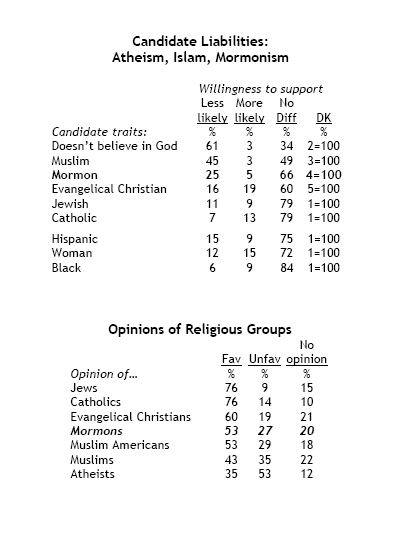
Public Opinion About... Atheists

Yep, it's that time again when they survey what Americans think of various religious groups. This time the Pew Research centre has measured what people think of Mormons, and it's as depressing as always:

Friday, August 24, 2007

Out-of-body experience recreated

"Experts have found a way to trigger an out-of-body experience in volunteers.
The experiments, described in the Science journal, offer a scientific explanation for a phenomenon experienced by one in 10 people."

news.bbc.co.uk 24 August 2007

Monday, July 30, 2007

Categorising communities by religion is dangerous and counterproductive

"The Conservative party has commissioned a report about national security. One of the findings is that the Government is wrong to communicate with people from ethnic minorities as though they were members of groups rather than individual citizens.
(Read related BBC Story here)

The NSS has been saying this for years. The Blair Government created these group categories – mostly based on religion – to define whole swathes of the population. But the huge numbers who didn’t want to define themselves in this way were left without a voice.

[...]

Maryam Namazie and her recently-launched group, The Ex-Muslim Council of Britain, has vividly illustrated that there is no way that the label “Muslim” can be accurately attached to everyone who has come from a Muslim cultural background."

National Secular Society, 27.07.2007