Tuesday, February 26, 2008

Holy places of Jerusalem are popular with mentally deranged people.

"This exotic disease is labeled by professionals as the Jerusalem syndrome, reports Wednesday Argumenty i Fakty weekly.

[...]

After fighting down policemen who tried to interfere, "Samson" was taken to the Kfar Shaul Psychiatric Hospital in Jerusalem. After therapy treatment he returned back to the USA by himself.
The Hospital diagnoses about a hundred patients obsessed with the syndrome, and about forty of them require hospitalization.
Most of them had been mentally affected in their home countries, and only few opened to the world as "Jesus", "The Virgin Mary", "John the Baptist", "Mohammed" or "Isaiah" in Jerusalem, the weekly reports."

Interfax, Russia, February 13 2008

See also: Jerusalem Syndrome

Why religion is in decline or changing for the better all over the world

"Yet breathless warnings about rising religious fervor and conflicts to come ignore two basic facts. First, many areas of the world are experiencing a decline in religious belief and practice. Second, where religions are flourishing, they are also generally evolving—very often in ways that allow them to fit more easily into secular societies, and that weaken them as politically disruptive forces.

[...]


We have seen how rapidly religion has spread in the past, claiming adherents from competing faiths before the competition knew what hit them. Both secularism and secularly inspired ways of being religious are spreading just as rapidly—maybe even more so. Historians may one day look back on the next few decades, not as yet another era when religious conflicts enveloped countries and blew apart established societies, but as the era when secularization took over the world. "


March 2008 Atlantic Monthly
A very thorough and uplifting article on the state of religion and secularism.

Also a good excuse to post this graph again:

Pew survey: Americans freely change, or drop, their religions

"Nothing" matters: 12.1% say their religious identity is "nothing in particular," outranking every denomination and tradition except Catholics (23.9%) and all groups of Baptists (17.2%).[...] Nearly 20% of all men and 13% of all women say they are unaffiliated. So are 25% of adults under age 30.[...] All the major Christian denominations are losing numbers fast. Only non-denominational Christian churches showed growth outpacing losses. "Two in three people who say they grew up as Jehovah's Witnesses have left the faith. Any one of 10 people you meet is a former Catholic," Lugo says.[...] "It will become increasingly difficult to find people who share a love for a distinct doctrine. [...] Green says he can already foresee implications in the public square as "firm beliefs and firm organizations are increasingly a thing of the past. In political life, when candidates go out to mobilize voters, they face a much more complicated picture.[...] Lugo predicts that as world religions such as Islam, Hinduism and Buddhism continue to grow in the USA through immigration and conversion, workplaces, schools and eventually the courts will face increasing challenges over religious accommodation.

USAToday, 25. February

"To illustrate this point, one need only look at the biggest gainer in this religious competition - the unaffiliated group. People moving into the unaffiliated category outnumber those moving out of the unaffiliated group by more than a three-to-one margin."

Pew Forum on religion


I was first a little dismayed to see that the numbers still were so low, but what's notable about this survey is how much things are changing, and that the losers in this game are traditional beliefs(catholic decline is only slowed down because of immigration), while the gainers are the unaffiliated.
It is also interesting that it will become much more difficult to use religion in politics, since you only end up gaining some and losing even more.

Monday, February 25, 2008

Faith school boom 'creates division'

"The rapid growth of faith-based schools under the previous federal government has threatened the social cohesion of the nation, according to Deputy Prime Minister Julia Gillard's most senior education adviser.

[...]

Professor McGaw's remarks reflect a profound shift in education in the past two decades, with more than 200,000 children — almost 40% of non-government school students — now attending a religious school outside the main Catholic, Anglican and Uniting systems.
The change has meant that, for instance, increasing numbers of children are taught creationism as part of their science classes."

The Age, Australia, February 25, 2008

Sunday, February 24, 2008

The reality of America’s ‘sexual culture’

"Journalist Pamela Druckerman didn’t think it would be hard to discuss sex issues with Alain Giami of the French National Institute of Health and Medical Research.[...]
“What do you call ‘infidelity’? I don’t know what ‘infidelity’ is,” he said, in what the former Wall Street Journal correspondent later described as a “rant.”
“I don’t share this view of things, so I would not use this word,” he added, and then delivered the coup de grace. “It implies religious values.”

[...]

While she didn’t set out to write a book about sex and religion, Druckerman found that in large parts of the world — from Bible Belt cities to Orthodox Jewish enclaves, from Islamic nations to post-Soviet Russia — it’s hard to talk about infidelity without talking about sin, guilt, confession, healing and a flock of other religious topics.
However, she also reached a conclusion that many clergy would find disturbing. When push comes to shove, cheaters are going to do what they’re going to do — whether God is watching or not.

[...]

Recent studies offer a vivid contrast[to the Kinsey report]. In the early 1990s, she noted, 21 percent of American men and 10 percent of women said they had cheated while married. In 2004, 21 percent of men and 12 percent of women said they had strayed at least once.
Meanwhile, 3.8 percent of married French men and 2 percent of married French women say they’ve had an affair during the past year — in one of the world’s most secular nations. And in highly religious America? The parallel figures are 3.9 percent of the married men and 3.1 percent of the women.

[...]

“Even when I talked to religious people about adultery, they weren’t really worried about God, about God striking them down for their sins,” concluded Druckerman. “Americans just don’t think that way now. Even the religious people were more worried about what their families, or perhaps the people in their religious communities, would think of them. ...
“When it comes to matters of infidelity, Christian Americans act more like Americans than they do like Christians.”

The Daily Dispatch, Sunday, February 24, 2008

Bulgaria debates bringing religious studies back into schools

"[...] Under a bid to promote respect for minority rights, optional studies on Christianity or Islam were actually introduced about a decade ago though only 14,000 students nationwide follow the course on their respective religion.
But these classes "are attracting less and less interest," said an opponent to the government's plan, Lyutfi Mestan, [...] "Instead of teaching tolerance, this type of religious study has divided pupils," he insisted.[...]
During communism, church-going was not tolerated so when the regime fell in 1989, people reacted by crowding back into churches. Traditional rituals were revived for Easter and Christmas and are still largely followed, even if only 30 percent of Bulgarians define themselves as believers.

[...]

Many Bulgarians still confuse religious faith and superstition, a 2004 Gallup poll showed.
Half of all people in this east European country still believe in black magic and fear the evil eye, while one in five people believe ghosts exist, black cats bring bad luck and that one can talk to the dead, according to the poll.
Gallup analyst Andrey Raychev suggested that imposing religious studies on an atheist population could be "dangerous" if religion was only presented in a good light without discussing the Crusades, the Inquisition or moments when religious fervor led to repression and abuse.
This would be "a grave error", he insisted.

AFP, 23. February 2008

Saturday, February 23, 2008

Sign here against Sharia in Britain: One law for all!

"Faith-based arbitration, where people agree to settle disputes in by the judgement of a religious figure is a highly problematic form of privatising law: using laws which are not publicly enacted, in forums which are not monitored, with no right of appeal, often within environments where women's rights are routinely subordinated to traditional and patriarchal cultures and beliefs which threaten the welfare of women and children.
Arbitration is an acitivity which should be entered into willingly: yet the ability to make an independent choices within a relationship is based in equality in social and economic choices, which is rare in society generally, is even rarer amongst those who cleave to traditional gender roles. Some women face violence for resisting pressures put on them in the name of religion or culture; many others face rejection from the family or community, isolation, financial hardships and other pressures.
The rights of equality between men and women, gay and straight, the rights to divorce and child custody on equal terms, and the criminalisation of domestic violence and marital rape have been hard-fought for by human rights activists over centuries, and continue to be fought for across the world. It is a deeply backward step for human rights to withdraw rights from the weakest and most powerless sectors of society. Women's, and children's, powerlessness will be legitimized and enforced, codified into law.
Given the central role of family in most societies, religious elites seek to strengthen their control and influence over their communities by controlling family relationships. Religious laws—especially in family matters—have long been a battleground. For many women, the family is the source of patriarchal oppression, and those forces which seek to normalise religious interference into private life are often the same ones which seek the control of women and girls.
Fundamentalism in all major religions involves similar views on gender relations and sexuality. Among other things, it seeks to establish and strengthen male-dominated control over the family and restrict women's sexual and social freedoms. Recognising a right for religious figures to intervene in family affairs priveleges the fundamentalist forces by definition, strengthening the worldwide growth of fundamentalism, and eroding women's hard won rights.
We ask our political representatives to respect and protect women’s constitutionally and internationally protected human rights by ensuring access to a single, uniform family law regime. Equally, we ask that religious freedoms of the majority not be confined to the interpretation of a limited few."

Middle-eastern women's campaign against faith-based arbitration and sharia law

Notice that you can sign under at "UK" and "Worldwide".
I urge all Atheist bloggers with any sense of justice to sign and pass this around.

Most Britons belong to no religion

"Freedom from religion in Britain is becoming as important as freedom of religion, according to a United Nations investigation.
A 23-page report by Asma Jahangir, the UN special rapporteur on freedom of religion or belief, says that the 2001 census findings that nearly 72 per cent of the population is Christian can no longer be regarded as accurate. The report claims that two thirds of British people do not admit to any religious affiliation.
The report calls for the disestablishment of the Church of England. It says that the role and privileges of the Church do not reflect “the religious demography of the country and the rising proportion of other Christian denominations”.
The report says that there is an “overall respect for human rights and their value” but it gives warning of discrimination against Muslims.
Citing research that 80 per cent of Muslims in Britain feel that they have been discriminated against, the report singles out the Terrorism Act 2000 for particular criticism. Under the Act police in some areas can stop and search people without having to show reasonable suspicion.
The report says that this affects ethnic and religious minorities more than other groups, especially since the bombings of July 7, 2005. Figures for 2004 to 2006 “show that searches of people with Asian appearance under this provision increased by 84 per cent, compared to an increase of only 24 per cent for white people”.
The report’s author also criticises terms in the Terrorism Act 2006 for being “overly broad and vaguely worded”."

The Times, February 22, 2008
Now here are good news and bad news. The good news, that most Britons are non-religious are very good.

The bad news is of course discrimination. Unfortunately, I couldn't find the report anywhere, so I'm not sure about what's been written on the issue. But you know things have gotten out of hand in Britain when an Iraqi minister is surprised to see so much extremists in the mosques:
"UK mosques too radical for Iraq, says minister
Dr Barham Salih commented that some of the mosques he had seen in Blackburn during a visit to the UK as a guest of Jack Straw were highly radicalised, and that it was unsurprising that Britain had problems with extremism.

[...]

"I am not surprised that you British are facing so many problems with extremists after what I saw in those mosques in Blackburn," he said. "What I saw ... would not be allowed here in Iraq - it would be illegal.""


Telegraph.co.uk, 24/01/2008
There has also been plenty of examples lately where Muslims have been behaving badly. I wrote this earlier:
Lately, we have seen a couple of disturbing developments where freedom of religion has been used to make other people's lives miserable. Muslim staff at Sainsbury in England refused to handle alcohol, Muslim staff at Marks & Spencer refused to sell a book of bible stories, Muslim medical students refuse to learn about alcohol or sexual diseases and finally: Muslim medical students are refusing to obey hygiene rules."
Oh, and I forgot setting up sharia courts and blowing up bombs and stuff. Not to mention the episode after the "Undercover mosque" documentary where the West Midlands Police discriminated against Channel 4 for trying to do their job when the WMP clearly didn't.
Have these Muslims been discriminated against? No, not apart from those working for Channel 4. Will their persistent Koran-pushing result in a bad-tempered British society who is willing to cut corners, resulting in discrimination of innocent Muslims and non-Muslims who may look like Muslims? No doubt, and that's a shame.

So I hope that Asma Jahangir also has a solution for the religious bigots who I am sure will scream discrimination whenever they can.

Friday, February 22, 2008

America still works

"Many observers abroad have the impression that Americans are growing more religious, while Europeans are growing more secular. This simply isn't true. Americans are far more religious than western Europeans, but in the US, no less than in Europe, the long-term trend is towards greater secularism.
In a 2001 study of religious attitudes among Americans, researchers at the City University of New York discovered that the number of Americans who profess no religion had grown from 8.16 per cent in 1990 to 14.17 per cent in 2000. Americans with no religion at all are now the third largest belief group in the US after Catholics and Baptists, and their number, around 30m, is almost as great as that of Baptists, who number around 34m. Moreover, the number of Americans who, even if they believe in God, do not belong to any religious organisation went from 46 per cent in 1990 to a 54 per cent majority by 2000, according to the study.
When the subject is actual church attendance rather than vague spiritual belief, the gap between the US and Europe shrinks further. According to the Gallup millennium survey of religious views, the number of North Americans (the US plus Canada) who attend church at least once a week is 47 per cent, compared with the west European average of 20 per cent. And some scholars say that the number is inflated, because many Americans are embarrassed to tell pollsters how rarely they attend church.
According to the Gallup poll, the number of North Americans who believe that the Bible is "the actual word of God" has fallen from 65 per cent in 1963 to just 27 per cent in 2001. At the same time, attitudes among Americans toward homosexuality, sex out of marriage and censorship are growing steadily more liberal. Abortion is the major exception; younger Americans tend to be more opposed to abortion than their elders. Possibly this reflects the growing use of ultrasound by parents to view their offspring in the womb, a practice which may be inadvertently undermining the distinction that supporters of liberal abortion laws have tried to make between foetuses and babies."
Michael Lind, Prospect Magazine (UK), February 2008
Another interesting development:

[...]

"Some will wish to argue that the slowing growth rate is evidence of an increasing secularization of American postmodern society," said the Rev. Dr. Eileen W. Lindner, editor of the Yearbook. "While such an explanation will satisfy some, caution in drawing such a conclusion is warranted."

[...]


Largest 25 Churches (ranked by membership)

1. The Catholic Church – 67,515,016
2. Southern Baptist Convention – 16,306,246
3. The United Methodist Church – 7,995,456
4. The Church of Jesus Christ of Latter-day Saints – 5,779,316
5. The Church of God in Christ – 5,499,875
6. National Baptist Convention, U.S.A., Inc. – 5,000,000
7. Evangelical Lutheran Church in America – 4,774,203
8. National Baptist Convention of America, Inc. – 3,500,000
9. Presbyterian Church (U.S.A.) – 3,025,740
10. Assemblies of God – 2,836,174
11. African Methodist Episcopal Church – 2,500,000
12. National Missionary Baptist Convention of America – 2,500,000
13. Progressive National Baptist Convention, Inc. – 2,500,000
14. The Lutheran Church - Missouri Synod (LCMS) – 2,417,997
15. Episcopal Church – 2,154,572
16. Churches of Christ – 1,639,495
17. Greek Orthodox Archdiocese of America – 1,500,000
18. Pentecostal Assemblies of the World, Inc. – 1,500,000
19. The African Methodist Episcopal Zion Church – 1,443,405
20. American Baptist Churches in the U.S.A. – 1,371,278
21. United Church of Christ – 1,218,541
22. Baptist Bible Fellowship International – 1,200,000
23. Christian Churches and Churches of Christ – 1,071,616
24. The Orthodox Church in America – 1,064,000
25. Jehovah’s Witnesses – 1,069,530

Christian Post, Feb. 20 2008
I'm satisfied, all right! When the biggest growth is JWs and Mormons, it probably means that "mainstream "Christianity is standing pretty still. See also my previous post on increasingly secular Catholics.

Thursday, February 21, 2008

Priests too secular says Cardinal

"Priests are becoming less obedient and more worldly, a top Vatican Cardinal lamented, adding they are neglecting their duties under the pressures of secular values.
Catholic News Agency and Catholic World News reports Prefect of Congregation for Institutes of Consecrated Life and Societies of Apostolic Life Cardinal Franc Rode says more responsive to the world, citing a reluctance to wear clerical dress as a symptom of this trend.
"A drift towards bourgeois values and moral relativism are the two great dangers that weaken religious life," Cardinal Rode said.
"The biggest problem today is the climate of secularisation, present not only in Western society but also within the Church itself."

[...]

During the almost 27 years of the Pontificate of Pope John Paul II, the number of religious dropped 25%, expanding the gap between men and women religious, with male religious orders being the most affected by the decline.

Cathnews, February 18, 2008
Great news! Carry on, Joe! There was something else:
"Cardinal Rode said while young people are hearing God's call to a vocation in the priesthood or religious life, he suggests that a lax model of priestly or religious life is unlikely to encourage vocations.
"Young Catholics who are attracted to contemplative life in highly disciplined religious orders are attracted because it is a radical life choice," he said."

Let's see if this is true?

"In a recently released book titled “American Catholics Today: New Realities of Their Faith and Church,” University of Connecticut Professor and Emeritus of Sociology William d’Antonio confirms a consistent trend among younger Catholics – in every survey since 1987, younger Catholics have become increasingly more liberal and less practicing in their faith and values.

[...]

According to the results, only 15 percent of college-aged Catholics said they attended mass. In contrast, 60 percent of those aged 65 and older said they attended church services every week.
Most revealing, however, is the divergence in views among younger Catholics with their parents and grandparents regarding abortion, homosexuality, and divorce. D’Antonio attributes the results to the increasing tolerance that young people give to different lifestyles in today’s culture.
"When I was [that] age I didn't know anyone who was homosexual. When anyone got divorced, it was a scandal,” he says.

[...]

“Cafeteria Catholicism,” the practice of picking and choosing only those beliefs considered “convenient,” has been attributed to the increasing rise in liberal views among many Catholics."

Christian Post, Feb. 17 2008
And as far as I remember, in USA last year, they had to import Catholic priests. Right, here's the story:

Cardinal (Francis George) to ordain 13 new priests -- 12 from overseas

Marvellous!

Wednesday, February 20, 2008

Sweden: Muslims required to divorce according to Sharia law

"The social services in Karlshamn are apparently discriminating against Muslims. Muslims who apply for welfare support need to show a certificate that they've been divorced, not only from a court, but also from an imam.
Susanne Loveheim, head of the welfare services in Karlshamn says that it isn't a strange procedure since Muslim custom requires them to go through an imam for the divorce to be considered complete.
The discrimination ombudsman (DO) is critical of this procedure since it discriminates against Muslims. Katri Linna, discrimination ombudsman, says that it's clear that they've been divorced according to Swedish law, and there's no reason for a special certificate. The DO wants the municipality of Karlshamn to stop the special requirement from Muslims. They will continue to take up the matter with the National Board of Health and Welfare and will make sure that they tighten up their guidelines.
Sweden Radio has discovered that Örebro also requires a divorce certificate from an imam. The DO is now considering to start a nation-wide investigation to see how wide-spread this procedure is and whether it's discriminatory against Muslims.

Islamineurope.blogspot.com, February 20, 2008
Now, apart from the shock-horror factor, this poses an interesting problem. Firstly, it shows how unfair a multiculturalist interpretatation of sharia is. There is one law for muslims and one for others. Some nominal Muslims may not feel the need for an Imam to bother, and should not have to deal with him.
However, there's the welfare thing. What if you are a more or less devout Muslim, who do not think that you are properly divorced unless you are divorced by an imam. Technically, a secular divorce then, is no divorce. Yet, you get welfare benefits.
Of course, a proper divorce means you don't live together, but I'm starting to think that this isn't really a multiculturalist invention, it's someone trying to save money by making sure Muslims are through and through divorced.
But it's completely wrong. The only way to deal with this is to make sharia divorces completely irrelevant. Who on earth brought this up in the first place? It should be outlawed.
Muslims must all recognize Swedish law. And Swedish law must recognize Muslims when they do.

The Silence of the progressives is deafening

"And in response to this barbarism, the silence of the Progressives in the west is deafening. They will go out of their ways to appease the dictators in Tehran, as if engaging a bunch of religious despots is the new sign of open-mindedness. They are ready to talk to the Mullahs with no pre-conditions!! Isn´t that heart-warming? No pre-conditions!! Not even requiring them to show minimal respect for the most basic human rights of their citizens. It is utterly sad to see the progressives who should stand alongside the people, so easily forget the oppressed masses and silently recognize their oppressors. It is very disturbing to watch them turn a blind eye to these executions and massacres by the fundamentalist regime ruling Iran. After all, progressives claim to be the voices of conscience and humanity; do they not? In the short run, they are not the ones who would pay for their own appeasement and conciliatory policy towards the clerical regime. Iranian people are the victims of the twisted policy of "watching the mullahs´ ruthlessness and turning your face away". Iranian women are the ones suffering the brunt of it, as the second class citizens in a society that treats them so harshly.

[...]

And as the Great Civil Rights leader of this land, Dr. Martin Luther King said: "In the end, they will remember not the words of their enemies but the silence of their friends"."

Jila Kazerounian (WFAFI)American Chronicle/ncr-iran.org February 5, 2008

Americans Reject Morality of Nanotechnology on Religious Grounds

Dietram Scheufele, a University of Wisconsin-Madison professor of life sciences, and a colleague found in their study that only 29.5 percent of respondents from a sample of 1,015 adult Americans agreed that nanotechnology was morally acceptable.

[...]

In the United Kingdom, 54.1 percent found nanotechnology to be morally acceptable. In Germany, 62.7 percent accepted nanotechnology on moral grounds. That percentage climbed higher in France where 72.1 percent of survey respondents expressed no moral qualms about the technology.

[...]

According to Scheufele, Americans with strong religious convictions lump together nanotechnology, biotechnology and stem cell research as means to enhance human qualities. Researchers are viewed as "playing God" when they create materials that do not occur in nature, especially where nanotechnology and biotechnology intertwine, he said.

Christian Post, Feb. 18 2008

Friday, February 15, 2008

An Atheist in the Pulpit

"We tend to ignore how much cognitive effort is required to maintain extreme religious beliefs, which have no supporting evidence whatsoever," says the evolutionary biologist David Sloan Wilson. He likens the process to a cell trying to maintain its osmotic pressure. "You're trying to pump out the mainstream influences all the time. You're trying to maintain this wall, and keep your beliefs inside, and all these other beliefs outside. That's hard work." In some ways, then, at least for fundamentalists, "growing out of it is the easiest thing in the world."

Psychology Today Magazine, Jan/Feb 2008
A long but very interesting article about priests who lose their faith.

Karen Armstron on secularism

"Q: Is the separation of religion from politics practicable in the context of Islam?
A: It has worked very well for us in the west, and one of the reasons for that is that when we did mix religion and politics during our modernisation period, it was a horror. There were terrible wars of religion in the 17th century that left 35 percent of the population dead. This was one of the great catastrophes of European history, and it was that experience which made the enlightenment - people said, ‘No, we’ll keep politics out of religion.’ Now, we had a long time to develop institutions - we didn’t have to do it overnight.
In the Muslim world, secularism has been introduced far too rapidly. When Kemal Ataturk secularised Turkey, he closed down all the madrassas and pushed the Sufis underground; the Shah of Iran used to make the soldiers go out with their bayonets, taking off the women’s veils and ripping them into pieces in front of them. In this context, secularism seems like an assault upon religion — it is too quick, and this has given it a bad name.

The News(Pakistan), February 03, 2008
She's right here. It is tragic that secularism has been given a bad name in the Middle East, simply because it was forced upon people. (Same thing with USSR for that matter.) However, if there's a time for secularism among Muslims, it's now. We can hardly let 35% of the population die so they will appreciate secularism they way we do. But no bayonets.
"My next book will be titled ‘The Case for God.’ It looks at some of the modern atheists; the movement of atheism; and how the present-day atheism is due to bad modern theology. The book will be with the publisher by September 2009."

Turkey: After Headscarves, What's Next?

"What will happen now that the turban is permitted? [turban: "a specific, nontraditional type of headwear that arose in Turkey during the early 1980s after first appearing in other Muslim countries. The turban exposes no hair and, unlike the other scarves, covers part of the face."] Conditions in much of Istanbul and the West will not change much. In low-tolerance areas, however, things will be different. In rural central Turkey, women may feel uncomfortable without the turban, and in the southeast women will feel compelled to wear them. Instead of resolving the issue, lifting the turban ban will create a new problem for the many Turkish women who choose to not wear the turban. These women will be under social pressure to conform to the new practice of "virtuous living."
In order to resolve this issue, the AKP must convince the Turkish population that it is ready to protect women who do not wear the turban and that it is genuinely interested in women's freedom. For instance, the AKP could pass legislation protecting women who do not cover their heads as well as those who do. According to a recent poll, 10 percent of women who cover their heads are forced to do so by their families and husbands. What is more, to assure secular Turks that it is not a single-issue party, the AKP should pass the turban legislation as part of a package of freedoms and liberties towards European Union (EU) accession -- lately, the party has shied away from EU reforms. Third, the AKP should allow more room for debate; the amendments passed after only three weeks of public discussion.
In the absence of these steps, Turkey will not necessarily become a fundamentalist state overnight, but it will become a country in which one symbol of religious practice -- the turban -- will become universally enforced in many areas. Religious homogenization will ensue, resulting in court interventions and counter-protests by secular Turks. What lies ahead for Turkey is a period of soul-searching and, unfortunately, political turmoil, until the country settles on a new balance between religion and politics."

Soner Cagaptay, Washingtoninstitute.org/PostGlobal, February 13, 2008

Evangelical priorities: abortions, homos and TV

"The survey explored two important slices of the Christian vote: born again Christians, a group of Americans who accounted for about half of all ballots cast in the 2004 election and the smaller, more socially conservative subset of born agains, labeled as evangelical voters. Evangelicals represent about one-fifth of all born again Christians.

[...]

The nation's 68 million registered voters who are born again Christians were most concerned about personal indebtedness (79%), poverty (78%), and HIV/AIDS (77%) - levels similar to that of other voters. However, born again Christians emerged as distinct from other voters in relation to many other issues. They are more concerned than were non-born again adults about illegal immigration (68%), abortion (67%), the content of television and movies (60%), homosexual lifestyles (51%), and homosexual activists (49%).
The subset of evangelicals (representing about 15 million of the born again voters) displayed a significantly different view on many issues. Evangelicals' top concern - by a wide margin - was abortion (94%). This was followed by the personal debt of Americans (81%), the content of television and movies (79%), homosexual activists (75%), and gay and lesbian lifestyles (75%). Evangelicals were more likely than other adults to be concerned about illegal immigration, but they were less worried about HIV/AIDS than virtually any other segment of the population. One of the most significant differences of opinion expressed in the survey was the skepticism evangelicals harbor toward global warming (only 33% identified it as a major issue) compared to the rest of the population."

Barna.org, January 21, 2008

Thursday, February 14, 2008

Statistics on Christians and porn

"* April 6, 2007: 70% of Christians admitted to struggling with porn in their daily lives. From a non-scientific poll taken by XXXChurch, as reported by CNN.
* August 7,2006: 50% of all Christian men and 20% of all Christian women are addicted to pornography. 60% of the women who answered the survey admitted to having significant struggles with lust; 40% admitted to being involved in sexual sin in the past year; and 20% of the church-going female participants struggle with looking at pornography on an ongoing basis.
From the results of a ChristiaNet poll reported by Marketwire.com
* In December of 2000, the National Coalition to Protect Children and Families surveyed 5 Christian Campuses to see how the next generation of believers was doing with sexual purity:
48% of males admitted to current porn use
68% of males said they intentionally viewed a sexually explicit site at the school
* Roger Charman of Focus on the Family's Pastoral Ministries reports that approximately 20 percent of the calls received on their Pastoral Care Line are for help with issues such as pornography and compulsive sexual behavior.
* A 1996 Promise Keepers survey at one of their stadium events revealed that over 50% of the men in attendance were involved with pornography within one week of attending the event.
* In 2000 Christianity Today survey, 33% of clergy admitted to having visited a sexually explicit Web site. Of those who had visited a porn site, 53% had visited such sites “a few times” in the past year, and 18% visit sexually explicit sites between a couple of times a month and more than once a week.
* Out of 81 pastors surveyed (74 males 7 female), 98% had been exposed to porn; 43% intentionally accessed a sexually explicit website
National Coalition survey of pastors. Seattle. April 2000."

Safe Families
It's a long list. (Picked up from kellym78)
Notice how they all "struggle" with porn. Maybe change ISP so they can download faster?

Wednesday, February 13, 2008

Johann Hari: Rowan Williams has shown us one thing – why multiculturalism must be abandoned

"We don't need to speculate about what these British sharia courts would look like. They already exist in some mosques across Britain, as voluntary enterprises.

[...]

These are the courts that Rowan Williams would give the stamp of British law. In his lecture, he worries that this could harm women – before serving up a theological gloop, saying that sharia could be reinterpreted in a way compatible with the rights of women. But if that happens, why would you need different courts? What would be the point?

The argument that women will only have to enter these courts if they freely choose to shows a near-total disconnection from the reality of Muslim women's lives. Most of the women who will be drawn into "consenting" are, like Nasirin, recent immigrants with little idea of their legal options. Then there are the threats of excommunication – or violence – from some families. As the Muslim feminist Irshad Manji puts it: "When it comes to contemporary sharia, choice is theory; intimidation is the reality."
These courts highlight in their purest form the problem with multiculturalism. It has become a feel-good doctrine mindlessly celebrating "difference", without looking at what that difference actually means.

[...]

Multiculturalism was formed with good intentions as a counter-reaction. But it has become a mirror-image of this old racism, treating Muslim women – and others – as so different that they do not deserve the same rights as the rest of us. As the European-Iranian feminist Azar Majedi puts it: "By creating different laws and judicial systems for each ethnic group, we are not fighting racism. In fact, we are institutionalising it."
When people talk about defending Muslim culture, ask them – which culture? The culture of Irum and Nasireen, or the culture of their abusive husbands? Multiculturalism patronisingly treats immigrants as homogenous blocks – when in fact they are as diffuse and dissenting as the rest of us.

[...]

The job of a liberal state is not to stamp The True National Essence on its citizens, nor to promote "difference" for its own sake. It is to uphold the equal rights of every individual – whether they are white men or Muslim women. It has one liberal culture, with freedoms used differently by different people."

Johann Hari, Independent, 11 February 2008

Here's the same piece on his website.

I'll throw in a comment that Irshad Manji made earlier this year:
"Superficial diversity reduces all of us to external markers of race, religion, gender, sexual orientation and the like. Far more meaningful to elevate ourselves to different ways of thinking. It’s high time to popularize the distinction between diversity of thought, which recognizes individuality, and diversity of appearance, which glorifies only the group."

Tuesday, February 12, 2008

Homicide and religion linked


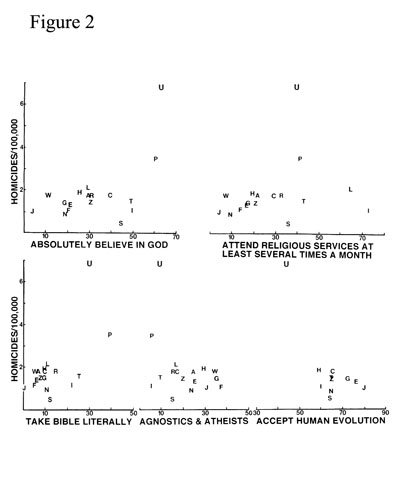
"In general, higher rates of belief in and worship of a creator correlate with higher rates of homicide, juvenile and early adult mortality, STD infection rates, teen pregnancy, and abortion in the prosperous democracies (Figures 1-9). The most theistic prosperous democracy, the U.S., is exceptional, but not in the manner Franklin predicted. The United States is almost always the most dysfunctional of the developed democracies, sometimes spectacularly so, and almost always scores poorly. The view of the U.S. as a “shining city on the hill” to the rest of the world is falsified when it comes to basic measures of societal health. Youth suicide is an exception to the general trend because there is not a significant relationship between it and religious or secular factors. No democracy is known to have combined strong religiosity and popular denial of evolution with high rates of societal health. Higher rates of non-theism and acceptance of human evolution usually correlate with lower rates of dysfunction, and the least theistic nations are usually the least dysfunctional. None of the strongly secularized, pro-evolution democracies is experiencing high levels of measurable dysfunction. In some cases the highly religious U.S. is an outlier in terms of societal dysfunction from less theistic but otherwise socially comparable secular developed democracies. In other cases, the correlations are strongly graded, sometimes outstandingly so.

Legend: A = Australia, C = Canada, D = Denmark, E = Great Britain, F = France, G = Germany, H = Holland, I = Ireland, J = Japan, L = Switzerland, N = Norway, P = Portugal, R = Austria, S = Spain, T = Italy, U = United States, W = Sweden, Z = New Zealand.

Cross-National Correlations of Quantifiable Societal Health with Popular Religiosity and Secularism in the Prosperous Democracies. Gregory S. Paul, 2005.

Plenty of other figures and text in the article.
See also a new article (1. February 2008) by Gregory S. Paul: Why is Secular European Society Doing so Much Better Than God-Fearing America?

30 per cent Australians practise no religion

"And, interestingly, two thirds of Australians still claim a religious affiliation. According to the yearbook 26 per cent of Australians are Catholic, 19 per cent Anglican and 19 per cent favour other Christian denominations. More than 30 per cent say they practise no religion, but followers of religions other than Christianity have shown the largest proportional increase."

Livenews.com.au, 12/02/2008
Btw. since I come across a bunch of articles that are good/interesting but which I don't make blog posts about, I've made a feed for them and you'll see it on the right. "Other news items..."
If you want to subscribe to it, then here's the link.


"One third of Russians believe in immortality – the poll
Almost one third of Russians (29%) believe in ‘eternal life’, Yury Levada’s analytical center told Interfax.
The theme of immortality is closer to women, people of 55 years old and upward, with low income level, those who live in towns and villages, the sociologists reported.
The number of Russians who believe in tokens has increased by 9%, and in prophetic dreams by 17%.
63% of participants say they believe in tokens while 59% believe in prophetic dreams. Respectively 31% and 33% stated the contrary.
One third of Russians (33%) are predisposed to listen to astrological predictions, the same percentage is sure that UFO-people visit Earth every now and then.

Interfax, February 11
In other words: Old wives' tales.

Why the Archbishop of Canterbury is not a bleeding heart liberal

"Yet what is truly significant about the Archbishop’s statement is not his apparently liberal tilt towards respecting the customs of a competing faith. Although the focus of Williams’ speech was on the place of Sharia law in Britain, its main purpose was to argue for the re-legitimation of the role of religion in British society. As head of the Anglican Church, Dr Williams is painfully aware of the diminishing significance and influence of his institution. In Britain, there are now more Christians practising Catholicism than Anglicanism. Islam appears to motivate and inspire people in ways that many ordinary Anglicans find difficult to comprehend. The Church of England is haunted by dissension over sexual and lifestyle issues and continually struggles to uphold its international authority over the world’s 77million Anglicans.
The Anglican Church faces a crisis of authority. It finds it difficult to assert its role as the ‘established church’. And instead of looking within itself and asking probing questions about its own meaning and purpose, it prefers to blame the onward march of materialistic secularist culture for its institutional demise. Sometimes it presents itself as a beleaguered minority faith victimised by a cruel secular crusade. Some Anglicans have joined with their Catholic colleagues to decry the attempts by anti-religious forces to ban Christmas and other religious customs. Dr Williams’ speech was only the latest attempt to win more space for the exercise of religious authority in Britain. But instead of asking for greater recognition of Anglican sensibilities, Williams instead chose to put the case for the exercise of ‘religious conscience’ through demanding greater recognition of Sharia law.

[...]

In other words, he is not simply demanding more recognition for Sharia but for all forms of religious law."

Frank Furedi, Spiked, 11 February 2008
With all the right-wing paranoia about the archbishop, it is apt to get some other views.
(Ironically, not from the left)
"Many commentators are mistakenly seeing demands like the Archbishop's as “liberal”, “progressive” or “PC gone mad”. They are anything but.
Properly understood, the effect of devolving national law and national morality to local and group level is profoundly conservative. Dr Williams's ideas really represent the wilder fringes of a bigger idea: communitarianism. Communitarianism can come in a surplice, a yarmulka or from a minaret and is all the more dangerous because armed with a divine rather than a local loyalty. It almost always proves a repressive and reactionary force, fearful of competitors, often anti-science, sometimes sceptical of knowledge itself, and grudging towards the State.
There is absolutely nothing “left-wing” or woolly-liberal about empowering it. A Britain in which Muslim communities policed themselves would be more ruthlessly policed, and probably more law-abiding than today. But it would be a Britain in which the individual Muslim - maybe female, maybe ambitious, maybe gay, maybe a religious doubter - would lose their chances of rescue from his or her family or community by the State.

Matthew Parris, The Times, February 9, 2008

Btw. I really loved the introduction of Matthew Parris' article:

"You say,” said Lord Napier (confronted as Commander-in-Chief of the British Army in India by locals protesting against the suppression of suttee) “that it is your custom to burn widows. Very well. We also have a custom: when men burn a woman alive, we tie a rope around their necks and we hang them. Build your funeral pyre; beside it, my carpenters will build a gallows. You may follow your custom. And then we will follow ours.”"